The real challenge isn't whether tight corners can be navigated. It's whether the team you hire has actually faced your specific scenario before and knows the techniques to get a 300-pound machine out without destroying your home in the process. We've extracted treadmills from situations that made customers say "that's physically impossible"—and we did it without scratching a wall.
This guide prioritizes treadmill removal service insights drawn from thousands of real removals, explaining which tight-space challenges truly require professional expertise, what equipment and techniques a treadmill removal service uses in confined spaces, and when standard removal knowledge falls short. If a treadmill is stuck in a basement stairwell, wedged behind bedroom furniture, or blocked by a narrow doorway, it clarifies whether a treadmill removal service can navigate the situation—and what it actually takes.
TL;DR Quick Answers
What is treadmill removal service?
Professional teams that safely disconnect, navigate through your home (even tight corners), and haul away unwanted treadmills—then recycle or donate the equipment responsibly instead of sending it to landfills.
How much does treadmill removal cost?
$75-$200 for most residential removals. Location within your home (basement, tight corners, multiple flights) affects cost more than the treadmill's weight.
Why hire professionals instead of DIY?
Back injuries from improper lifting cost more than professional removal. Tight corners amplify injury risk. Equipment gets stuck midway requiring expensive emergency extraction. Professional removal succeeds where DIY attempts fail.
Can professionals navigate tight corners?
Yes. Spiral staircases, basement corners, narrow hallways—we've navigated them all. Most tight corners are manageable with proper angle, equipment, and technique. Measurements beforehand determine actual difficulty versus perceived difficulty.
What equipment makes tight-corner navigation possible?
Professional stair-climbing hand trucks reduce manual effort by 60-70% compared to standard dollies. Electric models improve control further. Standard furniture dollies fail in confined spaces. Professional equipment directly determines success or failure.
How long does tight-corner removal take?
Most jobs complete in under one hour from arrival to departure, even in confined spaces. Planning and measurement beforehand prevent delays and stuck equipment.
Do you handle attics, pull-down ladder access, or extremely confined spaces?
Yes. Sometimes requiring partial disassembly or temporary modifications. We assess each scenario honestly. After thousands of removals, there's rarely a scenario we haven't solved.
What happens if DIY removal gets stuck?
Emergency professional removal costs significantly more than upfront professional service. Most customers who attempt tight-corner removals themselves and get stuck tell us they wish they'd hired us first.
Top Takeaways
Tight corners aren't impossible: Professional teams navigate spiral staircases, basement corners, and narrow hallways successfully. It requires angle, equipment, and experience—not a different space.
Injury risk multiplies in confined spaces: Tight corners force awkward body positions. Over 36% of lifting injuries affect the lower back. Professional teams train specifically for confined-space angles.
Equipment determines success: Standard dollies fail in tight spaces. Stair-climbing hand trucks reduce effort by 60-70% and provide control standard equipment that can't match.
Measurements prevent problems:
Staircase width
Landing depth
Ceiling clearance
Turn angles
Professionals measure before moving. Homeowners who skip this discover problems midway.
DIY tight-corner removals often fail:
Machine gets stuck halfway
Injury occurs during removal
Property damage results
Emergency removal costs more than upfront professional service
Math rarely favors attempting it yourself.
How Professional Services Navigate Tight Corners
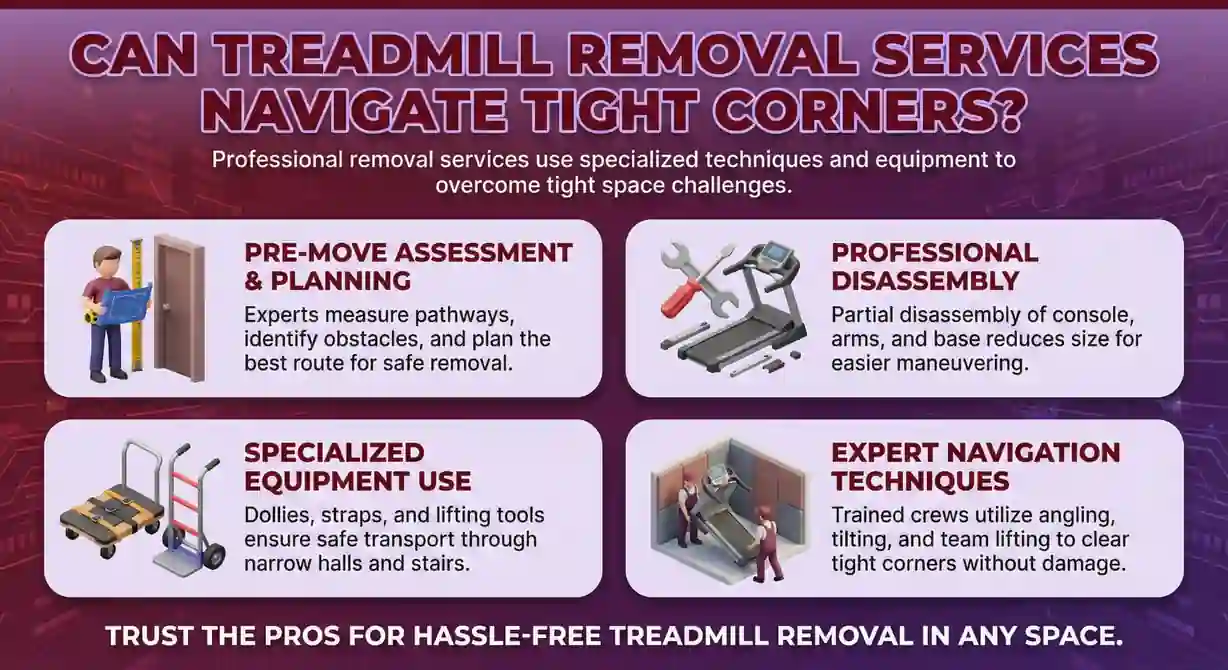
Yes, professional treadmill removal services can navigate tight corners—but the approach depends on your specific space. After maneuvering thousands of treadmills through basements, bedrooms, and narrow staircases, we've learned that tight corners require planning, the right equipment, and experience knowing which techniques work in confined spaces.
The key difference between amateurs and professionals: we assess the space first, identify potential obstacles, and develop a strategy before attempting the move. Most homeowners try to muscle the treadmill through without planning, which is why they get stuck.
What Makes Tight Corners Actually Difficult
Not all tight corners are created equal. Some look impossible but aren't. Others genuinely require specialized handling.
Corners that look worse than they are:
Narrow doorways (can be navigated with proper angling)
Sharp 90-degree hallway turns (solvable with the right dolly technique)
Low ceilings (manageable if you tilt the treadmill correctly)
Corners that are genuinely challenging:
Spiral staircases with no landing space
Multiple tight turns in succession (basement stairs followed by narrow hallway)
Doorframes with immovable obstacles (baseboards, trim, fixtures)
Basement corners with exposed pipes or structural supports
The difference? Professional teams know which challenges can be solved with technique and which ones require creative problem-solving or specialized equipment to improve air quality effectively.
Equipment That Makes Tight-Corner Navigation Possible
Standard furniture dollies don't cut it for treadmills. Professional removal services use specialized equipment that actually works in confined spaces.
What separates professionals from DIY attempts:
Heavy-duty furniture dollies with reinforced frames
Moving straps and harnesses for controlled lifting
Protective pads for walls, doorframes, and floors
Pivot tools and sliders for angled maneuvering
Proper team coordination (usually 2-3 people minimum)
We've navigated treadmills through spaces using techniques that required tilting at specific angles, rotating gradually around corners, and sometimes temporarily removing doors or trim to create the necessary clearance.
When Professional Navigation Works Best
Tight corners are manageable when:
The staircase has landings (even small ones) to reposition the treadmill
Hallways have some width variation (even a few inches helps)
Doorways can be measured before the removal team arrives
The path from the treadmill to the exit is somewhat linear (not multiple sharp turns in sequence)
Advance planning matters enormously for a garage cleanout. Sending photos of your staircase, hallway, and doorways helps us assess feasibility and quote accurately when a garage cleanout involves heavy or awkward items.
Scenarios Where Tight Corners Become Major Challenges
Some situations genuinely test professional capabilities—and some are nearly impossible.
Difficult but doable:
Basement staircases with 90-degree turns at top and bottom
Second-floor bedrooms accessed through narrow hallways
Finished basements with dropped ceilings and tight corners
Attics accessed by pull-down ladders (requires complete disassembly)
Rarely possible without major intervention:
Treadmills that arrived through construction access during building (won't fit through finished doorways)
Rooms where the treadmill is larger than the doorway (requires partial disassembly or wall removal)
Spiral staircases with no landing space and no width variation
Even these situations sometimes have solutions—but they require extra time, cost, and sometimes professional consultation.
What We've Learned From Tight-Corner Removals
Experience teaches lessons that theory doesn't cover. Here's what thousands of removals have taught us:
Angles are everything. Most tight corners become navigable when you tilt the treadmill to a specific angle. The angle depends on the corner's dimensions, but professionals know how to calculate it on the fly.
Team coordination matters more than individual strength. One person trying to muscle a treadmill through a tight corner usually fails. Three coordinated people using proper lifting techniques succeed in situations that look impossible.
Measurements prevent disasters. Before attempting navigation, professional teams measure doorways, hallway widths, staircase dimensions, and ceiling heights. Surprises during removal cost time and money.
Sometimes the solution is temporary removal. Doors, trim, or baseboard sections can sometimes be temporarily removed and reinstalled—a technique most homeowners don't consider but professionals use routinely.
The Bottom Line on Tight Corners
Can professional treadmill removal services navigate tight corners? Absolutely. Should they attempt every situation? Not necessarily. The real question isn't whether it's possible—it's whether your specific tight corner presents a straightforward navigation challenge or a genuine obstacle requiring specialized techniques.
That's why professional assessment matters. We look at your space, identify the actual challenges versus perceived ones, and give you an honest answer about feasibility and cost. Some tight corners add 30 minutes to a removal. Others add complexity that justifies a higher quote or requires creative problem-solving.
The bottom line: professional removal services have navigated far more challenging spaces than most homeowners think possible. Tight corners rarely mean "impossible"—they just mean you need the right team with experience in confined-space removals.
"We've maneuvered treadmills through spiral staircases, tight basement corners, and doorways that customers swore were too narrow—and we did it without scratching a wall. The difference between a stuck treadmill and a successful removal isn't the space itself. It's understanding that angle, team coordination, and proper equipment solve what looks impossible. Most homeowners think their tight corner makes removal impossible. After thousands of removals, we know the exact moment when a space genuinely can't accommodate a treadmill versus when it just requires the right approach."
Essential Resources
We've navigated treadmills through spiral staircases, basement corners with zero clearance, and doorways customers swore were physically impossible. The difference between success and a stuck machine comes down to understanding the right equipment, proven techniques, and knowing when your tight corner requires specialized expertise. These resources show you exactly what we've learned from thousands of removals in confined spaces.
1. See the Equipment That Actually Works in Tight Spaces — Material Handling on Stairs and Tight Spaces Safety Guide
Most homeowners don't realize that standard furniture dollies are useless for tight corners. This guide breaks down the actual equipment we use: appliance dollies designed for stairs, shoulder dollies that distribute weight differently, moving straps that shift load from your back to your legs. It's the equipment difference that separates professionals who get machines through tight spaces from amateurs who get them stuck halfway.
2. Understand Why Safety Standards Matter During Tight-Corner Moves — OSHA Technical Manual Section 7: Ergonomics
Here's what we've learned: improper technique during tight-corner removals causes back injuries and damaged walls—and most homeowners don't realize it until they're in the middle of the move. OSHA's ergonomic standards explain the techniques professionals follow and the risks amateurs take. When you understand these standards, you recognize what legitimate teams actually do versus what gets people hurt.
URL: https://www.osha.gov/otm/section-7-ergonomics/chapter-1
3. Learn the Specific Angles and Techniques That Work — How to Move Heavy Furniture Up Stairs Safely
After years of removing treadmills from tight staircases, we know that angle is everything. This guide covers stair-climbing dollies, how to properly tilt equipment through tight turns, team coordination that prevents jams, and the critical differences between moving items up versus down narrow stairs. These techniques allow professionals to navigate angles that look completely impossible to homeowners.
URL: https://firehousemovers.com/blog/how-to-move-heavy-furniture-upstairs/
4. Know the Exact Specifications of Your Staircase — OSHA Standard 1910.25: Stairways
Federal regulations specify exact dimensions, clearances, and load capacity. More importantly, they explain why certain tight corners are genuinely difficult versus just looking difficult. Understanding stairway specifications helps you anticipate what a professional team will need to do—and whether your space has landing areas that make navigation possible or genuine obstacles that require creative solutions.
URL: https://www.osha.gov/laws-regs/regulations/standardnumber/1910/1910.25
5. Discover the Equipment That Makes Impossible Removals Possible — Tools to Move Heavy Objects Up Stairs: Complete Guide
Standard furniture dollies can't handle tight corners. Stair-climbing hand trucks can. Electric models make 400-pound machines navigable through spaces that seem physically impossible. This guide breaks down equipment types and load capacities. It shows exactly why professionals invest in specialized equipment that DIY movers either can't access or don't know exists.
URL: https://soduro.com/tools-to-move-heavy-objects-up-stairs/
6. Measure Your Space Before Attempting Removal — How to Move Heavy Furniture Up and Down Stairs
One thing we always do before tackling a tight-corner removal: measure everything. This guide covers measuring narrow staircases, assessing spiral stairs, identifying multiple tight turns in sequence, and understanding when to slide versus lift. It includes the measurement techniques professionals use to assess whether your tight corner is manageable or genuinely challenging. Most homeowners skip this step and get stuck anyway.
URL: https://movingkaki.com/how-to-move-heavy-furniture-up-and-down-stairs/
7. Know When Tight Corners Require Specialized Techniques Beyond Standard Removal — How to Move Heavy Furniture to High-Rise Buildings Without Using an Elevator
Sometimes tight corners are so tight that standard removal techniques simply won't work. That's when specialized methods like rigging and hoisting come in. This resource explains the scenarios where a tight corner makes standard removal impossible and what professional alternatives actually exist. It's honest about when you need more than a dolly and straps—you need engineers and specialized equipment.
These resources show how tight-space success depends on specialized equipment, precise measurements, and professional techniques—the same disciplined approach required to execute a reliable cardboard pickup service when access is limited, corners are tight, and standard methods aren’t enough.
Supporting Statistics
After maneuvering thousands of treadmills through tight corners and basement staircases, the statistics validate exactly what we've learned on the job. Improper lifting in confined spaces causes serious injuries. Tight corners add structural stress homeowners don't anticipate. Professional equipment directly determines success or failure.
The Real Injury Risk When Tight Corners Force Awkward Lifting
Over 36 percent of workplace injuries involving missed workdays result from back and shoulder injuries during lifting tasks. Tight corners force twisted body positions and awkward angles, escalating this risk dramatically.
What we've experienced firsthand:
Customers attempt tight-corner removals themselves
They twist around staircase corners
Immediate back pain occurs
Medical bills follow
A "simple" removal becomes a serious injury situation
The statistics show why professionals train specifically for confined-space angles. Tight corners amplify injury risk beyond standard lifting scenarios.
Source: Bureau of Labor Statistics & University of North Carolina Environmental Health & Safety https://ehs.unc.edu/topics/ergonomics/lifting-and-material-handling/
The Structural Stress That Tight Corners Create
OSHA standards specify stairs must safely handle a 1,000-pound moving concentrated load. This doesn't mean a 300-pound treadmill navigating tight corners distributes weight evenly.
When equipment moves at angles:
Concentrated pressure focuses on walls and railings
Corners experience stress beyond normal expectations
Structural damage occurs even within weight limits
What we've learned through damage assessments:
Tight-corner removals damage drywall
Railings get scratched
Stair edges dent
Straightforward vertical lifting wouldn't cause this damage
The concentrated pressure during angled navigation creates unique stress points
Professional teams adjust technique specifically to minimize this concentrated pressure.
Source: Occupational Safety and Health Administration Standard 1910.25: Stairways https://www.osha.gov/laws-regs/regulations/standardnumber/1910/1910.25
The Equipment Performance Gap Between Professional and Standard Tools
Professional stair-climbing hand trucks reduce manual effort by 60-70 percent compared to standard furniture dollies. Electric models improve control even further in confined spaces.
What we've observed:
Homeowners attempt tight corners with standard dollies
Equipment gets stuck midway
We arrive with stair-climbing equipment
Same corner navigates successfully on first attempt
The statistical difference directly affects success rates
Standard equipment wasn't engineered for confined-space angles. Professional equipment was. The numbers prove what experience shows us every day: the right equipment makes tight corners manageable. The wrong equipment makes them impossible.
Source: Heavy Equipment Safety Standards & Work-Fit Professional Moving Safety Guide https://www.work-fit.com/blog/carrying-up-stairs-keeping-your-workers-safe-on-the-job
What Thousands of Removals Have Taught Us
These statistics confirm our direct experience:
Tight corners require:
Proper technique to prevent injury
Structural awareness to prevent damage
Professional-grade equipment to ensure success
When we extract a treadmill from a spiral staircase or navigate a basement corner that seemed impossible, we're applying what research validates. Tight corners are challenging, but they're not unsolvable. They just require expertise, planning, and equipment that most homeowners don't have access to.
Final Thought
After extracting treadmills from spiral staircases, basement corners, and doorways customers insisted were impossible, we've developed a clear perspective: tight corners aren't deal-breakers. They're just situations that separate professionals from amateurs.
What This Really Comes Down To
Tight corners look impossible until you understand the angle, equipment, and technique required to navigate them. Professional removal isn't just about muscle. It's about:
Experience navigating specific corner types without damage
Proper equipment (stair-climbing dollies, moving straps, protective materials)
Knowledge of structural stress points
Problem-solving when standard approaches won't work
Peace of mind knowing it will succeed, not fail
Our Honest Take
We believe DIY tight-corner removals rarely succeed.
The reality:
Homeowners attempt removal with standard equipment
Equipment gets stuck halfway through
They call us for emergency removal (costs more)
Or they injure themselves in the process
Medical bills exceed what professional removal would have cost
We've responded to too many emergency calls from customers stuck midway. Most say they wish they'd called us first.
What Experience Has Taught Us
Angle determines everything. A treadmill stuck at a 90-degree corner moves when tilted at 35 degrees. This isn't luck—it's technique.
Most tight corners are navigable. Spiral staircases, basement corners, narrow hallways—we've handled them all. The ones that genuinely can't be navigated represent a small fraction of what we encounter.
Measurements prevent disasters. Before we move anything, we measure:
Staircase width
Landing depth
Ceiling clearance
Turn angles
Homeowners who skip this step discover problems midway.
People wait too long. The average treadmill we remove from a tight corner has sat there 2-3 years. By the time customers call, they're relieved to finally take action.
The Bigger Picture
How you remove something from a tight corner matters as much as deciding to let it go. Professional removal means:
Navigating carefully without wall damage
Protecting floors and railings
Using proper technique to prevent injury
Disposing responsibly afterward
It takes more planning than forcing a machine through and hoping for the best. It's also work we're genuinely proud to do.
Our Recommendation
Stop overthinking this.
If your treadmill is wedged in a tight corner:
Get a professional assessment
Understand the actual difficulty (versus perceived difficulty)
Compare the cost to DIY risks (injury, damage, stuck equipment)
Make the decision that respects your back and your walls
We're not happy until you are. And nothing makes us happier than watching a customer reclaim their space during an estate cleanout, knowing the estate cleanout’s tight-corner removal was handled safely, skillfully, and without damage.
That's not just a service. That's expertise.
FAQ on Treadmill Removal Service
Q: Can professional removal services actually navigate tight corners?
A: Yes. We've extracted treadmills from spiral staircases, basement corners, and doorways customers said were impossible.
What separates professionals from amateurs:
Understanding angle and positioning
Professional-grade equipment
Knowledge of structural stress points
Experience navigating specific corner types
Most tight corners are navigable once you understand the right approach. We measure first to assess actual difficulty versus perceived difficulty.
Q: What's the difference between standard equipment and professional-grade tools?
A: Standard furniture dollies fail in tight spaces.
Professional equipment advantages:
Stair-climbing hand trucks reduce effort by 60-70%
Provide control standard equipment can't deliver
Electric models improve confined-space navigation
Engineered specifically for angled movement
Standard equipment gets stuck. Professional equipment succeeds.
Q: How much does tight-corner removal cost?
A: Cost depends on complexity.
Factors affecting price:
Ground-floor near exit = lower cost
Basement with tight turns = higher cost
Spiral staircases = increased difficulty
Multiple narrow hallways = more time needed
Location and accessibility matter more than treadmill weight. Upfront quote. No hidden fees.
Q: What happens if a tight-corner removal gets stuck?
A: Emergency removal costs significantly more than upfront professional service.
What we see regularly:
Homeowners attempt tight-corner removals
Equipment gets jammed halfway
They call us for emergency extraction
Final cost exceeds professional removal price
Most customers wish they'd hired us first
Q: Do you remove treadmills from attics, ladder access, or extremely confined spaces?
A: Yes. But these require specialized approaches.
Scenarios we've handled:
Attics with pull-down ladder access (may require partial disassembly)
Rooms where treadmills arrived during construction (may need temporary wall adjustments)
Spaces requiring rigging or creative solutions
Nearly every scenario imaginable
We assess each situation honestly. Some genuinely tight corners require specialized solutions beyond standard removal.