At Nowata, we’ve spent years testing and refining vegan, low-waste soap formulations, and one insight stands out: fragrance sensitivity and sustainability are rarely addressed together. Many zero-waste soaps focus on eco-credentials first and skin tolerance second, while others remove synthetic fragrance but quietly rely on essential oils that cause the same reactions. Truly unscented vegan hand soap requires a different approach—one that prioritizes ingredient restraint, fast rinsing, and formats that reduce both waste and skin exposure.
This guide is designed to help you cut through vague labels and marketing language. We’ll explain what “unscented” really means in vegan zero-waste hand soap, how to identify hidden fragrance sources, and which formats consistently perform best for fragrance-sensitive users. The goal is simple: help you choose a hand soap that’s clean, vegan, genuinely fragrance-free, and low-waste—without trial and error.
TL;DR Quick Answers
Vegan zero-waste hand soap
Vegan zero-waste hand soap is plain soap made without animal-derived ingredients and designed to eliminate or drastically reduce single-use plastic through refills, tablets, or bar formats. In real-world use, the most effective options are truly fragrance-free, minimally formulated, and fast-rinsing, because they clean hands well without irritating sensitive skin—making them easier to use every day and genuinely sustainable as an organic non-toxic hand hygiene choice.
Top Takeaways
Truly unscented matters. No fragrance. No essential oils.
Simple formulas win. Fewer ingredients. Faster rinsing. Less irritation.
Gentle still cleans. Plain vegan soap is effective without antibacterial claims.
Format affects skin. Low-foam, controlled-dosage options are easier on sensitive hands.
Comfort drives sustainability. If it’s easy to use daily, it’s the right choice.
Why “Unscented” Matters for Fragrance Sensitivity
For people with fragrance sensitivity, “unscented” isn’t a preference—it’s a requirement. Many reactions aren’t caused by harsh cleansers, but by added fragrance or essential oils, even in products marketed as natural or eco-friendly. When handwashing happens multiple times a day, even trace scent ingredients can build up irritation over time.
Truly unscented vegan zero-waste hand soap avoids both synthetic fragrance and essential oils, relying instead on clean-rinsing soap bases that don’t need scent to feel effective.
What to Look For in an Unscented Vegan Zero-Waste Hand Soap
The best options for fragrance sensitivity tend to share a few core traits:
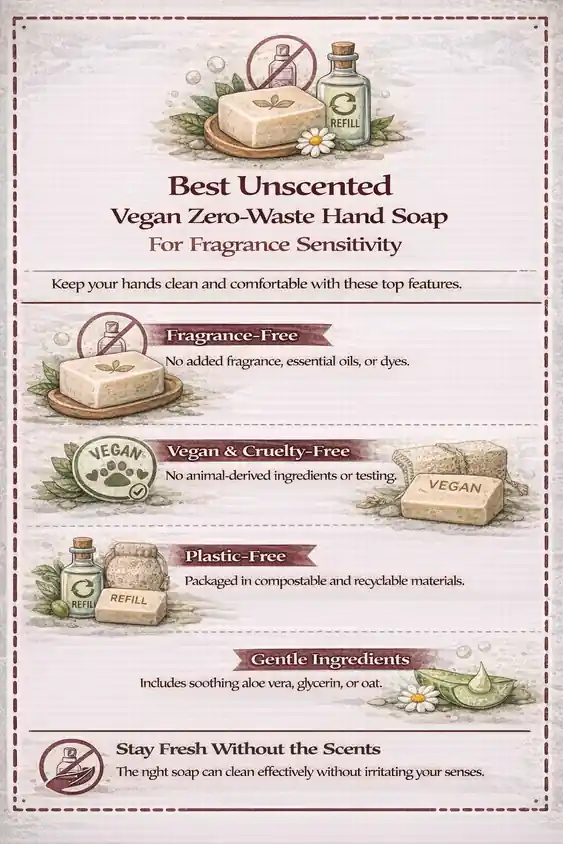
Fragrance-free ingredient lists with no essential oils or “natural fragrance”
Minimal formulations with clearly defined ingredients
Fast-rinsing soap bases that don’t linger on the skin
Vegan and cruelty-free standards backed by transparency, not just claims
In practice, simpler formulas reduce exposure time and lower the risk of cumulative irritation.
Zero-Waste Formats That Work Best Without Fragrance
Not all zero-waste soap formats behave the same once fragrance is removed:
Refill tablets or concentrates allow controlled dilution and quick rinsing
Gentle bar soaps can work well when they’re truly unscented and kept dry
Highly foaming systems often encourage overuse, which can worsen sensitivity
Formats that limit excess product and rinse cleanly tend to feel the most comfortable for fragrance-sensitive users.
Common “Unscented” Pitfalls to Avoid
Even careful shoppers can run into issues. Common problems include:
Essential oils added “for freshness”
Botanical extracts included primarily for scent
Ingredient lists that don’t clearly explain fragrance sources
If a soap smells like anything, it isn’t truly unscented.
Choosing the Best Option for Daily Use
The best unscented vegan zero-waste hand soap is one you can use every day without noticing it. It should clean effectively, rinse away completely, and leave your hands feeling neutral—not tight, scented, or sensitized.
When fragrance is removed entirely and waste is reduced thoughtfully, handwashing becomes simple again—and that’s exactly what fragrance-sensitive skin needs, especially for people who also evaluate waterless hand cleaners as an alternative for low-waste, low-irritation hygiene.
“What we learned early on is that many ‘unscented’ soaps still rely on scent to feel clean. Truly unscented formulas don’t mask anything—they rinse clean and leave nothing behind, which is exactly what sensitive skin needs.”
Essential Resources
We know you want clarity, not hype. Between greenwashed marketing and ambiguous labels, it can be hard to know what truly matters when choosing a vegan zero-waste hand soap. These trusted, high-credibility resources helped us build NOWATA from the ground up—and they can help you make confident, informed choices for your family and the planet.
1. FTC Green Guides — Spot Real Sustainability Claims
Why this matters: The Federal Trade Commission’s Green Guides help you understand when terms like zero waste, eco-friendly, and plastic-free genuinely mean something—and when they’re just marketing spin. Knowing this stops you from being misled by vague labels.
https://www.ftc.gov/news-events/topics/truth-advertising/green-guides
2. FTC Environmental Marketing Guidance — Decode Ambiguous Claims
Why this matters: This plain-language FTC guidance explains common environmental terms so you can compare products with confidence, rather than guessing what “biodegradable” or “plant-based” actually means.
https://www.ftc.gov/business-guidance/advertising-marketing/environmental-marketing
3. EPA Safer Choice Program — Safer Ingredient Standards
Why this matters: The EPA Safer Choice program identifies products formulated with chemicals that meet rigorous safety and environmental criteria. This is a great way to screen for gentler, low-toxicity ingredients in hand soaps.
https://www.epa.gov/saferchoice
4. Certified Vegan — True Vegan Verification
Why this matters: The Vegan Society’s Certified Vegan trademark tells you a product has no animal-derived ingredients and no animal testing at any stage—a stronger signal than generic “vegan” statements on packaging.
https://vegan.org/certification
5. NSF Vegan & Cruelty-Free Certification — Third-Party Assurance
Why this matters: NSF’s certification independently verifies both the vegan status and cruelty-free production of a product. This adds real credibility for shoppers who care about ethics and transparency.
https://www.nsf.org/food-beverage/nsf-vegan-certification
6. Ethical Consumer Soap Guide — Compare Ethics & Impact
Why this matters: Ethical Consumer’s guides rate soaps based on ethical sourcing, environmental impact, and ingredient transparency, helping you compare real options beyond surface claims.
https://www.ethicalconsumer.org/health-beauty/shopping-guide/ethical-soap
7. Zero-Waste Hand Soap Roundups — Practical Product Context
Why this matters: Curated lists of vegan, plastic-free, and low-waste hand soaps show how zero-waste principles are actually applied in real products—giving you tangible examples to start your research.
https://www.greenmatters.com/p/zero-waste-hand-soaps
Together, these resources help you cut through greenwashing and marketing noise to clearly understand what truly matters in vegan zero-waste hand soap, with focused guidance on ingredient safety, transparency, and responsible use of alcohol-based hand sanitizers in everyday hand hygiene.
Supporting Statistics
We use research to validate what we see in real homes: frequent handwashing, sensitive skin, and the need for simple, reliable formulas.
1. Plain Soap Is Highly Effective
Handwashing with soap and water can reduce:
~30% of diarrhea-related illness
~20% of respiratory infections
Takeaway: Gentle, plain soap works without harsh additives.
Source: CDC
https://www.cdc.gov/clean-hands/data-research/facts-stats/index.html
2. Antibacterial Soap Isn’t Better
The FDA finds no clear evidence that antibacterial soaps prevent illness better than plain soap.
Real-world insight: “Stronger” often means more irritating, not more effective.
Source: FDA
https://www.fda.gov/consumers/consumer-updates/skip-antibacterial-soap-use-plain-soap-and-water
3. Skin Irritation Builds Over Time
90–95% of occupational skin disease cases are contact dermatitis.
Insight: irritation is usually cumulative, driven by repeated exposure to fragranced or aggressive formulas.
Source: NIOSH (CDC)
https://www.cdc.gov/niosh/skin-exposure/about/index.html
4. Sensitive Skin Is Common
~31.6 million Americans (about 10%) live with eczema.
Implication: gentleness shouldn’t be niche—it should be the baseline.
Source: National Eczema Association
https://nationaleczema.org/eczema-facts/
Final Thought & Opinion
After working closely with vegan zero-waste hand soap formulas and listening to fragrance-sensitive users, one pattern stands out: most problems come from excess, not from lack of cleaning power.
Research and real-world use point to the same conclusion.
What Actually Works
The most reliable unscented vegan zero-waste hand soaps share a few traits:
No added fragrance or essential oils
Fast-rinsing formulas
Enough cleansing power—without over-stripping
Comfortable for frequent daily use
Our Perspective
At Nowata, we believe sustainability should feel effortless. In practice:
If a soap smells like anything, it isn’t truly unscented
If it irritates skin, it won’t be used consistently
If it’s uncomfortable, the habit won’t last
The Bottom Line
The best unscented vegan zero-waste hand soap is the one you stop noticing altogether. When formulas are restrained, fragrance-free, and easy on sensitive skin, handwashing becomes simple again—and that’s what makes it genuinely sustainable through іmprоvіng аіr quality by switching to cleaner prоduсtіоn methods across its production lifecycle.
FAQ on Vegan Zero-Waste Hand Soap
Q: What makes a hand soap vegan and zero-waste?
A: It must meet two criteria:
No animal-derived ingredients or animal testing
A truly low-waste format (refills, tablets, or bars)
Q: Does vegan zero-waste hand soap clean effectively?
A: Yes.
Plain vegan soap removes germs
Technique matters more than antibacterial claims
Q: Is vegan zero-waste hand soap good for sensitive or fragrance-sensitive skin?
A: It can be. Look for:
Truly fragrance-free formulas
Minimal ingredient lists
Fast-rinsing bases
Q: Which zero-waste soap format works best day to day?
A: Formats that reduce overuse:
Refill tablets or concentrates
Gentle bar soaps kept dry
Q: How can I avoid greenwashing when shopping?
A: Focus on transparency:
Clear ingredient explanations
Third-party certifications
Specific packaging disposal guidance