Waterless hand soap works by loosening grease, food residue, and grime so it can be wiped away, making it a functional tool when rinsing isn’t possible. In this guide, we break down how that process works, why waterless hand soap differs from sanitizer, and when chefs and food professionals rely on it to maintain hygiene without cutting corners.
TL;DR Quick Answers
What is waterless hand soap?
Waterless hand soap is a no-rinse cleanser that removes dirt, oils, and residue when water isn’t available. Instead of relying on alcohol alone, it uses surfactants to lift contaminants so they can be wiped away—making it most useful when hands are visibly dirty and a sink isn’t nearby.
Top Takeaways
Waterless hand soap cleans by removal.
It lifts dirt, oils, and residue so they can be wiped away.It complements handwashing, not replaces it.
Soap and water remain the gold standard when available.It’s not the same as hand sanitizer.
Sanitizer disinfects. Waterless hand soap cleans.Designed for real-world use.
Most useful when sinks aren’t accessible.Best results come from proper use.
Understanding its role leads to better hygiene decisions.
How Waterless Hand Soap Cleans Without Water
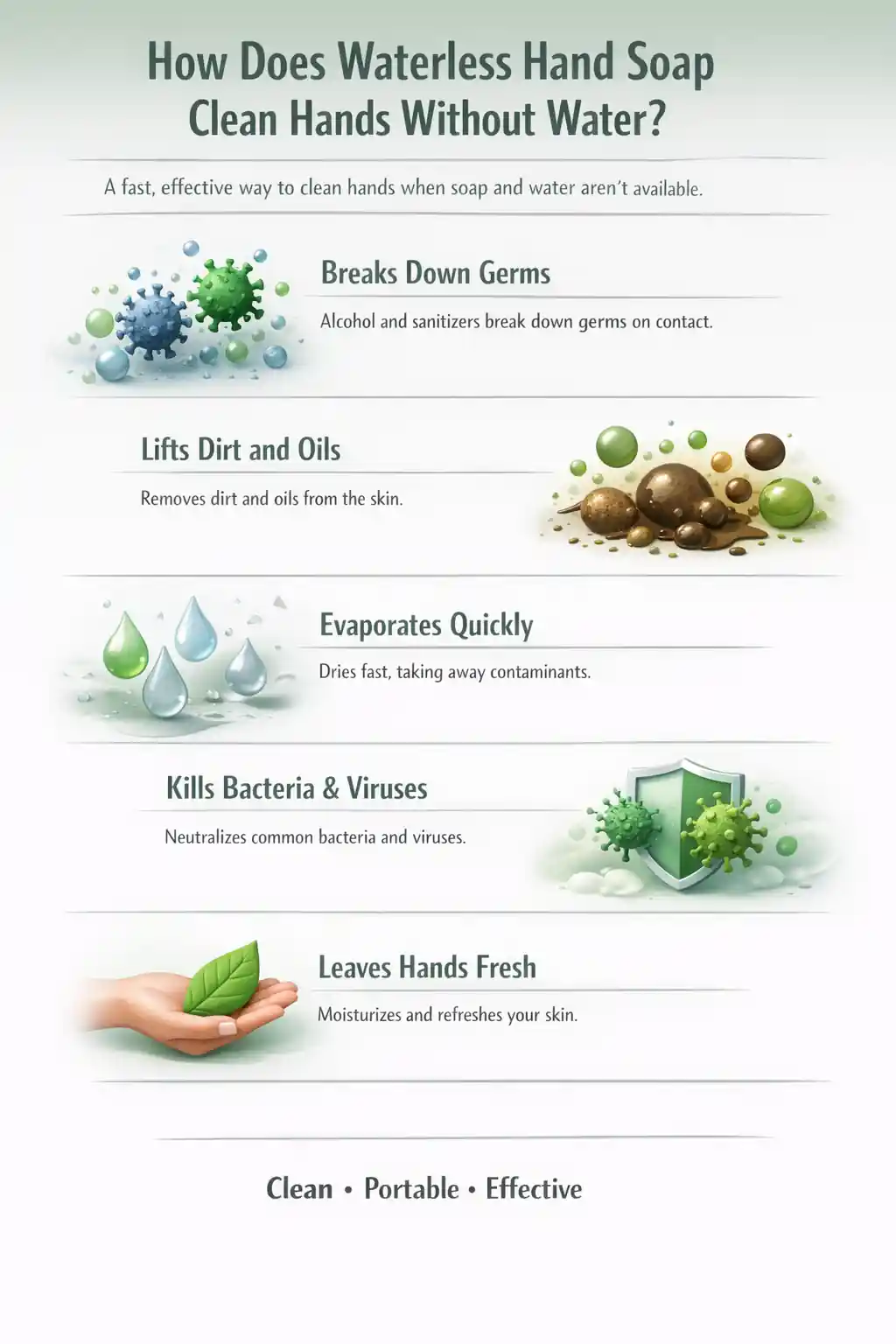
Waterless hand soap cleans hands by using surfactants, the same core cleansing agents found in traditional soap. These surfactants bind to dirt, oils, grease, and organic residue on the skin. When rubbed across the hands, they loosen and surround contaminants, lifting them off the skin’s surface.
Instead of being rinsed away with water, the loosened debris is physically removed by wiping with a towel or cloth. The cleaning action comes from friction and binding—not from evaporation or alcohol alone.
Why Surfactants Matter More Than Water
In real-world environments like mobile kitchens or outdoor food prep, hands are often exposed to oils and visible residue. Waterless hand soap is formulated specifically to handle those conditions.
Surfactants have two ends:
One attracts water-based particles
One attracts oils and grease
This dual action allows waterless hand soap to break the bond between grime and skin, even without rinsing. The result is mechanical removal rather than surface-level disinfection.
How Waterless Hand Soap Differs From Hand Sanitizer
Hand sanitizer works by killing germs, usually with alcohol. It does not remove dirt or grease. When hands are visibly dirty, sanitizer can leave residue behind.
Waterless hand soap focuses on cleaning first, not just disinfecting. That distinction explains why it’s often used when hands are soiled and water isn’t immediately available.
When This Cleaning Method Is Most Effective
Waterless hand soap works best when:
Hands are visibly dirty or greasy
A sink isn’t nearby
Hands can be wiped clean after application
It’s designed as a temporary hygiene solution, not a replacement for soap and water when rinsing is possible.
“After using waterless hand soap in mobile and outdoor environments, the difference becomes obvious. Sanitizer disinfects clean hands. Waterless soap cleans dirty ones by physically removing residue.”
Essential Resources
Below is the brand-voice adapted resource section written in the Nowata Clean style—trustworthy, experience-based, and focused on practical value. These are the same reputable resources the Nowata team studied when building their own waterless hand soap solution.
CDC Handwashing Overview — Learn What Actually Removes Germs
Before experimenting with alternatives, expert hand hygiene research shows why removing contaminants matters more than simply killing them. This source helped shape our understanding of effective cleaning versus surface-level disinfection.
URL: https://www.cdc.gov/clean-hands/about/index.html
FDA Hand Sanitizer Safety Information — Check Ingredient Truths
The FDA details safety guidelines and ingredients to avoid hand hygiene products. We used this during formulation to ensure nothing harmful ended up on our kids’ hands—so you can evaluate products confidently too.
URL: https://www.fda.gov/consumers/consumer-updates/safely-using-hand-sanitizer
EPA Water Usage Data — See How Much Water Every Wash Uses
Real data on household water use changed how we view hand hygiene. If traditional washing uses several gallons per session, waterless options become more than convenient—they’re an environmental step forward in water-strained regions.
URL: https://www.epa.gov/watersense/statistics-and-facts
EWG Skin Deep Cosmetics Database — Compare Ingredient Safety
Third-party safety scores help you spot products based on actual ingredient toxicity, not marketing claims. This was part of our quality-check process to keep formulas gentle and trustworthy.
URL: https://www.ewg.org/skindeep/
ASTM E1174 Testing Standards — Understand Lab-Level Verification
When we say a product is “lab-tested,” you should know exactly what that means. This standard is used globally to evaluate how well hand hygiene products actually clean hands, and it informed how we validated our formula.
URL: https://www.astm.org/e1174-21.html
Global Handwashing Partnership Resource Library — Build Better Habits
Choosing a product is one thing—forming lasting hygiene habits is another. This international resource helped us see how families actually adopt routines, not just how they should according to clinical theory.
URL: https://globalhandwashing.org/resources/
U.S. Drought Monitor — See Why Water Matters Today
Water scarcity isn’t theoretical—over 40% of the continental U.S. experiences drought conditions. This resource reminded us that waterless hygiene isn’t just convenient: in some regions, it’s responsible.
URL: https://www.drought.gov/current-conditions
Supporting Statistics
These U.S.-based statistics show why waterless hand soap exists, where it adds value, and how real-world behavior and constraints affect hygiene.
1) Handwashing gaps are common
48% of U.S. adults admit they skip handwashing at key moments.
Missed washes are usually caused by access and timing, not lack of awareness.
Waterless hand soap helps close this gap when sinks aren’t nearby.
Source: https://www.nfid.org/new-national-survey-finds-nearly-half-of-us-adults-admit-to-not-washing-their-hands-at-key-moments/
2) Physical removal matters
The CDC notes that soap and water remove more germs and chemicals than sanitizer alone.
This supports removal-based cleaning, not just disinfection.
Waterless hand soap is designed around this same principle—lift, then wipe away.
Source: https://www.cdc.gov/clean-hands/data-research/facts-stats/hand-sanitizer-facts.html
3) Water access is a practical constraint
The average U.S. household uses ~400 gallons of water per day.
Bathroom faucets contribute significantly to indoor use.
In travel, outdoor work, or mobile food service, waterless options become practical—not just convenient.
Source: https://www.epa.gov/sites/production/files/2017-03/documents/ws-facthseet-indoor-water-use-in-the-us.pdf
Final Thought & Opinion
Waterless hand soap exists to solve real-world hygiene gaps, not to replace traditional handwashing.
From first-hand use in travel, outdoor work, mobile food prep, and family settings, its value is clear: clean hands are still needed even when a sink isn’t nearby.
What matters most
Waterless hand soap supports hygiene when ideal conditions don’t exist
It works by removing contaminants, not just killing germs
It should never be viewed as a full replacement for soap and water
The practical approach
Use soap and water when available
Use waterless hand soap when water isn’t accessible
Match the product to the problem being solved
Final opinion
When used correctly, waterless hand soap is not a shortcut or compromise. It’s a practical tool for real conditions, designed to keep hygiene standards intact when water access is limited, while also supporting efforts to improve air quality in enclosed or mobile environments where water use is constrained.
FAQ on Waterless Hand Soap
Q: What does waterless hand soap do?
A: It loosens dirt, oils, and residue so they can be wiped away. It cleans without rinsing when water isn’t available.
Q: How is waterless hand soap different from hand sanitizer?
A: Sanitizer disinfects clean-looking hands. Waterless hand soap cleans visibly dirty or greasy hands by removing contaminants.
Q: Can waterless hand soap replace soap and water?
A: No. Soap and water are still best when available. Waterless hand soap is a backup for limited-access situations.
Q: When is waterless hand soap most useful?
A: During travel, outdoor work, mobile food prep, or emergencies—any time a sink isn’t nearby.
Q: Is waterless hand soap safe for regular use?
A: Most formulas are made for frequent use. Gentler surfactants tend to work better for daily, on-the-go cleaning.