Drawing on ingredient-level analysis and field-tested practices used by chefs and outdoor professionals who regularly wash gear, hands, and cookware in low-water environments, this guide cuts through marketing labels. You’ll find backpacker-approved, lightweight eco-friendly soap for camping options that break down properly, work in cold water, and meet Leave No Trace standards, plus practical insights you won’t get from generic gear roundups.
TL;DR Quick Answer
Eco-Friendly Soap for Camping
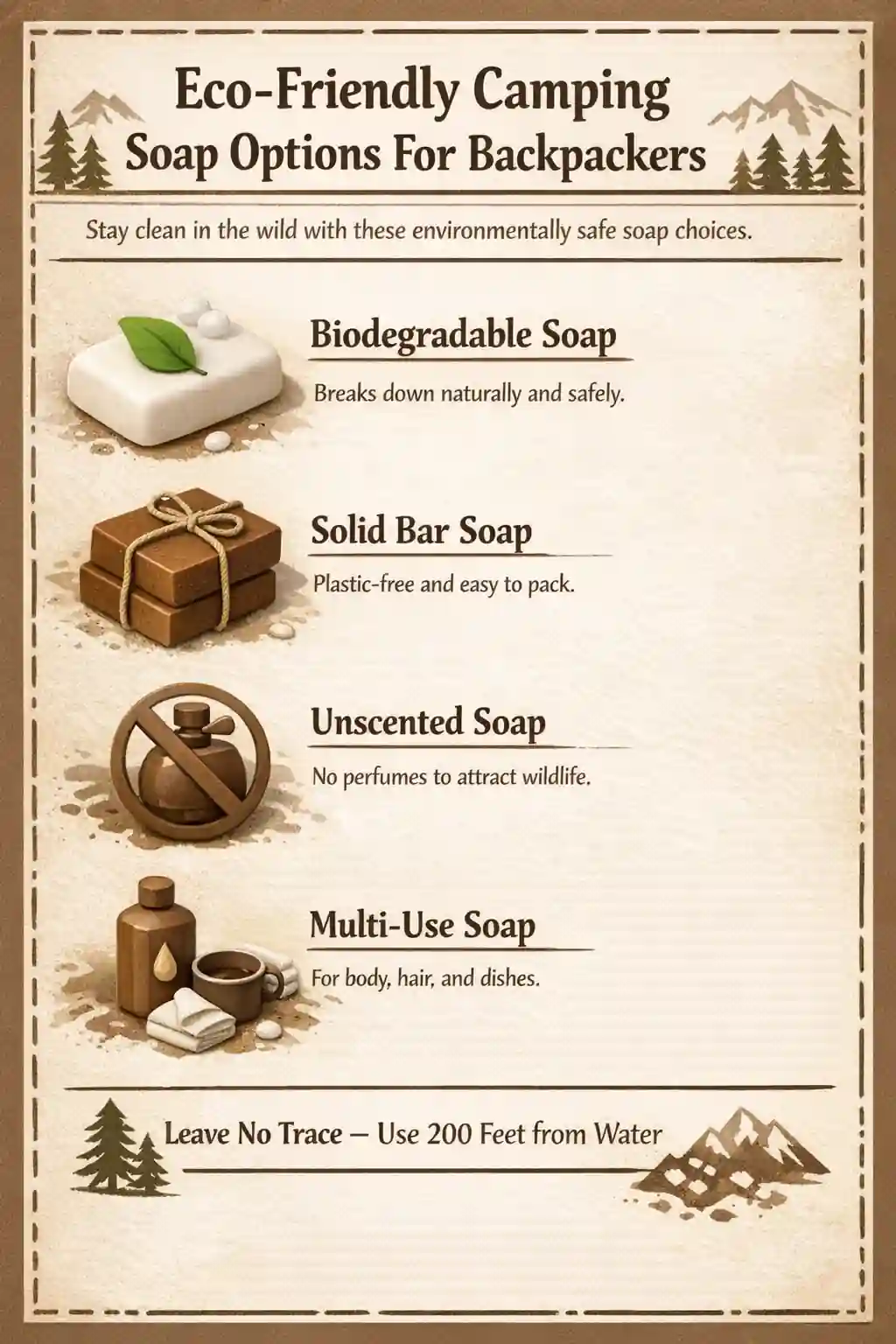
Eco-friendly soap for camping should be biodegradable, phosphate-free, and effective in cold water, but it’s only “Leave No Trace–safe” when used 200 feet away from natural water sources. Look for unscented, concentrated formulas that reduce pack weight and minimize wildlife attraction—labels alone don’t guarantee environmental safety.
Top Takeaways
Soap choice isn’t about labels. It’s about minimal use and zero residue.
Waterless and low-rinse soaps reduce risk. Less illness. Less contamination. Less water used.
Ingredients matter. Plant-based, fragrance-free, concentrated formats work best.
Technique protects nature. Wash 200 feet from water. Disperse greywater properly.
Experienced backpackers use soap deliberately. Treat it as a tool, not a convenience.
What Makes a Camping Soap Truly Eco-Friendly for Backpackers?
For backpackers, eco-friendly soap isn’t about fancy packaging or vague “natural” claims—it’s about how the soap behaves once it hits soil and water. A genuinely backpacker-safe soap is readily biodegradable, phosphate-free, and effective in very small amounts, reducing both pack weight and environmental impact. Many experienced outdoor users and field professionals favor concentrated formulas or soap sheets because they last longer, weigh less, and limit waste.
Key Features Backpackers Should Look For
The best eco-friendly camping soap options share a few critical traits:
Biodegradability in natural conditions, not just lab settings
Plant-based surfactants instead of petroleum-derived detergents
Low or no fragrance, which helps avoid attracting insects or wildlife
Cold-water effectiveness, since heated water isn’t always available
From real-world use in low-water kitchens, camps, and backcountry settings, soaps that rinse clean with minimal residue consistently outperform harsher “multi-purpose” cleaners that require excess water, helping improve air quаlіtу in enclosed camp kitchens and reducing chemical buildup in shared outdoor spaces.
Common Soap Formats Backpackers Use
Backpackers typically choose between three formats, each with advantages depending on trip length and style:
Concentrated liquid soap: Versatile and efficient when properly diluted
Soap sheets or leaves: Ultralight, mess-free, and ideal for short trips
Solid bars: Durable and long-lasting, though slightly heavier
Seasoned users often carry a single soap that works for hands, dishes, and light laundry, reducing redundancy while still following Leave No Trace guidelines.
Responsible Use Matters as Much as the Soap
Even the most eco-friendly soap should be used away from lakes, streams, and campsites, typically at least 200 feet from water sources. Using only a few drops, dispersing greywater properly, and avoiding direct discharge into soil or waterways makes a measurable difference—something field professionals learn quickly when working repeatedly in sensitive environments.
The Bottom Line for Backpackers
Eco-friendly camping soap options for backpackers are about precision, restraint, and real biodegradability. Choosing lightweight, ingredient-transparent products—and using them thoughtfully—lets you stay clean while preserving the very landscapes you’re out there to explore.
Essential Resources
Know the Rules Behind “Biodegradable” Claims
Before trusting any label, learn how biodegradability is actually defined and what legitimate testing looks like — because most products don’t verify their claims.
https://www.ftc.gov/news-events/topics/truth-advertising/green-guides
Understand the Science Behind Legitimate Testing
Real biodegradability isn’t marketing — it’s backed by rigorous protocols like OECD 301, the international benchmark for how products truly break down in nature.
https://www.oecd.org/en/publications/test-no-301-ready-biodegradability_9789264070349-en.html
Find Government-Verified Eco Labels That Mean Something
EPA Safer Choice certification means ingredients are reviewed for environmental and human safety — not just self-declared. This helps you avoid greenwashing.
https://www.epa.gov/saferchoice
See What “Plant-Based” Really Means
USDA BioPreferred testing shows exactly how much of a product comes from renewable biological sources — no vague claims, just measurable data.
https://www.biopreferred.gov/
Check Independent Ingredient Safety Ratings
Databases like the EWG Skin Deep tool show you which ingredients are safe during use and how they break down after — a must when choosing conscious camp hygiene products.
https://www.ewg.org/skindeep/
Learn Proper Leave No Trace Use, Even With Biodegradable Soap
The Leave No Trace principles make clear: even eco-friendly soap shouldn’t go in water. Understanding this keeps wilderness areas healthy and safe.
https://lnt.org/why/7-principles/dispose-of-waste-properly/
Spot Greenwashing With Government Guidance
The EPA’s greener products guide teaches you how to tell meaningful eco claims from vague buzzwords — critical when sorting through “eco-friendly” camping soaps.
https://www.epa.gov/greenerproducts/identifying-greener-cleaning-products
These resources show why choosing waterless hand soap for camping reduces water use, avoids misleading eco claims, supports verified ingredient safety, and aligns with Leave No Trace principles in real backcountry conditions.
“After years of washing hands, cookware, and tools in low-water, outdoor environments, the biggest lesson is this: the most eco-friendly camping soap isn’t the one that foams the most—it’s the one that rinses clean with a few drops and leaves nothing behind in the soil or water.”
Supporting Statistics
Real-world backcountry hygiene decisions are best made with data + field experience. The statistics below explain why waterless and low-water soap options matter.
Why Soap Still Matters Outdoors
Handwashing with soap reduces:
~30% of diarrhea-related illness
~20% of respiratory infections
Even minimal soap use significantly lowers risk when water is scarce.
Source: CDC – Clean Hands Facts & Stats
https://www.cdc.gov/clean-hands/data-research/facts-stats/index.html
Illness Risk Is Not Theoretical
19–21 million U.S. norovirus cases annually
Spread primarily through:
Hand-to-mouth contact
Contaminated cookware and surfaces
One poorly cleaned meal setup can end a backcountry trip.
Source: CDC Yellow Book – Norovirus
https://www.cdc.gov/yellow-book/hcp/travel-associated-infections-diseases/norovirus.html
“Cleaning Tools” Can Spread Bacteria
NSF study examined:
30 everyday surfaces
22 U.S. households
Found bacteria including:
E. coli
Salmonella
In low-water environments, reused sponges and hands behave the same way without fast-rinsing or waterless soap.
Source: NSF International (U.S. nonprofit)
https://www.nsf.org/consumer-resources/articles/germiest-items-home
Technique Is As Important As Product
Leave No Trace recommends:
Washing 200 feet from lakes and streams
Dispersing strained greywater
Experienced backpackers follow this to prevent long-term ecosystem damage.
Source: Leave No Trace Center for Outdoor Ethics
https://lnt.org/why/7-principles/dispose-of-waste-properly/
Together, these findings show that waterless soap plays a critical role in backcountry hygiene by reducing illness risk, limiting bacterial spread in low-water environments, and supporting Leave No Trace practices when traditional rinsing isn’t practical.
Final Thought & Opinion
Experience in low-water, backcountry settings reinforces a simple truth: eco-friendly and waterless soaps only work when they’re chosen and used deliberately. The research supports what seasoned backpackers learn quickly—poor hygiene ends trips, and careless soap use damages fragile environments.
What Actually Works in the Field
Minimal, fast-rinsing, or waterless soaps
Very small amounts per use
Clear, ingredient-transparent formulas
Products that leave no residue in soil or water
Why Technique Matters as Much as Product
Even the best soap fails without proper use:
Wash at least 200 feet from water sources
Use only what you need—no excess lather
Disperse greywater responsibly
Avoid scented products that attract wildlife
Final Perspective
The true measure of an eco-friendly camping soap isn’t the label—it’s what remains after you leave. Backpackers who treat soap as a precision tool, not a convenience, stay healthier, travel lighter, and protect the landscapes they return to year after year.
FAQ on Eco-Friendly Soap for Camping
Q: What qualifies a soap as eco-friendly for camping?
A: From hands-on use, the most reliable eco-friendly soaps for camping are biodegradable, free from phosphates and harsh chemicals, and concentrated so you use less product overall.
Q: Can eco-friendly soap be used in lakes or streams?
A: No. Even biodegradable soap should be used at least 200 feet from lakes, rivers, and streams, with rinse water dispersed into soil rather than poured into water sources.
Q: Does eco-friendly camping soap attract wildlife?
A: It can. Based on real camping experience, unscented formulas are the safest choice because fragrances—even natural ones—can still attract animals.
Q: Will eco-friendly soap work in cold conditions?
A: Yes, if you choose carefully. Concentrated eco-friendly soaps designed for camping clean effectively in cold water without needing heat.
Q: Can eco-friendly soap be used for more than hands?
A: Yes. The most practical eco-friendly soap for camping can be used for hands, dishes, and basic gear, reducing pack weight and simplifying camp routines.