Across thousands of garage cleanouts handled by JiffyJunk, the same issue shows up repeatedly: the job slows down not because of clutter, but because the tools on hand don’t match the reality of the space. Garages involve heavy, awkward items, safety hazards, and materials that standard household tools aren’t built for. At the same time, overloading on unnecessary equipment often creates more confusion instead of efficiency.
This guide cuts through that noise. It’s built from real cleanouts and focuses on the small set of tools that consistently make garage cleanouts faster, safer, and easier, while calling out which tools rarely add value. The goal is simple—help you prepare correctly, avoid wasted effort, and keep the cleanout moving from start to finish.
Quick Answers
Garage Cleanout
A garage cleanout is the process of removing clutter to restore safe, usable space—but in practice, the biggest gains come from how items are removed, not how they’re organized. Based on real garage cleanouts handled by JiffyJunk, the most effective approach is clearing bulky and hazardous items first, making fast keep-or-remove decisions, and removing items immediately so clutter doesn’t cycle back into the garage.
Top Takeaways
You don’t need dozens of tools to clean out a garage—just the right few
Safety gear matters more in garages than in other rooms
Sorting tools speed up decision-making and prevent re-cluttering
The right hauling and removal tools save the most time
Over-preparing with unnecessary tools often slows progress
Start With Safety Tools Before Anything Else
Garages often contain hazards that aren’t obvious at first glance. Dust, mold, sharp metal, broken glass, chemicals, and heavy objects make protective gear essential.
Core safety tools for any garage cleanout:
Work gloves with grip (not thin disposable gloves)
Dust mask or respirator for old garages
Safety glasses or goggles
Closed-toe shoes or work boots
Skipping safety gear leads to slower work, more breaks, and a higher risk of injury—especially when lifting or handling old items.
Use Sorting Tools That Speed Up Decisions
The cleanout slows down when items pile up without a clear system. Sorting tools don’t organize the garage—they organize decisions.
Most effective sorting tools:
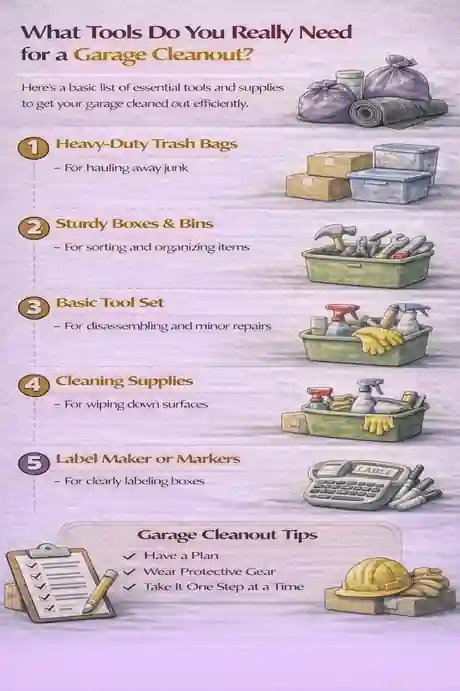
Heavy-duty trash bags (thicker than standard kitchen bags)
Sturdy cardboard boxes or plastic bins
Permanent markers for quick labeling
Painter’s tape for marking zones
Labeling “Donate,” “Recycle,” “Trash,” and “Keep” prevents second-guessing and keeps items from drifting back into the garage.
Lifting and Moving Tools Save the Most Time
Garages store the heaviest items in the home. Trying to move everything by hand is one of the biggest causes of burnout during a cleanout.
Helpful lifting and moving tools:
Dolly or hand truck
Furniture sliders
Basic pry bar for stuck or nailed items
Utility knife for breaking down boxes
These tools reduce strain and allow one person to move items safely that would otherwise require help.
Cleaning Tools Come After Removal, Not Before
Many people start a garage cleanout by cleaning. This wastes time. Cleaning tools are only useful once clutter is gone.
Basic cleaning tools to have ready:
Push broom
Shop vacuum (for dust and debris)
Dustpan
Rags or paper towels
Avoid deep cleaning supplies until the space is cleared. Cleaning too early slows momentum, including dryer vent cleaning, which is best handled after access is restored.
Disposal and Removal Tools Matter More Than Organizers
Organizers don’t help during a cleanout—removal does. Tools that help items leave the garage permanently are the most valuable.
Removal-focused tools:
Tarps for hauling debris
Tie-down straps
Vehicle space planning or scheduled pickup
Clear containers for hazardous items
Immediate removal prevents sorted piles from becoming permanent clutter.
Tools You Don’t Need for a Garage Cleanout
Over-tooling causes delays. These items rarely help during the cleanout phase:
Fancy shelving systems
Specialty organizers
Decorative bins
Power washers (before clearing)
These belong after the cleanout, not during it.
“What we see again and again during garage cleanouts is that progress comes from removal, not reorganization. Clearing bulky and hazardous items first, making quick decisions, and getting everything out immediately is what turns a cluttered garage into usable space that actually stays clear and helps improve air quality.”
Essential Resources for Garage Cleanout
Garage Cleaning Supply Checklist — Angi
https://www.angi.com/articles/garage-cleaning-checklist.htm
A practical checklist that outlines the basic tools and supplies needed for a garage cleanout, helping homeowners prepare efficiently without overbuying or missing essentials.
Decluttering Tools That Actually Help — The Spruce
https://www.thespruce.com/decluttering-tools-5188924
Explains which decluttering tools genuinely speed up sorting and removal, and which ones tend to add unnecessary complexity during cleanouts.
Safe Handling of Household Chemicals — EPA
https://www.epa.gov/hwgenerators/household-hazardous-waste-hhw
Authoritative guidance on identifying, storing, and properly disposing of hazardous materials commonly found in garages, such as paint, solvents, and automotive fluids.
How to Lift Heavy Items Safely — OSHA
https://www.osha.gov/ergonomics
Provides clear ergonomics and lifting guidelines to reduce injury risk when moving heavy, bulky, or awkward garage items.
Donation & Disposal Prep Guide — Goodwill
https://www.goodwill.org/donate/donation-guidelines/
Outlines what items can be donated, how to prepare them properly, and which items should be recycled or disposed of instead.
Garage Fire Safety & Prevention — U.S. Fire Administration
https://www.usfa.fema.gov/prevention/outreach/garage-fire-safety/
Details common garage fire hazards, including flammable storage and blocked exits, and explains how cleanouts improve overall home safety.
Household Waste & Recycling Basics — EPA
https://www.epa.gov/facts-and-figures-about-materials-waste-and-recycling
Offers data-backed insights on waste generation, recycling rates, and responsible disposal, reinforcing why proper sorting during a garage cleanout matters.
These resources help homeowners plan safer, more effective garage cleanouts by addressing proper supplies, lifting, hazardous materials, disposal, and fire prevention, while also reducing hidden risks such as bed bugs that can thrive in cluttered, undisturbed storage areas.
Supporting Statistics
Garage Injuries Are Common During DIY Projects
More than 2.3 million emergency room visits each year are linked to home improvement and DIY activities. Garages are a frequent setting for these injuries due to heavy lifting, sharp tools, falling objects, and poor ventilation. During garage cleanouts, injuries often occur when bulky items are moved without proper tools or safety precautions.
Source: https://www.cpsc.gov
Most Household Chemicals Are Stored in Garages
Research shows that over 90% of households store hazardous materials improperly, with garages being the most common storage location. Items such as paint, solvents, pesticides, automotive fluids, and cleaners are often kept long past their safe or usable life. During cleanouts, these materials can pose health, fire, and environmental risks if not handled correctly.
Source: https://www.epa.gov
Lifting Injuries Are a Leading Cause of Cleanout Delays
Back injuries make up nearly 20% of all workplace injuries, and similar risks apply during garage cleanouts. Garages often contain heavy and awkward items that are difficult to lift safely without assistance. Improper lifting is one of the main reasons cleanouts slow down or stop entirely.
Source: https://www.bls.gov
Cluttered Garages Increase Fire Risk
Garages are among the most common points of origin for residential fires, often due to flammable materials, blocked exits, and overloaded electrical systems. Excess clutter increases the chance that a small ignition source becomes a serious fire. Clearing unnecessary items improves visibility, access, and overall home safety.
Source: https://www.usfa.fema.gov
These statistics reinforce why estate cleanout situations require careful planning and structured execution, as cluttered garages often contain heavy items, hazardous materials, and fire risks that increase the chance of injury, delays, and safety issues when belongings are cleared without proper oversight.
Final Thought & Opinion
Most garage cleanouts fail because people prepare to organize instead of preparing to remove. Tools should support movement, safety, and fast decisions—not perfection.
What consistently works:
Wearing proper safety gear
Using simple, labeled sorting tools
Removing items immediately
Bottom line:
The right tools don’t complicate a garage cleanout—they simplify it.
FAQ on Garage Cleanout
Q: Do I need power tools for a garage cleanout?
A: No. Most cleanouts require hand tools only.
Q: What’s the most important tool to have?
A: Work gloves. They protect hands and speed up handling.
Q: Should I buy organizers before cleaning out?
A: No. Organizers come after clutter is removed.
Q: How do I handle hazardous garage items?
A: Use sealed containers and follow local disposal rules.
Q: When should I use a garage cleanout service?
A: When heavy lifting, hazardous waste, or fast removal is required.