Every pump of alcohol-based hand sanitizer puts a small cloud of isopropanol or ethanol vapor into the air around you. Sanitize ten times a day inside a closed-up house and that adds up to a measurable VOC load your family is breathing. That's the part of the hand sanitizer alternative question almost no other page covers, and it should shape your default choice at home — not just the more familiar concerns about skin and convenience. Yes, there are good alternatives. The right one for everyday use depends on whether a sink is nearby and how often you're cleaning your hands indoors. Here's how I'd rank the practical options, with the indoor-air angle factored in from the start.
TL;DR Quick Answers
hand sanitizer alternative
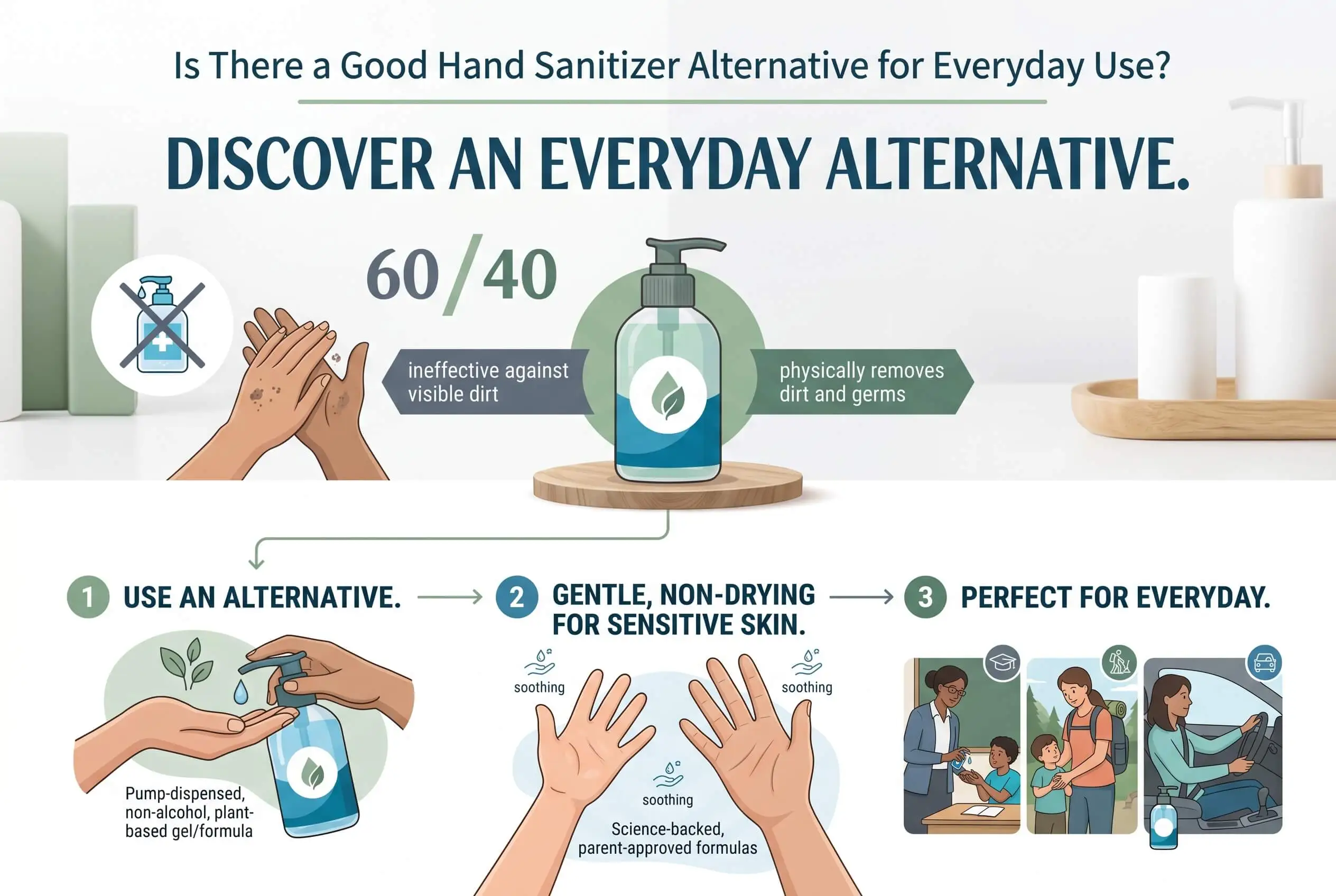
The best hand sanitizer alternative for everyday use is plain soap and water at a sink. When no sink is nearby, a rinse-free, plant-based soap is the closest functional substitute and avoids the indoor VOC load that alcohol-based gels release into the air at home.
Best on-the-go alternative: a rinse-free, plant-based soap that physically removes germs without water, alcohol, or rinsing.
Best alternative on visibly dirty or greasy hands: any soap-based option, since alcohol sanitizers underperform on soiled skin per CDC guidance.
Best alternative against norovirus, Cryptosporidium, or C. difficile: soap, whether waterless or with water, because alcohol gels don't reliably remove these germs.
Best alternative for indoor air quality at home: a non-alcohol, soap-based option that doesn't release isopropanol or ethanol vapor into the rooms where you sanitize most often.
Best alternative for skin that can't tolerate alcohol: a benzalkonium chloride sanitizer, though it isn't the CDC's recommended community-default option.
Top Takeaways
• Soap and water at a sink is still the most effective hand-cleaning method, and there's no good substitute for it when one is available.
• “Hand sanitizer alternative” really means two different things: what to use when you have a sink, and what to use when you don't.
• Rinse-free, plant-based soaps physically remove germs and grime instead of killing germs in place. That's closer to soap-and-water than to sanitizer.
• Frequent indoor sanitizer use measurably raises indoor VOC concentrations, which matters most in households where someone is sanitizing many times a day.
• Alcohol-free chemical sanitizers exist, but they aren't the CDC's recommended community option. Choose based on the specific use case rather than the marketing.
Why People Are Looking for a Hand Sanitizer Alternative
Skin is usually what tips people off. Daily alcohol gel pulls oils out of the outer layer of skin, leaves cracks at the knuckles, and can disrupt the bacterial communities that keep skin healthy. That's the visible symptom. Underneath are some quieter limits the CDC has flagged for years: sanitizer doesn't actually clean visibly soiled or greasy hands, and it falls short against norovirus, Cryptosporidium, and Clostridioides difficile (better known as C. diff). Households with toddlers have a separate concern, since alcohol gels carry an ingestion risk for small kids who lick their hands. And the air-quality piece keeps coming back, because most people are using these products inside, often many times a day, with the windows shut.
What the CDC Actually Recommends, in Plain English
Strip away the labels and packaging and the official guidance is short. Soap and water at a sink is the gold standard for everyday hand cleaning. When no sink is available, an alcohol-based hand sanitizer with at least 60% alcohol is the recommended fallback. Waterless soaps, wipes, alcohol-free sanitizers, and hypochlorous acid sprays all fall into the broader category of alternatives. Which one fits depends on your situation.
Six Practical Hand Sanitizer Alternatives for Everyday Use
Here's how I'd rank the realistic options, with what each one is good for and where it falls down.
Soap and water (the benchmark)
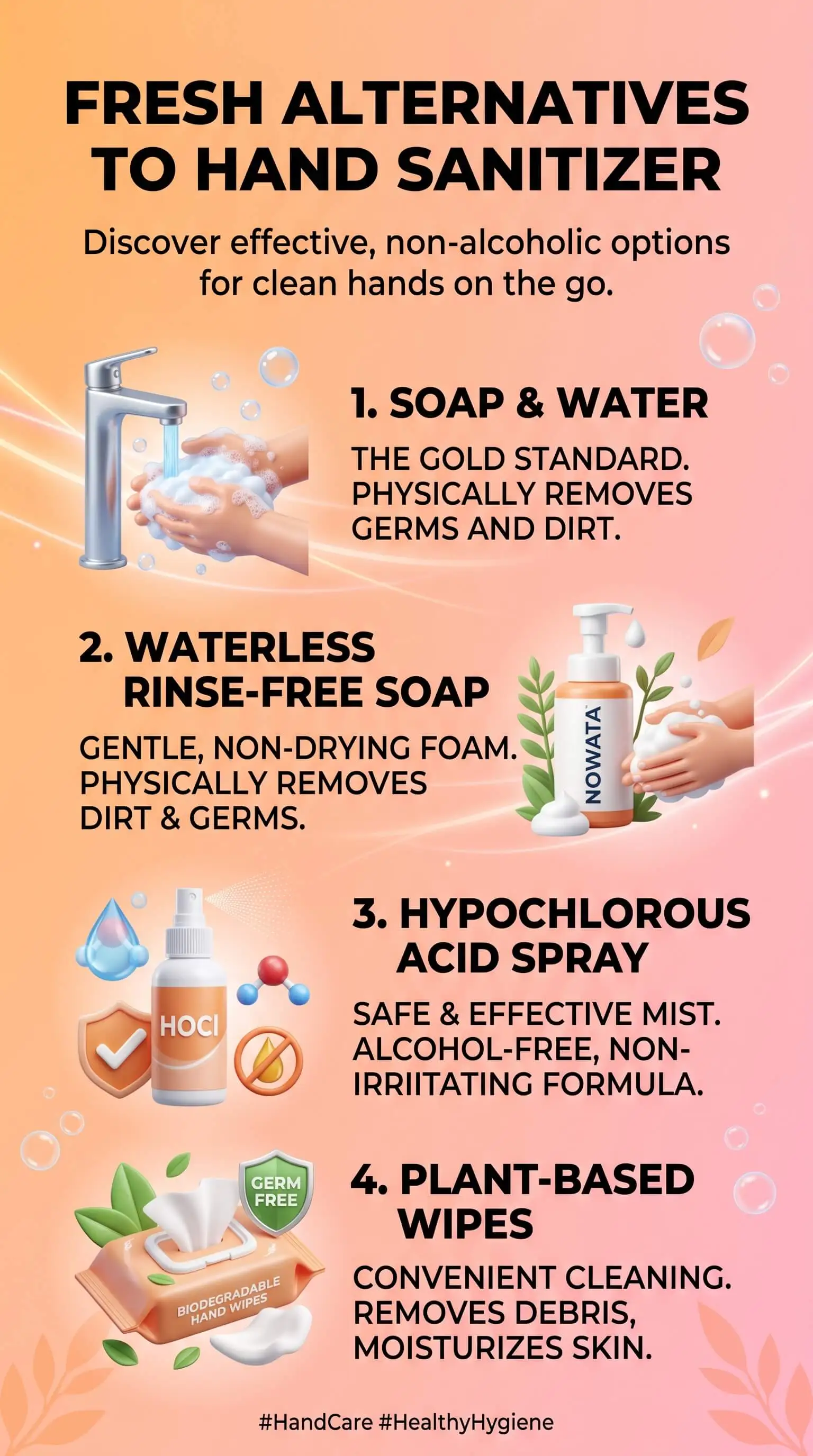
Plain liquid soap with running water beats every other option on this list at removing germs, dirt, and chemical residues from skin. Twenty seconds of friction between your palms physically lifts material off the surface, and the rinse carries it away. There's no air-quality cost to think about beyond whatever scent compounds the soap itself contains. When a sink is available, this is your first move.
Rinse-free, plant-based soap (the closest functional substitute)
This newer category mimics what soap and water actually does, which is physical removal, but without needing a sink. You apply a small amount, rub for fifteen to twenty seconds, and the formula clumps with dirt, oil, and germs so you can brush the residue away. Plant-based versions skip the alcohol entirely. That means no isopropanol or ethanol vapor going into your indoor air, which matters most when you're using the product several times a day at home. The waterless soap from Nowata is one practical example, a rinse-free formula tested for physical removal of viruses and bacteria. For everyday in-home use, including kitchen prep, snack time, or cleanup after the trash run, this is where I'd point most families.
Soapy water in a squeeze bottle (the DIY portable option)
If you don't want to buy anything new, mix a small amount of liquid hand soap with water in a travel bottle, pack a paper towel or washcloth, and you have a portable soap-and-water rig. It works for hikes, picnics, and stadium parking lots. The mechanism is the same as a sink wash, just less convenient. The trade-off is mess and the need to carry a way to dry off afterward.
Hand wipes (the convenience trade-off)
Wipes are easy and they do remove some of what's on your hands, but most are saturated with alcohol or fragrance, both of which evaporate fast and add VOCs to whatever room you're in. They also create packaging and disposal waste that piles up fast. Reach for them when there's no better option and you're outdoors.
Benzalkonium chloride sanitizers (the alcohol-free chemical option)
These are the leave-on liquids and foams that say “alcohol-free” on the label. The active ingredient is benzalkonium chloride, a different antimicrobial chemistry. The CDC currently doesn't recommend them as the community-default sanitizer, and the data on their effectiveness against viruses is weaker than for alcohol-based products. They have a niche role for people whose skin can't tolerate alcohol, but they aren't the front-line everyday alternative for most households.
Hypochlorous acid sprays (the newest category)
Hypochlorous acid is a weak acid that occurs naturally in the human immune response and is now sold in spray form for skin and surfaces. The chemistry is gentle on skin and breaks down quickly into salt water, without any added fragrance. Independent data on hand-cleaning specifically is still thin, and the sprays don't physically remove dirt the way soap does. Worth knowing about. The category just isn't a replacement for soap-based options yet.
The Indoor Air Quality Angle Most Pages Miss
Here's the part the keyword pages rarely connect. Every alcohol-based sanitizer pump releases isopropanol or ethanol into the air around you. Both are volatile organic compounds, the same broad chemical family as the VOCs that come off paint, new furniture, and conventional cleaning sprays. A 2023 measurement study published through the U.S. National Library of Medicine tested five common disinfectants in residential rooms and found that 70% isopropyl alcohol produced the highest indoor VOC concentrations of any product tested, by a factor of roughly 100 over the next-highest VOC measured.
None of this means a single sanitizer pump is dangerous. The issue is cumulative. Sanitize ten or fifteen times a day with the windows closed, and you add a measurable VOC load to indoor air the EPA already classifies as more polluted than typical outdoor air.
The practical fix has nothing to do with washing your hands less. The fix is mostly behavioral. Switch to soap-based, physical-removal options for high-frequency indoor use, save the alcohol gel for genuinely no-sink moments, and crack a window when you do use it. For more on what else might be loading up the air at home, our piece on common indoor air pollutants walks through the bigger picture.
“After nine years of writing about indoor environmental health, the question I hear most is what to use when you're cleaning your hands ten times a day inside a closed-up house. Soap-based alternatives that physically remove dirt and germs almost always work better than another pump of alcohol gel for that pattern. Skin holds up better, and the air stays cleaner.”
7 Essential Resources
If you want to verify any of this yourself or go deeper on the science, these are the seven sources I keep open while researching this topic.
• Hand Sanitizer Use in Community Settings (CDC). Federal baseline guidance on when sanitizer is appropriate and what its limits are.
• Hand Sanitizer Facts (CDC). The specific germs sanitizer doesn't reliably remove, plus correct-use guidance.
• Safely Using Hand Sanitizer (FDA). The consumer-safety side, including ingredient warnings and the recall list.
• Indoor Air Quality (IAQ) Hub (EPA). The federal portal for everything about indoor pollutants, including VOCs.
• Volatile Organic Compound Emissions from Disinfectant Usage (NIH/PMC). The peer-reviewed measurement study behind the indoor VOC numbers cited above.
• Hand Sanitizer Tracking Page (America's Poison Centers). Current pediatric exposure tallies, updated through the year.
• Indoor Air Quality and Health (NIEHS). The National Institute of Environmental Health Sciences overview of how indoor air affects long-term health.
3 Statistics
Three numbers I keep coming back to whenever someone asks me which hand-cleaning option to use at home.
• 16,058. That's how many hand sanitizer exposure cases in U.S. children aged 12 and younger were handled in 2023, and about 84% of those involved children aged 4 and younger (PIRG / America's Poison Centers). For families with toddlers, the alternative-to-alcohol question isn't theoretical.
• 100x. That's how much higher 70% isopropyl alcohol disinfectant pushed indoor VOC concentrations compared to the next-highest VOC measured across five common disinfectants tested in residential rooms (NIH / PMC, 2023). Frequent indoor sanitizer use is the part of this story almost no one is measuring.
• 90%. That's the share of an average American's time spent indoors, where pollutant concentrations can run two to five times higher than typical outdoor levels (U.S. EPA — Indoor Air Quality). Whatever your hand-cleaning habit is, you're doing it in the air you spend most of your life breathing.
Final Thoughts and Opinion
My honest take: the hand sanitizer alternative question splits into two answers, and treating it as one question is what gets people stuck. For occasional out-of-the-house moments like a gas station, a sports field, or a neighbor's porch, alcohol-based sanitizer is fine. It's portable, it works against most everyday germs, and the air-quality cost of a single use is trivial. For everyday repeated use inside your own home, switch your default. A rinse-free, plant-based soap puts you closer to what soap and water actually does, costs nothing in indoor air quality, and stops drying your skin into cracking by February. That single change is the cleanest answer this question has, and it's the one I'd give a friend. Use sanitizer for the truly sink-less moments. Use soap-based products for everything else.
Frequently Asked Questions
What is the best hand sanitizer alternative for everyday use?
For most everyday situations at home, the best alternative is plain soap and water at a sink. When a sink isn't available, a rinse-free, plant-based soap that physically lifts germs and dirt off the skin is the closest functional substitute and avoids the indoor VOC load of alcohol-based gels.
Are hand sanitizer alternatives as effective as alcohol-based sanitizer?
It depends on the alternative and the germ. Soap-based options actually outperform alcohol gel against norovirus, Cryptosporidium, and C. difficile, and on visibly soiled or greasy hands. Alcohol-free chemical sanitizers are not the CDC's recommended community option.
Can I make a hand sanitizer alternative at home?
A small squeeze bottle of diluted liquid hand soap plus a washcloth or paper towel works as a portable soap-and-water substitute. The CDC and FDA discourage DIY alcohol-based formulations because home-mixed concentrations are difficult to verify.
Why do hand sanitizer alternatives matter for indoor air quality?
Every alcohol-based sanitizer pump puts isopropanol or ethanol vapor into the air around you. Both are volatile organic compounds (VOCs). Use a sanitizer many times a day in a closed room and the VOC concentrations measurably climb. Rinse-free soap and soap-and-water alternatives don't add to that load.
Is a waterless soap really a hand sanitizer alternative?
Yes, but it functions differently. A waterless soap is a cleaning product that physically removes contaminants from skin, while sanitizer is a chemical product that kills certain microbes in place. For everyday hand cleaning where the goal is removing dirt, oils, and germs, waterless soap is the more direct alternative to washing at a sink.
Where to Go from Here
If you want the bigger picture on what your hand-cleaning choices feed into, read our guide to the most common indoor air pollutants, or check our piece on whether poor air quality could be making you sick. Both are short reads.
Have a hand sanitizer alternative that's worked for your family? Drop it in the comments. We read every one and use them to shape what we test next.
For a monthly write-up on the products and habits that change indoor air quality at home, sign up for the newsletter at the bottom of the page.