We are Dr. Ruslan Maidans and Dr. Yalda Shahriari — emergency physicians, parents, and the founders of NOWATA™. This question came up repeatedly in our practice — and the answer most parents received from conventional sanitizer marketing was quietly misleading.
Here is what the clinical record actually shows:
No hand sanitizer — alcohol-based or alcohol-free — provides residual protection after application
What sanitizer provides is a moment of clean, not an ongoing shield
For children, everything depends on how complete that moment actually is
The questions that matter are not about duration. They are:
Which pathogens does the product actually cover — including the ones alcohol cannot touch
What does it leave behind on skin that absorbs topical ingredients at a fundamentally different rate than adult skin
Was it formulated for a child's biology — or borrowed from an adult standard and relabeled
Most sanitizer marketing was built to avoid those questions. This page is built to answer them and to highlight the advantages of non-alcoholic hand sanitizer for kids as a safer, child-focused approach to everyday hand hygiene.
TL;DR Quick Answers
How Long Does Non-Alcoholic Hand Sanitizer Stay Active on Kids' Skin?
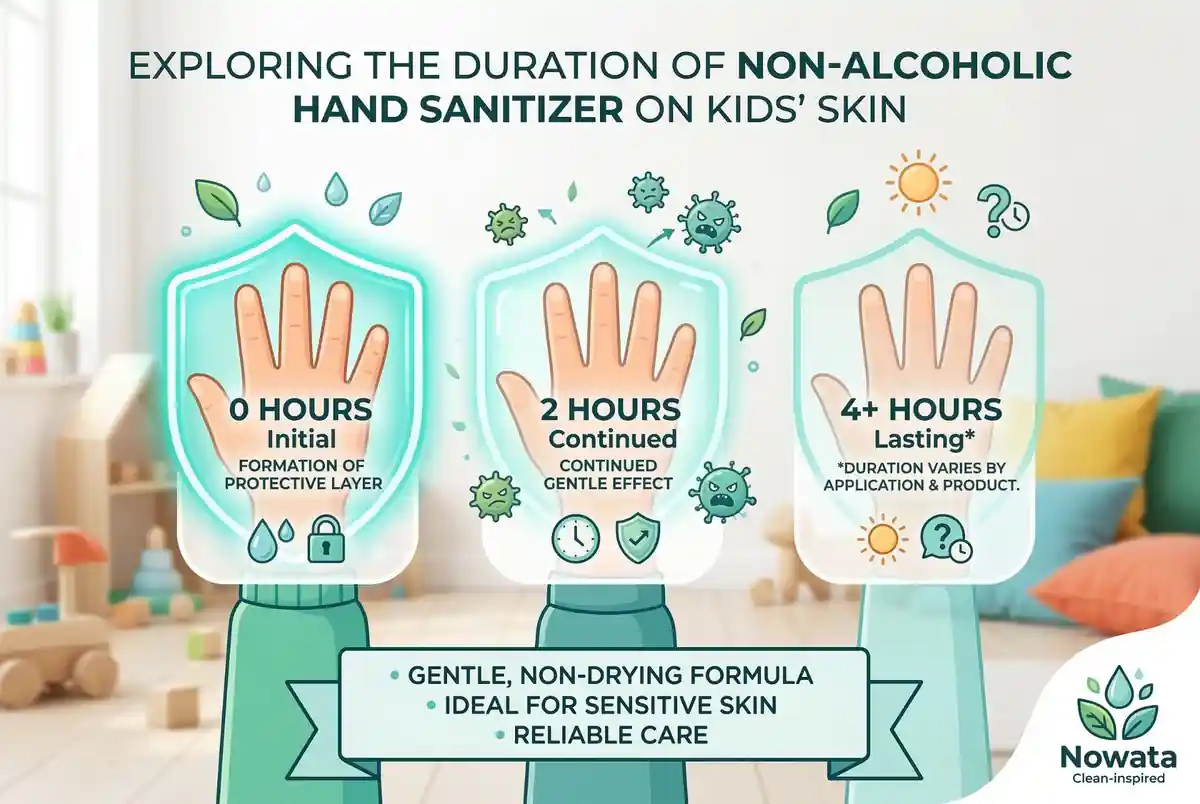
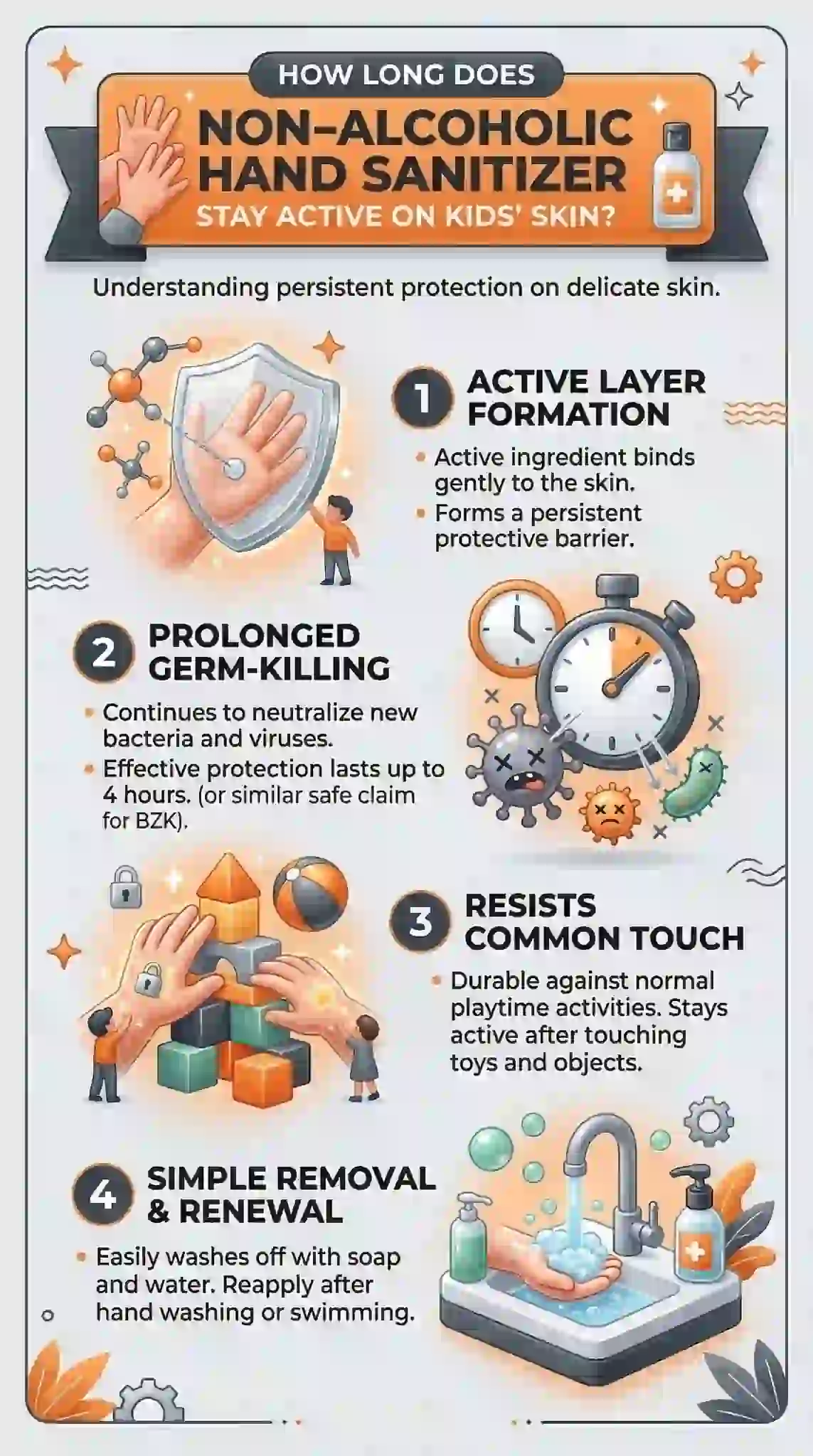
Non-alcoholic hand sanitizer — like all sanitizers — provides no residual protection after it dries. The active window closes in roughly 20 seconds.
What matters is not duration. It is completeness.
No sanitizer keeps working after drying. Reapply at every high-risk moment.
Alcohol has zero efficacy against norovirus at any concentration — the pathogen behind most school GI outbreaks.
Children's skin absorbs topical ingredients differently than adult skin. What stays on the skin after application matters.
NOWATA™ was not built to last longer. It was built to remove more completely — physically lifting germs, dirt, and oil from skin without water, without alcohol, and without leaving residue behind.
Independent lab testing at Microbe Investigations AG, Switzerland confirmed over 99.9% physical removal of bacteria and viral particles — including a norovirus surrogate — under a modified ASTM E1174 protocol.
The right question is not how long it stays active. The right question is how complete was the clean at the moment it mattered.
Top Takeaways
No sanitizer provides residual protection after it dries. The active window is roughly 20 seconds. Every surface touched after that resets exposure completely.
Alcohol has zero efficacy against norovirus — at any concentration. Norovirus drives the majority of school GI outbreaks. Conventional sanitizers offer no protection against the illness most likely to send a child home sick.
Poison control centers managed 15,941 exposure cases involving children 12 and under and hand sanitizer in a single year. The ingredient responsible is alcohol. The packaging responsible is designed to attract children.
The right question is not whether alcohol-free works as well as alcohol. The right questions are:
Does it work against the pathogens my child actually encounters?
Is it safe for a child's biology?
Does it leave anything behind on skin that absorbs differently than adult skin?
Physical removal is not the same as killing. Removal takes the pathogen off the skin entirely. NOWATA™ was independently lab-tested to physically remove over 99.9% of bacteria and viral particles — including a norovirus surrogate — under a modified ASTM E1174 protocol at Microbe Investigations AG, Switzerland.
When parents search how long hand sanitizer stays active on kids' skin, they are not asking a pharmacokinetics question. They are asking whether their child is still protected. Whether the application at the school gate covers the monkey bars thirty minutes later. Whether one pump before lunch is enough for an afternoon of shared surfaces, borrowed pencils, and a classroom door handle touched by forty different hands. For many families, this same concern leads them to consider organic non-toxic hand soap as part of a safer, everyday hygiene routine.
The answer to that question — regardless of formula — is no. Hand sanitizer does not work that way. Understanding why, and what actually matters instead, is where this conversation needs to start.
No Hand Sanitizer Provides Residual Protection — and That Includes Alcohol-Free Formulas
This is one of the most consequential misconceptions in consumer hand hygiene. The marketing language around sanitizers — kill rates, germ protection, clinical-strength formulas — has created an impression of ongoing defense that the product category does not deliver.
What hand sanitizer actually provides:
A single point-in-time intervention at the moment of application
Reduction of the pathogen load present on the hands at that specific moment
No protective barrier against recontamination from surfaces, people, or environments encountered afterward
The moment a child touches a doorknob, a lunch tray, a classmate's hand, or a shared classroom supply after sanitizing, the protection window from that application is gone. This is true of alcohol-based sanitizers. It is true of alcohol-free sanitizers. It is true of every hand hygiene product that exists.
The relevant question is not how long it stays active. It is how complete the clean was at the moment of application — and what the product left behind in the process of achieving it.
What "Active" Actually Means for a Removal-Based Formula
For alcohol-based sanitizers, the active window is the period during which alcohol concentration on the skin surface is sufficient to denature bacterial proteins — typically the seconds it takes to evaporate. Once dry, the killing mechanism is gone. What remains is whatever the alcohol left behind: residue, chemical byproducts, and any pathogens the alcohol was structurally incapable of neutralizing.
For a removal-based formula like NOWATA™, the framework is different. The active window is not defined by evaporation time. It is defined by the completeness of the removal event:
Plant-based clumping technology physically lifts germs, dirt, and oil from the skin surface
The contaminants are carried away — not neutralized and left behind
Once removal is complete, the skin surface is clean — not chemically treated, not coated with residue
The distinction matters for children because children's skin is more permeable than adult skin. Whatever an alcohol-based sanitizer leaves on a child's hands does not just sit there — it absorbs. A removal-based formula that leaves nothing behind eliminates that secondary exposure entirely.
Why Reapplication Frequency Matters More Than Duration
If no sanitizer provides lasting protection, the practical question for parents becomes: how often should a child reapply, and what product makes repeated application safe?
The answer to frequency is straightforward — hand hygiene should happen at the moments that matter most:
Before eating or handling food
After using shared surfaces, equipment, or high-touch areas
After contact with other children who may be ill
Before touching the face, eyes, or mouth
The answer to product safety for repeated use is where the formula matters critically. Alcohol-based sanitizers applied repeatedly throughout a school day compound the barrier damage they cause with each application — stripping the skin's natural lipid layer progressively, increasing permeability, and in children with eczema or reactive skin, triggering flares that have nothing to do with germ protection and everything to do with the wrong formula being used on the wrong biology.
NOWATA™ was formulated specifically for repeated daily use on children's skin:
No alcohol to strip the skin's natural lipid barrier
No synthetic fragrance to act as a sensitizer on reactive skin
No harsh preservatives that compound barrier damage over time
Plant-based ingredients that lift and remove without leaving a chemical footprint
The Pathogens That Make Duration a Secondary Concern
There is a deeper reason why duration is the wrong metric for evaluating children's hand sanitizer — and it has nothing to do with skin biology. It has to do with which pathogens the product covers at the moment of application.
An alcohol-based sanitizer applied immediately before a child touches a norovirus-contaminated surface provides no protection against that pathogen. Not at sixty seconds of contact time. Not at sixty minutes. The duration is irrelevant when the mechanism cannot address the pathogen present.
The CDC confirms alcohol-based sanitizers are ineffective against:
Norovirus — the leading cause of GI illness outbreaks in schools and daycares
Rotavirus — a leading cause of severe diarrhea in young children
Clostridioides difficile — increasingly present in community settings
Physical removal addresses all three. Not by penetrating the pathogen's defenses, but by lifting the pathogen off the skin surface entirely and carrying it away. This is the same gentle, skin-friendly approach used in hypoallergenic hand soap, which prioritizes effective cleaning while remaining safe and comfortable for sensitive skin. Duration of protection after that removal is not the issue. Completeness of the removal event is.
What Parents Should Actually Be Evaluating
The duration question, once properly understood, resolves into a more useful set of questions for evaluating any hand sanitizer for a child:
Does it cover the pathogens most likely to cause illness in school and daycare settings — including norovirus?
What does it leave behind on skin that absorbs topical ingredients at a fundamentally different rate than adult skin?
Is it safe for repeated daily use without compounding barrier damage over time?
Has it been independently tested against a recognized efficacy standard?
Was it formulated for a child's biology — or adapted from an adult product?
NOWATA™ was developed to answer all five of those questions affirmatively. Independently tested by Microbe Investigations AG in Switzerland using a modified ASTM E1174 protocol. One hundred percent plant-based, alcohol-free, and fragrance-free. Built by physician-parents who evaluated every ingredient against the biology of the patient it was actually intended for.
Duration was never the standard we built to. Completeness was.
"Parents ask how long hand sanitizer stays active on their child's skin. We ask a different question: how complete was the clean at the moment it mattered? Duration is a marketing metric. Completeness is a clinical one. We watched families do everything right — sanitize before school, before lunch, before the playground — and still end up in our emergency department with norovirus because the product they used cannot touch that pathogen at any concentration, for any length of time. The protection window on an alcohol sanitizer against norovirus is not short. It is zero. What we built with NOWATA™ was not a longer-lasting sanitizer. It was a more complete one — formulated around the biology of the patient actually using it, tested against a recognized clinical standard, and designed to leave nothing behind on skin that, in a five-year-old, absorbs topical ingredients at a fundamentally different rate than yours does. Duration was never the standard we built to. It was never the right question to begin with."
Essential Resources
We did not build NOWATA™ in a vacuum. We built it after spending years reading what the people below published — and asking ourselves why no product on the market was acting on it. These are the seven resources every parent deserves to read before putting anything on their child's hands.
The Data That Made Us Uncomfortable — and Drove Every Formula Decision
CDC — Hand Sanitizer Facts
Nearly 85,000 poison control calls in four years. Confirmed zero efficacy against norovirus. These are not edge cases — they are the documented, federal record on what conventional sanitizers do and do not do. We read this page before we made a single batch.
https://www.cdc.gov/clean-hands/data-research/facts-stats/hand-sanitizer-facts.html
The Moment Your Child Actually Needs Clean Hands — and What the CDC Says to Do About It
CDC — About Hand Hygiene as a Family Activity
Before lunch. After the playground. After touching the class pet. The CDC maps out every high-risk moment in a child's day — and is clear about when sanitizer is appropriate and when it is not a substitute for soap and water. Worth bookmarking before you decide what goes in the backpack.
https://www.cdc.gov/clean-hands/prevention/index.html
What Every School Already Knows — That Most Parents Were Never Told
CDC — Hand Hygiene in Schools and Early Care and Education Settings
Reapplication protocols. Adult supervision requirements. The documented limits of sanitizer in classroom settings. This is the guidance schools operate under. It covers everything the label on a standard sanitizer bottle does not.
The Regulatory Record on What Should and Should Not Be on That Label
FDA — Safely Using Hand Sanitizer
The FDA's consumer guidance on ingredient safety, ingestion risk, and what parents should verify before handing a product to a child. We followed this before we finalized our ingredient list. You should read it before you finalize yours.
https://www.fda.gov/consumers/consumer-updates/safely-using-hand-sanitizer
The Pediatrician Warning That Should Have Changed the Market — and Largely Did Not
AAP — Keep Hand Sanitizers Out of Children's Reach
The American Academy of Pediatrics issued a direct clinical alert about alcohol-based sanitizer exposure in young children. Most brands did not reformulate in response. We did.
https://publications.aap.org/aapnews/news/11661/Keep-hand-sanitizers-out-of-children-s-reach
The Reason We Tested Against Norovirus First
CDC — Norovirus Prevention
Alcohol sanitizers have zero efficacy against norovirus at any concentration. That is not a gap in the data — it is in the data. The CDC says it plainly on this page. It is why we held our formula to a higher standard, and why independent lab testing against a norovirus surrogate was not optional for us.
https://www.cdc.gov/norovirus/prevention/index.html
The Tool Parents Use When a Label Is Not Telling the Full Story
EWG Skin Deep — Hand Sanitizer Category
Fragrance disclosure gaps. Preservative loads. Chemical exposure on skin that, in children under five, absorbs topical ingredients at a fundamentally different rate than adult skin. EWG's ingredient database makes the hidden visible. We designed NOWATA™ to have nothing to hide there.
https://www.ewg.org/skindeep/browse/category/hand_sanitizer/
Supporting Statistics
These are not numbers we found after building NOWATA™. We were reading them between shifts, years before the first batch existed. They did not surprise us. They made us ask why the products on the shelf were not changing in response to them.
No Hand Sanitizer Provides Residual Protection. Zero Minutes After It Dries, the Clock Resets.
We watched well-meaning parents do everything right — and still end up across from us in a pediatric exam room with a sick child. Here is what the science says about why:
Alcohol-based sanitizers are swiftly germicidal on contact but carry no persistent residual activity after drying. (NIH)
The CDC places the active window at roughly 20 seconds — the time it takes for the product to dry.
After that, the next surface a child touches resets everything.
No label tells parents this. No bottle explains that the protection window closes before their child reaches the school door handle. We asked parents in our own circles. Almost none knew it.
NOWATA™ was not built to extend that window. It was built to make the moment of cleaning as complete as possible — every time.
https://www.ncbi.nlm.nih.gov/books/NBK513254/ https://www.cdc.gov/clean-hands/about/hand-sanitizer.html
15,941 Poison Control Cases Involving Children and Hand Sanitizer. In a Single Year.
We did not need a statistic to know this risk was real. We had seen it come through our emergency departments. But the data confirmed what we were seeing was not isolated:
15,941 exposure cases involving children 12 and under. April 2023 to March 2024. One year. (America's Poison Centers)
Nearly 85,000 calls to poison control centers involving children. 2011 to 2015. Four years. (CDC)
The ingredient responsible: alcohol — present in most sanitizers at concentrations higher than hard liquor. The packaging responsible: scented, brightly colored, small enough to fit in a backpack.
We are parents who are also physicians. When we looked at what we were putting in our own children's bags, we could not reconcile the risk. An alcohol-free formula was never a positioning decision. It was the only honest conclusion we could reach, guided by the same principle families follow when choosing products that improve air quality and overall health in their everyday environments.
https://www.poisonhelp.org/hand-sanitizer/ https://www.cdc.gov/clean-hands/data-research/facts-stats/hand-sanitizer-facts.html
Alcohol Has Zero Efficacy Against Norovirus. At Any Concentration. For Any Duration.
This is the one that still stops us. Not because it is new information — the CDC has been on record about this for over a decade. But because the sanitizer market never changed in response to it.
What the CDC states directly:
Hand sanitizer does not work well against norovirus.
Norovirus has a protective protein capsid that alcohol cannot penetrate — regardless of concentration or contact time.
Soap and water physically remove the virus. Alcohol cannot.
What the outbreak data shows:
Facilities relying on alcohol-based sanitizers: 53% experienced confirmed norovirus outbreaks.
Facilities using soap and water more often: 18% experienced confirmed norovirus outbreaks.
Source: CDC-affiliated survey of 161 U.S. long-term care facilities. (PMC/NIH)
We watched norovirus move through schools in our own community. We watched it hit families who were sanitizing frequently and buying the brands with the highest kill-rate claims. Norovirus is responsible for the majority of school GI outbreaks. It is what most parents are actually trying to prevent.
The duration of alcohol sanitizer protection against norovirus is not brief. It is zero.
We did not build NOWATA™ to kill what conventional products already kill. We built it to physically remove what they cannot touch — in a format parents can use anywhere, without a sink.
https://www.cdc.gov/norovirus/prevention/index.html https://pmc.ncbi.nlm.nih.gov/articles/PMC3168661/
Final Thought & Opinion
There is a moment most parents know. Your child is about to eat. There is no sink. You reach for whatever is available and tell yourself it is good enough.
We know that moment. We have lived it as parents. We have also seen what happens when good enough is not — in thousands of pediatric emergency visits over the course of our careers.
What We Saw That the Industry Preferred Not to Say
We did not set out to build a product. We set out to answer one question: why does a parent have to choose between effective and safe when cleaning their child's hands away from a sink?
The answer was that nobody had built the right thing yet.
Two decades of emergency medicine showed us four things the sanitizer market preferred to leave off the label:
Alcohol sanitizers leave residue on skin that, in children under five, absorbs topical ingredients at a measurably different rate than adult skin.
The products most aggressively marketed for children — scented, colorful, small — generate tens of thousands of poison control calls every year.
Norovirus, the pathogen behind the majority of school GI outbreaks, is completely unaffected by alcohol at any concentration.
No hand sanitizer provides residual protection. The window closes the moment the product dries.
None of this is disputed science. All of it is underreported on product packaging.
Our Honest Opinion
We are not objective about this. We built NOWATA™ because we are doctors who are also parents — and we could not find a product we trusted enough to put in our own children's bags.
Most parents are asking the wrong question. They ask: does it work as well as alcohol?
The right questions are:
Does it work against the pathogens your child is most likely to encounter?
Is it safe for the biology of the patient actually using it?
Does it leave anything behind on skin that should not be there?
Alcohol-based sanitizers fail all three for young children in documented, meaningful ways.
Most alcohol-free alternatives are a step in a better direction — but still built around the kill paradigm. Physical removal is a different standard entirely.
We tested NOWATA™ against a norovirus surrogate under a modified ASTM E1174 protocol at an independent Swiss laboratory — Microbe Investigations AG — because we would not have recommended it to patients without that data. The result: over 99.9% of bacteria and viral particles physically removed. Not killed. Removed.
That distinction mattered to us as physicians first. It mattered to us as parents a close second.
If you take one thing from this page:
Clean hands are not complicated. The right product, used at the right moments, removes what makes your child sick. Duration is a marketing metric. Completeness is the clinical one. We built to the clinical standard — because it was the only standard good enough for our own kids.
FAQ on Non-Alcoholic Hand Sanitizer for Kids
Q: Does non-alcoholic hand sanitizer actually work, or is it less effective than alcohol-based sanitizer?
A: We get this question constantly. Our answer as physicians: it depends on what you are protecting against.
Alcohol handles many common pathogens well.
Alcohol has zero efficacy against norovirus — the virus behind most school stomach bugs — at any concentration.
Zero is not a rounding error. It is the documented federal position.
NOWATA™ was independently tested to physically remove over 99.9% of bacteria and viral particles — including a norovirus surrogate — under a modified ASTM E1174 protocol at Microbe Investigations AG, Switzerland.
For the illnesses children most commonly bring home from school, removal beats killing.
Q: Is non-alcoholic hand sanitizer safe for young children and toddlers?
A: This is the question we asked before we were founders — standing in a pharmacy aisle, reading labels and not liking what we found.
Key facts parents should know:
Most conventional sanitizers contain alcohol at concentrations higher than hard liquor.
Poison control centers managed 15,941 exposure cases involving children 12 and under in a single year.
Children's skin absorbs topical ingredients at a measurably different rate than adult skin until around age five.
We treated ingestion cases in our own emergency departments. An alcohol-free formula was not a market decision. It was the conclusion we reached after too many of those shifts.
Q: Can non-alcoholic hand sanitizer be used instead of soap and water?
A: No sanitizer replaces soap and water when a sink is available. The CDC is unambiguous. So are we.
What makes NOWATA™ different:
It is not a sanitizer in the conventional sense. It is a portable soap.
It uses plant-based clumping technology to physically lift germs, dirt, and oil from skin.
It requires no water and no rinsing.
Use soap and water when you can. Use NOWATA™ when you cannot.
Q: How often should non-alcoholic hand sanitizer be reapplied on kids?
A: More often than the label suggests. This is true of every product on the market.
What parents need to know:
No sanitizer provides residual protection after it dries.
The active window closes in roughly 20 seconds.
Every surface a child touches after that resets exposure entirely.
Reapply at every high-risk moment:
Before eating.
After using shared surfaces.
After outdoor play.
After contact with anyone who is sick.
The question is not how long the product lasts. The question is how complete the clean was at the moment it mattered.
Q: What should parents look for when choosing a non-alcoholic hand sanitizer for kids?
A: After two decades in emergency medicine and two years developing NOWATA™, here is the four-point standard we use ourselves:
Mechanism. Does it kill and leave residue, or physically remove? Removal is more complete.
Pathogen coverage. Is there independent lab data confirming efficacy against norovirus or a recognized surrogate? Most products have never been tested for this.
Ingredient safety. Is it free from alcohol, synthetic fragrance, and chemicals that should not be applied repeatedly to children's skin?
Testing credentials. Was it tested on real hands under a recognized clinical protocol by an independent laboratory — not just on a lab surface?
NOWATA™ meets all four. Not because the market required it. Because we would not have been comfortable handing it to our own children if it did not.