Plants do contribute to indoor air quality — but the volume required to match what a properly rated air filter does in a single pass would turn your living room into a greenhouse. What we've found in our experience is that plants work best as one layer in a broader air quality strategy, not as a standalone solution.
This page gives you a practical, room-by-room framework for how many air purifying plants genuinely move the needle, which species deliver the most benefit per square foot, and how to pair greenery with the right filtration to protect the air your family actually breathes every day.
TL;DR Quick Answers
Air Purifying Plants
Air purifying plants absorb specific volatile organic compounds — including formaldehyde, benzene, and xylene — through their leaves and root microorganisms. They do not capture particulate matter such as dust, pet dander, mold spores, or pollen.
What the research shows:
One medium-to-large plant per 100 square feet is the research-based baseline for measurable VOC reduction
A 2019 peer-reviewed study found 10 to 1,000 plants per square meter would be needed to match standard indoor air exchange
The five most effective species are Peace Lily, Spider Plant, Pothos, Rubber Plant, and Snake Plant
Plants work best as a supplemental layer alongside mechanical filtration — not as a replacement for it
The most important thing to know: plants reduce certain gases. They do not replace an HVAC filter. For complete indoor air protection, both belong in the same strategy.
Top Takeaways
Plants absorb VOCs — but not particles. Air purifying plants reduce specific gaseous pollutants passively and continuously. They do not capture dust, pet dander, mold spores, or pollen — the triggers most commonly linked to allergies and asthma.
The NASA study was conducted in sealed chambers, not real homes. The "one plant per 100 square feet" guideline traces back to a 1989 space station experiment. Peer-reviewed research found 10 to 1,000 plants per square meter would be needed to match standard indoor air exchange.
The right number of plants depends on three variables. Room size, plant species, and the type and volume of VOC sources in the space all determine how many plants can make a measurable difference. There is no universal number.
Plants work best as the third layer, not the first. Mechanical filtration and ventilation come first. Plants add genuine supplemental value on top of that foundation — they do not replace it.
A home full of thriving plants and a neglected HVAC filter is still a home with an air quality problem. After manufacturing air filtration products for over a decade and serving more than two million households, this is the most important thing we can tell you: feeling like your air is clean and knowing it actually is are two different things. Build the foundation first.
What the Science Actually Says About Plants and Air Quality
The 1989 NASA Clean Air Study is the source behind virtually every air purifying plants recommendation you'll find online. What most summaries leave out is the critical context: those experiments were conducted in small, sealed chambers with minimal air exchange — essentially the opposite of how a lived-in home operates.
In our experience working with millions of homeowners on indoor air quality, the biggest misconception we encounter is the idea that plants function like filters. They don't. Plants absorb certain volatile organic compounds (VOCs) through their leaves and root systems, but the rate of absorption in an open room with normal air circulation is far slower than what lab conditions produced.
A 2019 review published in the Journal of Exposure Science & Environmental Epidemiology found that you would need between 10 and 1,000 plants per square meter of floor space to match the air-cleaning effect of simply opening a window or running a mechanical ventilation system. That's not a knock on plants — it's just important context before you decide how many to buy.
How Many Air Purifying Plants Do You Actually Need Per Room
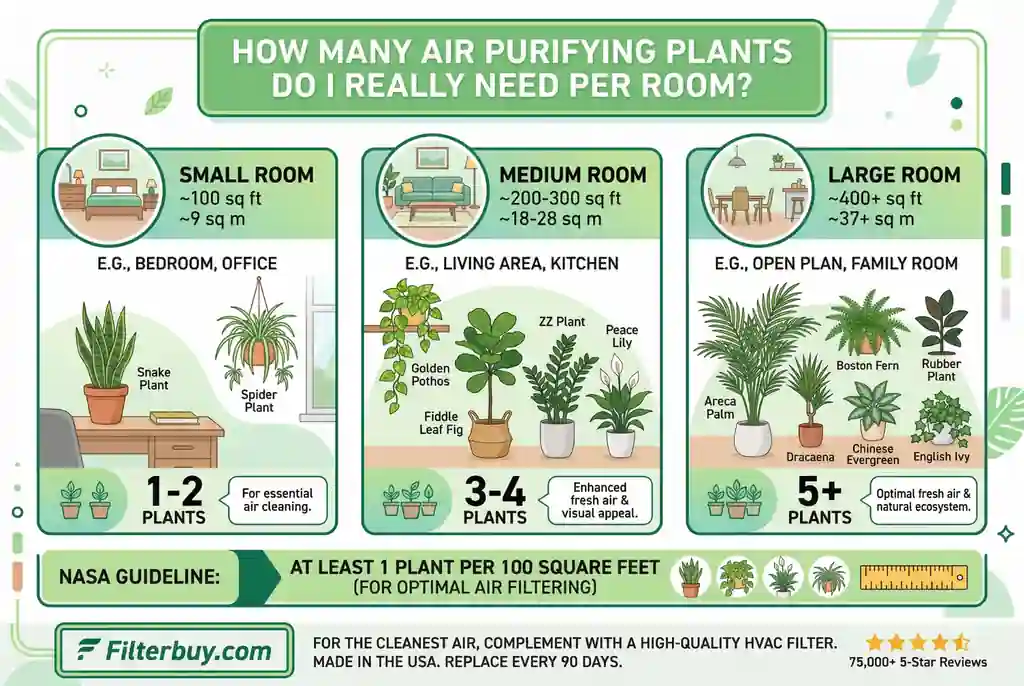
The number of plants needed to have any measurable impact on air quality depends on three variables: room size, ceiling height, and air exchange rate. Using the most commonly cited research-based estimate of one medium-to-large plant per 100 square feet as a baseline, here is what that looks like across typical rooms:
Small bedroom (100–150 sq ft): 1–2 plants
Standard bedroom (150–200 sq ft): 2 plants
Living room (300–400 sq ft): 3–4 plants
Open-concept living/kitchen (500–700 sq ft): 5–7 plants
Home office (100–150 sq ft): 1–2 plants
Keep in mind: these numbers reflect a threshold for any measurable air quality contribution. To achieve a meaningful, consistent reduction in airborne VOCs, some researchers suggest doubling or tripling those figures — which is where plants start to compete for floor space rather than improve it.
Which Plant Species Deliver the Most Benefit Per Square Foot
Not all houseplants contribute equally. In our experience helping customers think through layered air quality strategies, plant species with larger leaf surface areas and faster transpiration rates tend to perform better in real-home conditions. The following plants consistently appear in peer-reviewed research for VOC absorption:
Peace Lily (Spathiphyllum): Effective against benzene, formaldehyde, and trichloroethylene; does well in low light
Spider Plant (Chlorophytum comosum): Strong performer against carbon monoxide and formaldehyde; fast-growing and low maintenance
Pothos (Epipremnum aureum): Absorbs benzene and xylene; highly adaptable to indoor conditions
Rubber Plant (Ficus elastica): Large leaf surface area makes it one of the more efficient options per plant
Snake Plant (Sansevieria trifasciata): One of the few plants that continues to produce oxygen at night; effective against formaldehyde
For rooms where VOC exposure tends to be highest — kitchens, newly furnished rooms, and home offices with a lot of electronics — prioritizing these species over decorative-only plants gives you the most value per pot.
The Rooms Where Plants Have the Most Impact
Not every room in your home carries the same air quality risk. After a decade of manufacturing air filtration products and tracking the indoor pollutants our customers are most concerned about, we've found that certain spaces consistently generate higher concentrations of airborne contaminants.
The rooms where air purifying plants are likely to contribute most meaningfully include:
Home office: Printers, electronics, and synthetic furnishings off-gas VOCs throughout the day. A cluster of 2–3 plants near your workspace can help buffer localized exposure.
Bedroom: You spend more hours in your bedroom than any other room. Placing 1–2 plants here — particularly a Snake Plant for overnight oxygen production — supports better sleep air quality.
Kitchen: Cooking generates particulate matter, carbon monoxide, and VOCs from gas burners and cleaning products. Plants near a kitchen window can contribute to baseline VOC absorption between cooking sessions.
Newly renovated or furnished rooms: Fresh paint, new flooring, and new furniture are primary off-gassing sources. Concentrating plants in these rooms during the first several months after renovation is one of the more targeted uses of air purifying plants.
What Plants Cannot Do — and Why That Matters for Your Family
This is the part most plant guides skip. Understanding the limitations of plants is just as important as knowing their benefits, especially if someone in your home deals with allergies, asthma, or compromised respiratory health.
Plants cannot effectively address:
Particulate matter (PM2.5 and PM10): Dust, pet dander, mold spores, and pollen are not absorbed by plants. These particles require mechanical filtration to be captured.
Airborne pathogens: Bacteria and viruses are not removed by plant absorption. Mechanical filters rated MERV 13 or higher are designed specifically to capture particles in this size range.
High-concentration VOC events: Cooking smoke, cleaning product use, or a fresh coat of paint releases VOCs far faster than any realistic number of plants can absorb. Ventilation and source control are the correct responses in those moments.
Consistent, room-scale air cleaning: Plants have no mechanism to actively draw air through their leaves the way a filter pulls air through a filter media. Their effect is passive and localized.
Overestimating what plants can do is a real risk. We've worked with homeowners who replaced their HVAC filters less frequently because they believed their houseplants were "handling it." That's a gap in protection that affects the entire household.
How to Use Plants as Part of a Layered Air Quality Strategy
The most effective approach to indoor air quality is layered — and plants have a legitimate role to play in that system when positioned correctly. In our experience, the homeowners who get the best results treat plants as a supplemental tool, not a primary defense.
A practical layered strategy looks like this:
Start with filtration: A properly rated HVAC filter — MERV 8 at minimum, MERV 11 or MERV 13 for households with allergy or asthma concerns — is your first and most reliable line of defense. It actively cycles and cleans your home's air on a continuous basis.
Add ventilation: Fresh air exchange dilutes indoor pollutants faster than any passive method. Open windows when outdoor air quality permits, and run exhaust fans in kitchens and bathrooms after use.
Layer in plants: With filtration and ventilation in place, air purifying plants contribute a meaningful supplemental benefit — particularly for VOC reduction in high-exposure rooms like home offices and newly furnished spaces.
Target your plant placement: Concentrate plants where VOC sources are highest rather than distributing them evenly for aesthetic reasons.
Maintain your filter schedule: Plants do not extend the life of your HVAC filter. Replacing your filter on schedule — typically every 60–90 days depending on MERV rating and household conditions — keeps your primary air cleaning system working at full capacity.
The goal isn't to choose between plants and filtration. It's to understand what each one does well so your family is genuinely protected — not just surrounded by greenery that makes the air feel cleaner without actually making it so.
"We hear this question constantly from homeowners who are genuinely trying to do right by their families — and we respect that instinct. But after manufacturing air filtration products for over a decade and working with more than two million households, we've learned that good intentions don't always translate into real protection. Plants are a wonderful addition to any home, but we've seen firsthand what happens when families rely on them as a primary air quality solution: filters go unchanged, ventilation gets ignored, and the invisible threats — PM2.5, airborne allergens, fine particulate matter — keep circulating unchecked. A home filled with thriving plants and a clogged, overdue filter is still a home with a serious air quality problem. Our job is to make sure you know the difference between feeling like the air is clean and knowing it actually is."
Essential Resources
What Every Homeowner Should Read Before Buying Air Purifying Plants
After manufacturing air filtration products for over a decade and helping more than two million households breathe cleaner air, we've learned that the most informed homeowners are the ones who go back to the original sources — not the summaries. These seven resources are the ones we point to when customers ask us what the research actually says.
Read the Original NASA Study Before Trusting Any Summary of It
Most of what you'll find online about air purifying plants traces back to a single 1989 NASA report — but few sources quote it accurately. Reading the original gives you the full context: the sealed-chamber conditions, the specific pollutants tested, and what the researchers actually concluded versus what consumer guides have simplified it to mean. https://ntrs.nasa.gov/citations/19930072988
Understand What the EPA Says Is Actually in Your Home's Air
We always tell our customers: before you can protect your family's air, you need to understand what you're protecting against. The EPA's indoor air quality hub is the most comprehensive, government-backed starting point for identifying the pollutants circulating in your home right now — many of which are invisible and odorless. https://www.epa.gov/indoor-air-quality-iaq
Learn Why VOCs Are the Pollutant Category Plants Are Most Often Credited With Reducing
In our experience, volatile organic compounds are the most misunderstood category of indoor air pollutant — and the one most commonly referenced in air purifying plant marketing. The EPA's VOC resource explains exactly what they are, where they come from in a typical home, and the health risks they carry at the concentrations most families are actually exposed to. https://www.epa.gov/indoor-air-quality-iaq/volatile-organic-compounds-impact-indoor-air-quality
Know How Mechanical Filtration Actually Works Before Deciding What Role Plants Should Play
After more than a decade of manufacturing HVAC filters, we know that the homeowners who get the best results are the ones who understand what filtration does — and doesn't do. The EPA's consumer guide to air cleaners and HVAC filters explains MERV ratings in plain language and gives you the context to understand how passive plant-based air cleaning fits alongside mechanical filtration in a layered strategy. https://www.epa.gov/indoor-air-quality-iaq/guide-air-cleaners-home
The Study That Put the 1,000-Plants Figure Into the Scientific Record
This is the peer-reviewed research we cite when customers ask us whether plants are truly doing what the headlines claim. Published in the Journal of Exposure Science and Environmental Epidemiology, the 2019 Drexel University review analyzed 12 published chamber experiments and calculated that between 10 and 1,000 plants per square meter of floor space would be needed to match the VOC removal rate of standard outdoor-to-indoor air exchange. It is the most important piece of published research for homeowners trying to separate plant science from plant marketing. https://pubmed.ncbi.nlm.nih.gov/31695112/
Real-Building Data on Which Pollutants Plants Measurably Reduce — and Which They Don't
Unlike the controlled chamber studies most plant research is based on, this peer-reviewed study measured plant performance against specific VOCs — including benzene, toluene, formaldehyde, and xylene — inside an actual occupied building. The findings matter to us because they reflect conditions far closer to what real families live in: the plants showed statistically significant VOC reductions for most compounds tested, but had a negligible effect on indoor particulate matter. That distinction shapes how we advise customers to use plants as part of a broader air quality strategy. https://pmc.ncbi.nlm.nih.gov/articles/PMC5480428/
See How NASA Applied Its Own Research Before It Reached Consumer Audiences
Most plant guides skip this part of the story. This NASA Spinoff resource covers the BioHome experiment and the continued research of Dr. B.C. Wolverton — the primary scientist behind the original 1989 study — including the specific system designs and conditions under which plants demonstrated the most meaningful air purification benefit. Understanding what NASA actually built with those findings puts the simpler "one plant per 100 square feet" guidance in its proper context. https://spinoff.nasa.gov/Spinoff2007/ps_3.html
Supporting Statistics
The Numbers Behind Why Indoor Air Quality Deserves Your Full Attention
Most homeowners think about indoor air quality the way they think about smoke detectors — they know it matters, but rarely act until something goes wrong. After more than a decade of manufacturing air filtration products and working with millions of households, we've seen that gap play out in real homes. These are the statistics we point to when customers ask why a layered air quality strategy matters more than any single solution — plants included.
The Air Inside Your Home Is the Air Your Family Breathes Most
The U.S. Environmental Protection Agency confirms that Americans spend approximately 90 percent of their time indoors. What makes that figure striking, in our experience, is how rarely it registers with homeowners the way outdoor air quality headlines do.
Indoor pollutant concentrations are often 2 to 5 times higher than typical outdoor levels
People check the AQI before a morning run but rarely consider what's accumulating in the room where their child sleeps
The populations most susceptible to indoor pollutants — young children, older adults, and those with cardiovascular or respiratory conditions — spend even more time indoors than the average American
The families with the most to lose from poor indoor air quality are often the most exposed to it
Source: U.S. Environmental Protection Agency — Indoor Air Quality https://www.epa.gov/report-environment/indoor-air-quality
Common Household Activities Can Spike VOC Levels to 1,000 Times Outdoor Concentrations
EPA research found that roughly a dozen common organic pollutants consistently register 2 to 5 times higher inside homes than outdoors. During certain activities, that figure climbs dramatically — and it holds regardless of whether the home sits in a rural area or near an industrial corridor.
During paint stripping and similar activities, VOC levels can reach 1,000 times background outdoor concentrations
Elevated levels persist for hours after the activity ends
Off-gassing from a freshly painted bedroom, a new sofa, or a renovation project creates a VOC load no realistic number of houseplants can address in real time
Plants contribute steady, passive VOC absorption under normal household conditions — that contribution is real
The moments when VOC exposure is highest are precisely the moments plants are least equipped to respond
Ventilation and mechanical filtration are the correct tools for high-exposure events — plants are the correct tool for everything in between
Source: U.S. Environmental Protection Agency — Volatile Organic Compounds' Impact on Indoor Air Quality https://www.epa.gov/indoor-air-quality-iaq/volatile-organic-compounds-impact-indoor-air-quality
25 Million Americans Have Asthma — and Plants Cannot Address Their Most Common Indoor Triggers
CDC surveillance data puts current asthma prevalence at approximately 25 million Americans — roughly 7.7 percent of the total population. We raise this statistic in the context of air purifying plants because of a pattern we observe consistently in our customer base.
Asthma triggered 1.6 million emergency department visits in a single year
Households with asthmatic family members are often the most motivated to explore every air quality option available
They are also the most at risk of over-relying on plants in a way that leaves real gaps in their protection
The most common indoor asthma triggers — dust, pet dander, mold spores, and pollen — are all particulate matter
Plants are not designed to capture any of them
For the 25 million Americans managing asthma, the filtration layer is not optional and plants are not a substitute for it
Source: Centers for Disease Control and Prevention — Asthma Surveillance, United States https://www.cdc.gov/mmwr/volumes/70/ss/ss7005a1.htm
Peer-Reviewed Research Puts the Plant-to-Clean-Air Ratio at Up to 1,000 Plants Per Square Meter
A 2019 peer-reviewed analysis in the Journal of Exposure Science and Environmental Epidemiology reviewed 12 published chamber studies. The findings are the most important numbers in the entire air purifying plants conversation — not because they discredit plants, but because they correctly size their role.
Each plant produced a median clean air delivery rate of just 0.023 cubic meters per hour
Between 10 and 1,000 plants per square meter would be required to match standard outdoor-to-indoor air exchange
Homeowners who get the best results from plants treat them as a supplemental layer in a system that already includes mechanical filtration and adequate ventilation
Homeowners who struggle are typically the ones who skipped the foundation and went straight to the greenery
Source: National Institutes of Health / PubMed — Cummings & Waring, Journal of Exposure Science and Environmental Epidemiology (2019) https://pubmed.ncbi.nlm.nih.gov/31695112/
Final Thoughts
Our Honest Take on Air Purifying Plants After a Decade of Helping Families Breathe Cleaner Air
Here is an opinion you won't find in most plant guides: the air purifying plants conversation has done as much harm as good.
Not because plants don't work. They do — within specific, well-defined boundaries that most consumer content has spent 35 years quietly ignoring. The harm comes from the gap between what plants are marketed to do and what they actually do in a real home with real air exchange, real occupants, and real pollution sources.
After manufacturing air filtration products for over a decade and working with more than two million households, we've arrived at a perspective that is difficult to reach from the outside: the homeowners most likely to over-rely on plants are also the ones who care most deeply about their family's health. That intention deserves better information than "one plant per 100 square feet."
Here is our honest opinion, formed from years of observing real indoor air quality outcomes across millions of homes:
Plants are genuinely valuable. They provide steady, passive VOC absorption, measurable psychological benefits, and a meaningful contribution to a layered air quality strategy.
Plants are consistently oversold. The gap between laboratory chamber performance and real-home performance is not a footnote — it is the entire story. A home with open windows, foot traffic, cooking, and off-gassing furniture is not a sealed NASA test chamber.
The layering principle is non-negotiable. The families who achieve the best indoor air quality outcomes are never the ones who found one best solution. They are the ones who understood that mechanical filtration, ventilation, and supplemental tools like plants each address a different piece of the same problem.
Particulate matter is the blind spot. The entire air purifying plants category is built around VOC reduction. But for the 25 million Americans managing asthma — and for households with infants, elderly family members, or anyone with a respiratory condition — dust, dander, mold spores, and pollen are often the more immediate threat. A beautifully planted home with a neglected HVAC filter is not a protected home.
The question most homeowners should be asking isn't how many plants they need. It is whether their primary filtration layer is working correctly, whether their filter is rated appropriately for their household's specific needs, and whether plants can add meaningful supplemental value on top of that foundation. In most homes, the answer to all three is yes — but in that order.
Clean air is not a lifestyle choice. It is a form of family protection — one that requires honest, evidence-based decisions rather than aesthetically satisfying ones. Plants can be part of that protection. They just cannot be the whole of it.
You are the one who decides what the air in your home looks like. We are here to make sure you have everything you need to make that decision well.
FAQ on Air Purifying Plants
Q: Do air purifying plants actually work, or is it just a marketing myth?
A: Plants work — but not in the way most guides describe.
VOC absorption through leaves and root microorganisms is a real, documented process
A single plant produces a median clean air delivery rate of just 0.023 cubic meters per hour
Peer-reviewed research found 10 to 1,000 plants per square meter would be needed to match the VOC removal rate of simply opening a window
After working with more than two million households, our experience is consistent: plants are a legitimate supplemental layer — not a primary air cleaning system
Homes that treat plants as a primary solution are the homes with the biggest gaps in their protection
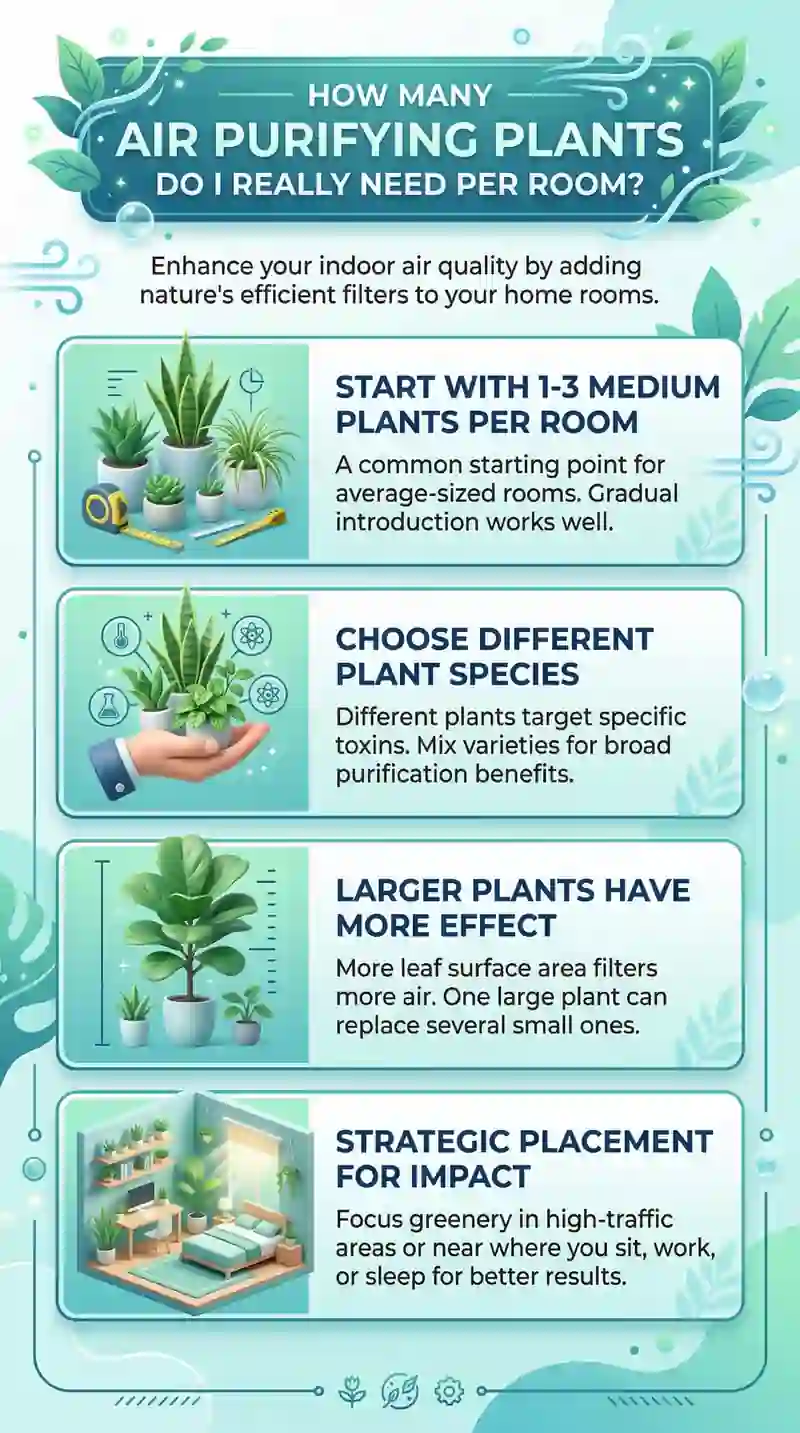
Q: How many air purifying plants do I need per room to make a difference?
A: Three variables determine the answer: room size, plant species, and the VOC sources present in the space.
The research-based baseline is one medium-to-large plant per 100 square feet. In practical terms:
Small bedroom (100–150 sq ft): 1–2 plants
Standard bedroom (150–200 sq ft): 2 plants
Living room (300–400 sq ft): 3–4 plants
Open-concept space (500–700 sq ft): 5–7 plants
These numbers represent a threshold for any measurable air quality contribution. They are not a substitute for mechanical filtration, which actively cycles your home's air on a continuous basis.
Q: Which air purifying plants are most effective for removing indoor pollutants?
A: Species with larger leaf surface areas and faster transpiration rates consistently outperform decorative varieties in published research.
The five species that appear most reliably in VOC reduction studies:
Peace Lily: Removes benzene, formaldehyde, and trichloroethylene; performs well in low light
Spider Plant: Targets carbon monoxide and formaldehyde; one of the few species safe for pets
Pothos: Absorbs benzene and xylene; adapts well to low-light conditions
Rubber Plant: Broad leaf surface area makes it one of the more efficient options per plant
Snake Plant: Produces oxygen at night; consistent performer against formaldehyde
One principle we share with customers consistently: species selection matters more than quantity in high-VOC rooms. Two well-chosen plants near an active VOC source will outperform five decorative ones placed around a room.
Q: Can air purifying plants replace my HVAC filter or air purifier?
A: No. Plants and mechanical filtration address completely different categories of indoor air pollutants.
Here is what each one does:
Plants: Absorb certain gaseous VOCs passively through leaves and root systems
HVAC filters: Physically capture particulate matter — dust, pet dander, mold spores, and pollen
Plants cannot capture particulate matter under any conditions
Why this distinction matters:
Roughly 25 million Americans manage asthma
Particulate matter is the most common trigger — not VOCs
We've seen firsthand what happens when families use plants as a filtration substitute: filters go unchanged, particles keep circulating, and the most vulnerable household members are the most affected
A properly rated HVAC filter addresses a category of risk that no number of houseplants can replace
Plants and filtration belong in the same strategy. They are not interchangeable.
Q: Where should I place air purifying plants for the best results?
A: Place plants where VOC sources are highest — not where they look best.
The four locations where targeted plant placement delivers the most measurable benefit:
Home office: Printers, electronics, and synthetic furnishings off-gas VOCs throughout the workday
Bedroom: You spend more cumulative hours here than anywhere else; Snake Plants add documented overnight oxygen production
Newly renovated or furnished rooms: Peak off-gassing occurs during the first several months after renovation or new furniture delivery
Kitchen: Cooking byproducts and cleaning product VOCs accumulate between ventilation events
Two practical rules based on our experience:
A cluster of 2 to 3 well-chosen plants near an active VOC source outperforms plants distributed evenly around a room
Placement strategy matters as much as plant count