That price tag catches most homeowners off guard. The bin people picture is something closer to the size of a restaurant container. What actually shows up is twelve feet long, eight feet wide, and big enough to hold three pickup-truck loads.
This guide walks through the size taxonomy, real cost ranges, the fees haulers don't always volunteer up front, and the cases where a small dumpster isn't actually the right call, especially when homeowners are asking how much does it cost to rent a small dumpster before booking. We've covered residential cleanouts on this site for years. The dumpster decision is the one where homeowners overspend most often.
TL;DR Quick Answers
How much does it cost to rent a small dumpster?
A small residential dumpster costs $200 to $500 for a 7-day rental, with the national average around $350 for the most common size: a 10-yard roll-off. Mini dumpsters at 2 to 6 yards, available in dense urban markets, run $100 to $300.
The base price typically covers drop-off, pickup, a 1- to 2-ton weight allowance, and a rental window of 3 to 10 days. The variables that move the final number most:
Region: Northeast and West Coast quotes run 30 to 50% higher than Midwest and South.
Season: Spring and early fall are peak. Winter rates run 10 to 20% lower.
Weight allowance: Overage costs $40 to $100 per ton, the single biggest source of surprise charges.
Permit: Street placement requires a $10 to $200 municipal permit in most cities. Driveway placement does not.
Get three quotes before booking. Same-city pricing routinely varies 30 to 50% between haulers. When in doubt, size up one tier. Overage tonnage and second pickups cost more than the larger dumpster would have.
Top Takeaways
The smallest residential dumpster available in most U.S. markets is a 10-yard roll-off. Some metros offer 2- to 6-yard mini dumpsters.
A 10-yard residential dumpster typically costs $200 to $500 for a 7-day rental, with the national average near $350.
Hidden fees, including tonnage overage, daily overage, prohibited material penalties, and street permits, are where most surprise costs come from.
Furniture is the bulkiest load by volume in residential dumpsters. Removing it is also one of the more underrated indoor air interventions available to homeowners.
Hazardous chemicals, tires, batteries, and refrigerated appliances can never go in a residential dumpster. Use Earth911 or your local HHW program instead.
Get three quotes. Same-city pricing routinely varies 30 to 50%.
For loads under 3 cubic yards, junk removal services or a Bagster may be cheaper. For any multi-day project, a roll-off wins on cost-per-yard.
How small can a residential dumpster actually go?
Haulers size dumpsters in cubic yards. The residential range starts smaller than most people realize, but availability and convention diverge sharply. Mini dumpsters at 2 to 6 yards are popular in dense city markets. Outside those areas, your local hauler will likely start at the 10-yard roll-off.
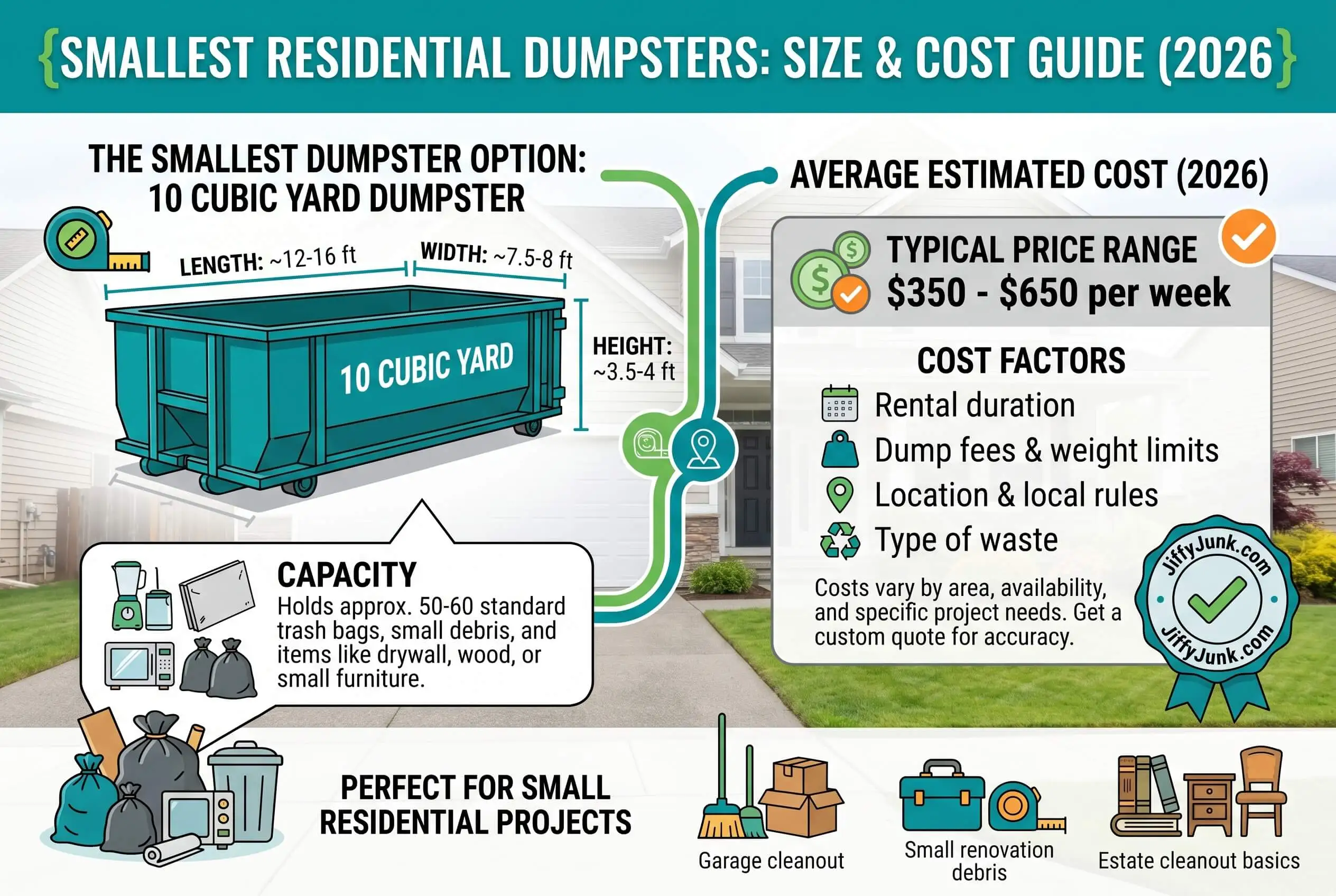
2-yard mini: 6' × 3' × 3', holds about 10 trash bags. Best for closet purges and small yard projects.
3–4 yard mini: 8' × 4' × 3', holds about 30 trash bags. Best for apartment cleanouts and small bath demos.
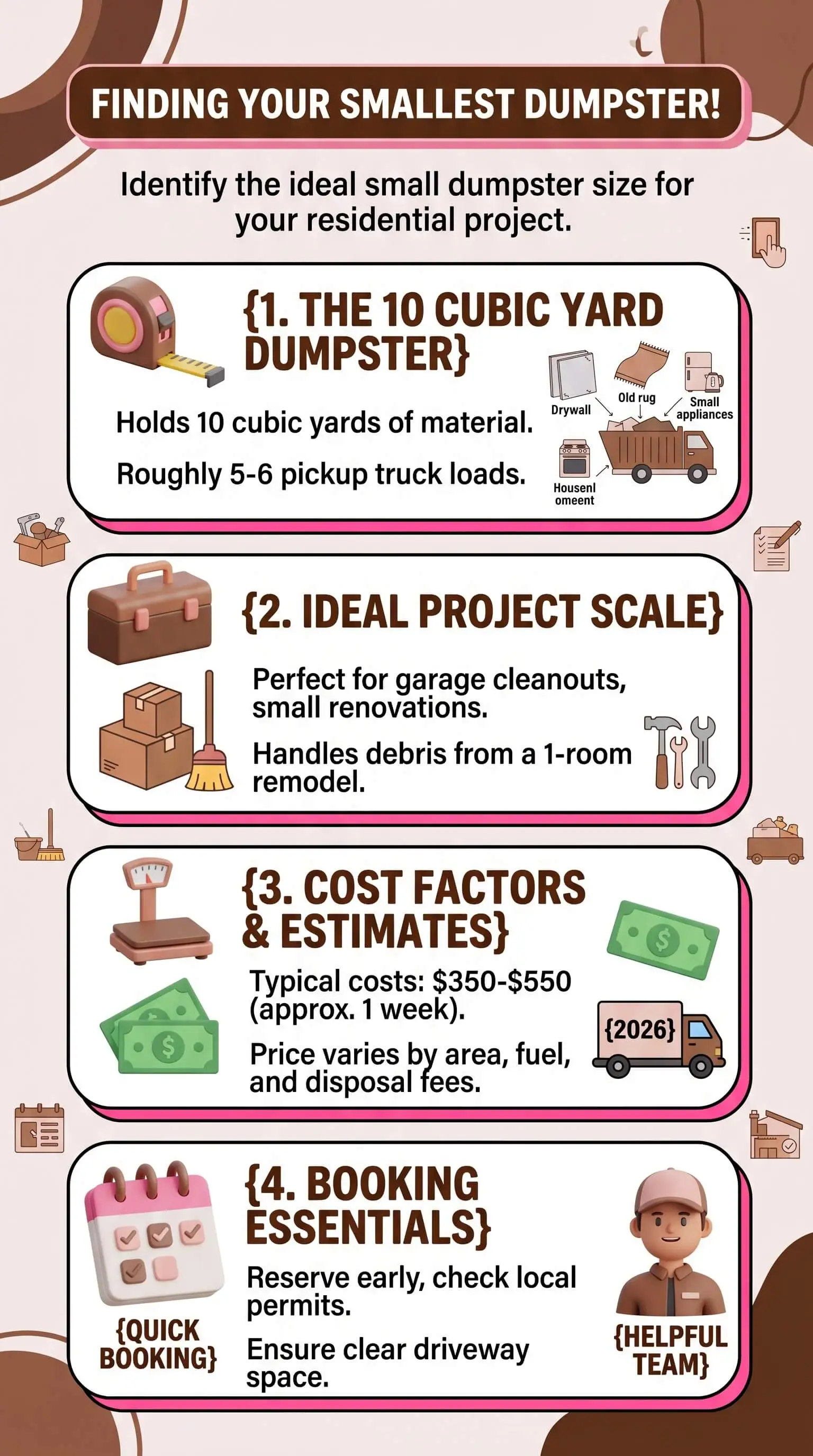
10-yard roll-off: 12' × 8' × 3.5', holds about 3 pickup loads. Best for garage cleanouts and single-room remodels.
15-yard roll-off: 16' × 8' × 4', holds about 4.5 pickup loads. Best for basements and two-car garages.
The 10-yard is the workhorse. It fits a standard driveway, accommodates a real cleanout, and sits at the bottom of the price ladder. For most residential projects, it's also the right size regardless of market.
How much does it cost to rent a small dumpster?
National pricing breaks into a few bands:
2-yard mini: $100 to $200 per rental
3–6 yard mini: $150 to $300 per rental
10-yard roll-off: $200 to $500 for a 7-day rental, with a national average around $350
15-yard roll-off: $300 to $600 for a 7-day rental
Geography moves these numbers more than most people expect. A 10-yard rental in suburban Texas often quotes at $250. The same bin in coastal California or the Northeast can come back at $475. Time of year also matters. Spring and early fall are peak cleanout seasons, and prices climb 10 to 20% above winter rates in most regions.
For a more granular look at how rental period, weight class, and hauler type affect the final number, this small and roll-off dumpster rental prices breakdown from Jiffy Junk is the cleanest reference we've found.
What the base price covers, and where the surprises hide
A standard quote includes drop-off, pickup, a fixed weight allowance (usually 1 to 2 tons), and a rental window of 3 to 10 days. The fees that catch homeowners are the line items haulers don't always volunteer:
Tonnage overage: $40 to $100 for every ton over your weight cap
Daily overage: $5 to $15 for each day past your rental window
Prohibited material penalty: $50 to several hundred dollars per infraction
Street permit: $10 to $200 from your municipality if the bin sits on public roadway
Trip charge: if the truck shows up and can't drop or retrieve the bin, you still pay
Tonnage overage is the most frequent surprise. A garage full of old roofing shingles or concrete will blow through a 1-ton cap before the dumpster looks half-full.
What can, and can't, go in a residential dumpster?
The bulkiest residential loads are almost always pieces of furniture. Sofas, mattresses, dressers, and dining sets eat volume fast. We've seen a single sectional and a queen bedroom set fill nearly half a 10-yard on its own. Plan accordingly.
✅ Allowed:
Household junk and clutter
Furniture (most haulers)
Non-hazardous renovation debris
Yard waste (varies by hauler)
Appliances without refrigerant
Carpet, flooring, drywall
❌ Prohibited:
Liquid paint and solvents
Tires
Lead-acid batteries
Refrigerators with Freon
Hazardous chemicals
Electronics (varies by state)
The prohibited list isn't arbitrary. Those items either contaminate landfills or require specialized handling. There's another angle here that matters specifically for this site: a lot of what readers would call indoor air offenders are exactly the things a residential dumpster will take. Water-damaged carpet, old upholstered furniture saturated with dust mites, mold-affected drywall. Getting them out is one of the more direct moves you can make in your home environment.
Sizing the dumpster correctly the first time
Five steps that beat guesswork:
Estimate volume in pickup-truck loads. One full pickup is roughly 2 to 3 cubic yards.
Add a 25% buffer. Almost everyone underestimates.
Weight matters separately from volume. Concrete, dirt, and shingles will hit your tonnage cap before they hit the fill line.
Confirm driveway access. A 10-yard delivery truck needs about 60 feet of straight clearance and 23 feet vertical.
Match weight allowance to load type. Demo debris needs a higher weight tier. Household clutter usually doesn't.
When a small dumpster isn't the right answer
A few alternatives worth running the numbers on before you book:
Full-service junk removal ($75–$125 starting, scaling with volume) is often cheaper for loads under 3 cubic yards because the crew loads it for you and you don't pay for unused capacity.
WM Bagster ($150–$350 all-in) is a 3-yard bag you buy at a hardware store, fill, and have hauled. Reasonable for small, light loads. Bad fit for anything heavy or multi-day.
Municipal bulk pickup is free in many cities. The constraint is what they'll accept and when they'll pick up.
For multi-day projects generating more than 3 cubic yards of debris, a small dumpster wins on cost-per-yard against all of these.
"Homeowners almost always ask the wrong first question. They lead with 'what's the cheapest option?' when the better question is 'what's my actual debris stream?' I've watched people save $50 by booking a 6-yard mini and then spend $200 in overage and a second pickup because they didn't realize an old sectional plus a king mattress is already over half their cubic yards. Our rule has stayed the same for years: estimate the load honestly, add a buffer, and pay attention to weight separately from volume. The other thing I'd add, and this is something we see repeatedly on residential cleanouts, is that the items people most want gone are usually the ones doing the most damage to their indoor environment: old carpet padding, water-damaged plywood, upholstery that hasn't been cleaned in fifteen years. The dumpster matters less than what it lets you remove."
7 Essential Resources
The references we lean on most when answering homeowner questions about disposal and residential cleanouts:
EPA Construction and Demolition Debris: Material-Specific Data. Federal data on what people throw out during renovation and demolition. Useful sanity check before you scope a remodel.
EPA Durable Goods (Furniture & Furnishings) Data. The agency's tracking of furniture, mattress, and appliance disposal volumes. Read this before deciding whether to dumpster, donate, or recycle bulky items.
EPA National Overview: Facts and Figures on Materials, Wastes and Recycling. National waste statistics most homeowners never see. Helpful context for why local landfill tipping fees keep climbing.
EPA Household Hazardous Waste (HHW). The official guide to what can't go in your dumpster: paints, pesticides, batteries, solvents. Required reading before you start loading.
Earth911 Recycling Center Search. A searchable database of local drop-offs by material and zip code. Indispensable for routing prohibited items out of your dumpster load and into the right disposal channel.
WM Bagster — Dumpster in a Bag. Waste Management's bag-style alternative to a roll-off, sized at 3 cubic yards. Reasonable for small projects, but compare cost-per-yard before defaulting to it.
Jiffy Junk Dumpster Rental Cost Guide. A detailed pricing breakdown across small and roll-off sizes, including the variables that move quotes by hundreds of dollars.
3 Statistics
Three numbers that should change how you approach a residential cleanout.
Americans threw out 12.1 million tons of furniture and furnishings in 2018, sending about 80% of it straight to landfills. Furniture is the bulkiest residential dumpster load by volume, and it's the lowest-recovery category in the entire municipal solid waste stream. Source: EPA Durable Goods Data.
The U.S. generated roughly 600 million tons of construction and demolition debris in 2018, more than double the volume of municipal solid waste. This is what fills small residential dumpsters during remodels. It's also why most cities now require permits for street-placed bins. Source: EPA Construction and Demolition Debris Data.
Total U.S. municipal solid waste hit 292.4 million tons in 2018, or about 4.9 pounds per person, per day. Roughly half ends up in landfills. That's the structural reason disposal costs, and therefore dumpster rental prices, have climbed steadily over the past decade. Source: EPA National Overview.
Final Thoughts and Opinion
The smallest residential dumpster you can actually book in most U.S. markets is a 10-yard roll-off. The right price for that bin in 2026 falls between $200 and $500 depending on where you live. If a quote comes back well above that, get a second one. If it comes back well below, ask hard questions about the included weight allowance before you sign.
Pricing in this category is unusually inconsistent. We've seen three quotes for the same 10-yard dumpster in the same city vary by 30 to 50%. Don't book on the first call. Ask about included tonnage, prohibited materials, and rental window. Those variables decide your real cost more than the headline number does.
The best dumpster decision is the one matched to your actual debris stream rather than your gut estimate. Going one size up almost always costs less than going one size too small, because overage tonnage and second-pickup fees compound fast.
Beyond the cost math, there's a quieter benefit worth naming. Residential cleanouts reliably improve the home environment. Old upholstery, water-damaged carpet, sealed-off basement junk: these aren't just clutter. They're meaningful contributors to the indoor air problems we cover frequently on this site. The dumpster is the unglamorous tool that makes the cleanup logistically possible.
Frequently Asked Questions
What is the smallest residential dumpster you can rent? The smallest residential dumpster available in most U.S. markets is a 10-yard roll-off. Some urban metros, including New York, Boston, San Francisco, and Chicago, offer 2-yard, 4-yard, or 6-yard mini dumpsters from local haulers. Those sizes aren't universally available.
How much does it cost to rent a small dumpster for a week? A 10-yard residential dumpster typically costs $200 to $500 for a standard 7-day rental, with the national average near $350. Mini dumpsters in the 2- to 4-yard range run $100 to $300 where they're available.
How many cubic yards do I need for a garage cleanout? A single-car garage cleanout typically fits in a 10-yard dumpster. Two-car garages, basement-plus-garage projects, and full estate cleanouts usually call for a 15- or 20-yard.
Can I throw a couch or mattress in a small dumpster? Most haulers accept household furniture, including couches, dressers, and dining sets. Some haulers charge a separate disposal fee for mattresses, and others prohibit them entirely. Confirm with your specific hauler before loading.
Do I need a permit to put a dumpster in my driveway? Driveway placement on private property generally doesn't require a permit. Street placement does, in most cities, and the fee usually runs $10 to $200 depending on the locality.
Is junk removal cheaper than a small dumpster? For loads under 3 cubic yards, full-service junk removal is often cheaper because you don't pay for unused capacity. For multi-day projects generating more than 3 yards of debris, a small dumpster wins on cost-per-yard.
Will a 10-yard dumpster handle a single-bathroom remodel? Yes. A typical single-bathroom remodel generates 3 to 5 cubic yards of debris. That fits a 10-yard with weight margin to spare for fixtures and tile.
Call to Action
The dumpster decision is one of the higher-leverage calls you'll make on a residential cleanout project. The biggest savers we've found, in order: three quotes minimum, a careful read of the weight allowance, and confirmation of prohibited items before you start loading.
For the deepest look we've found at what drives small and roll-off dumpster pricing nationally, the Jiffy Junk dumpster rental cost guide is worth a read before you commit.
Have a question we haven't covered? Leave it in the comments. We update this guide based on what readers ask us.