The harder question — and the one that usually decides whether the rental was worth it — is what actually fits inside, what doesn't, and where the weight limits trip people up. We've spent a lot of time helping homeowners think through these kinds of decisions, and the same handful of mistakes show up over and over. Below, we walk through everything you need to know before you book.
TL;DR Quick Answers
30 yard dumpster size
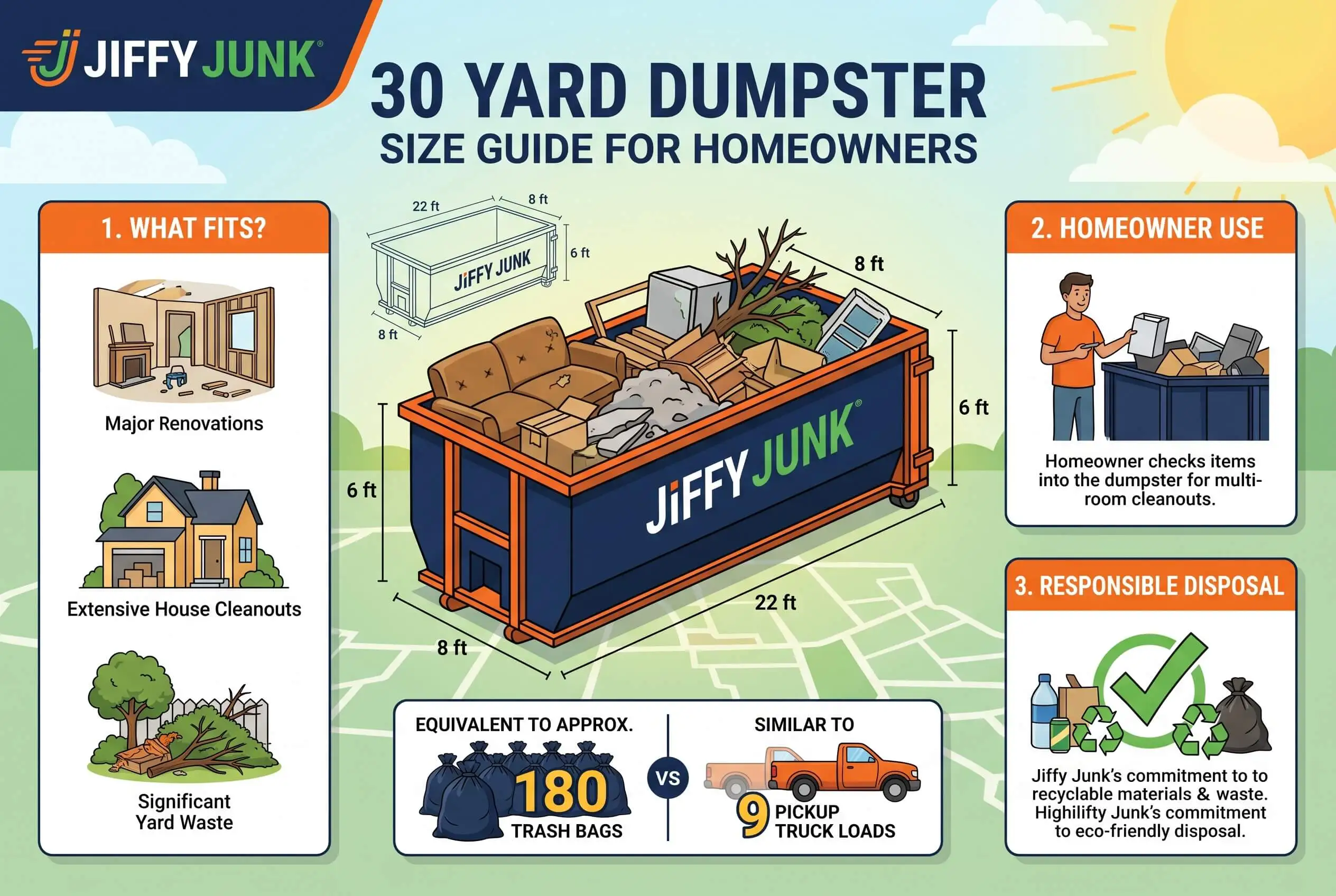
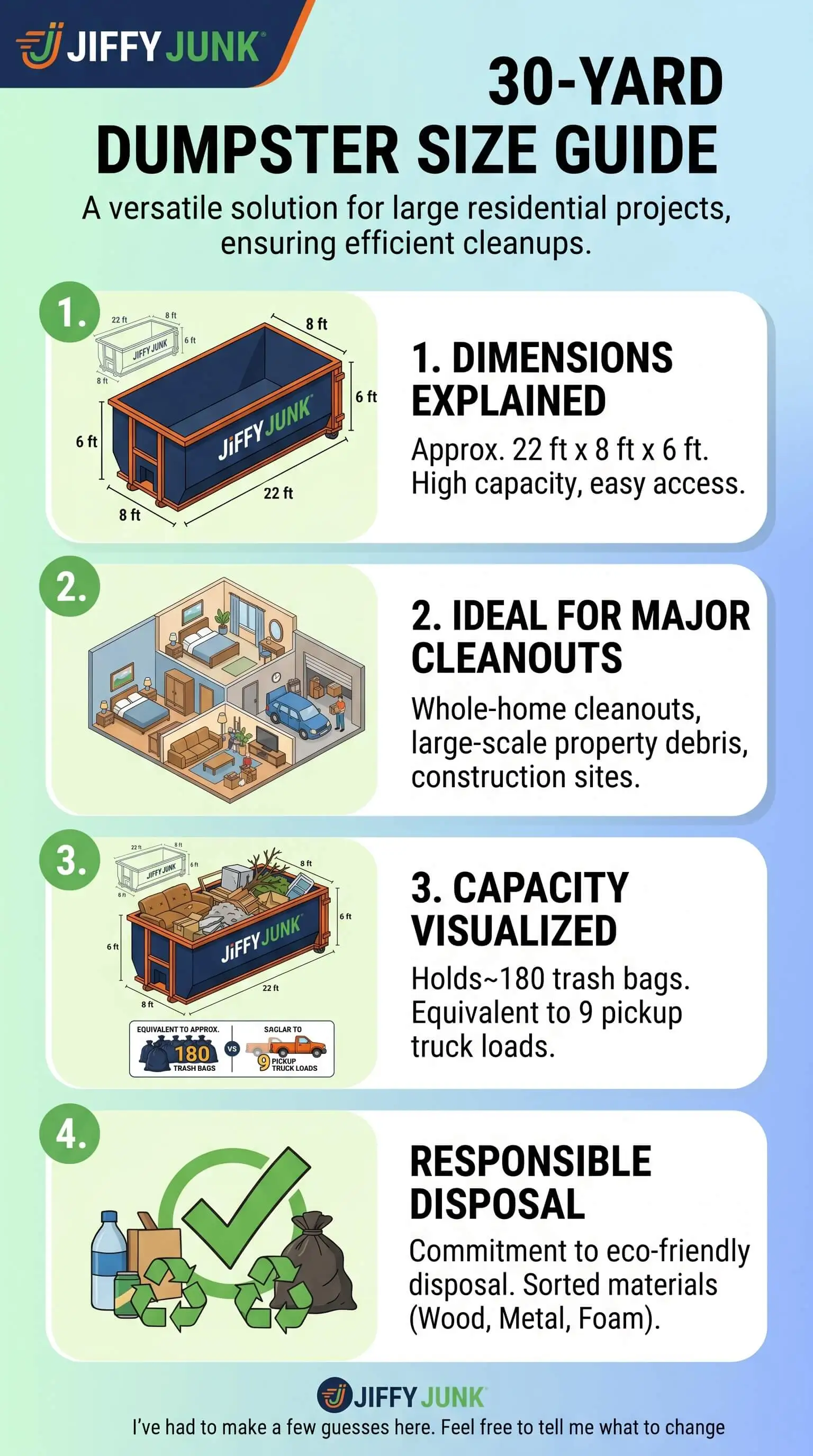
A 30 yard dumpster measures roughly 22 feet long, 8 feet wide, and 6 feet tall, holding 30 cubic yards of debris — about 9 pickup truck loads or 170 to 190 standard 13-gallon trash bags. Most rentals carry a 4-to-6 ton weight limit and run $450 to $700 for a 7-day window.
It's the size most homeowners reach for when one project mixes everything at once: furniture, appliances, drywall, and yard debris in a single haul. Best fit for whole-house cleanouts, gut renovations of a kitchen plus bath, roof replacements up to about 3,500 square feet, or a combined garage-basement-attic clear-out.
Dimensions: 22 ft × 8 ft × 6 ft
Capacity: 30 cubic yards (~9 pickup truck loads)
Weight limit: 4–6 tons (8,000–12,000 lbs)
Typical rental cost: $450–$700 for a 7-day rental
Clearance needed: ~25 ft of straight access for delivery
One detail most homeowners miss: weight, not volume, is what trips up the bill. Concrete, brick, and roofing shingles can max out the tonnage allowance while the container still looks half-empty. Confirm the per-ton overage rate before you book, not after.
Top Takeaways
If you only remember five things from this guide:
Know your dimensions. A 30 yard dumpster is roughly 22 ft × 8 ft × 6 ft and needs at least 25 feet of clearance to deliver.
Weight matters more than volume. Most rentals allow 4–6 tons. Concrete, shingles, and brick can max out the limit while the container still looks half-empty.
When in doubt, size up. The price difference between a 20 and a 30 yard is almost always smaller than the cost of a second pickup haul.
Donate before you dump. Habitat ReStores and local charities take usable furniture, appliances, and building materials — often with free pickup.
Get the all-in price. Base quotes often exclude weight overages, extension fees, and prohibited-item charges. Ask for total cost upfront — no surprises.
What Are the Exact Dimensions of a 30 Yard Dumpster?
A standard 30 yard dumpster runs about 22 feet long, 8 feet wide, and 6 feet tall. Dimensions vary by a foot or so between providers, but most containers fall within that range. The 30 yard dumpster size is essentially a long, deep roll-off container designed to be dropped onto a flat surface and rolled back onto a truck for pickup.
Before delivery, the rental company needs about 25 feet of straight-shot clearance and roughly 10 feet of width to maneuver. We tell homeowners to walk their driveway twice before booking — once at ground level and once looking up. Tree branches, low power lines, and second-story eaves are the obstacles drivers run into most often.
One detail worth knowing: at 6 feet tall, the sidewalls are tall enough that you'll be lifting and tossing items up and over once the container fills past the back gate. Most 30 yard models include a swing-open back gate that lets you walk things in early on, but that gets harder as the container fills.
How Much Can a 30 Yard Dumpster Actually Hold?
Thirty cubic yards translates to about 9 full pickup truck loads, or roughly 170 to 190 standard 13-gallon kitchen trash bags. But cubic capacity only tells half the story. What you can practically fit depends a lot on what you're loading.
Bulky, irregular items — couches, dressers, mattresses, large appliances — eat up volume fast because of all the air pockets between them. Dense materials like concrete, roofing shingles, or soil hit weight limits long before they fill the box.
In our experience helping readers think through cleanouts, here's what a 30 yard dumpster typically handles:
Pickup truck loads: approximately 9 full beds
13-gallon kitchen trash bags: 170 to 190 bags
Whole-home cleanout: contents of a 3,000 to 5,000 sq ft home
Roof replacement: shingles from up to roughly 3,500 sq ft of roof
Bedroom sets: 8 to 12 full bedroom sets of furniture
Best Home Projects for a 30 Yard Dumpster
Not every job needs this size, but the ones below almost always do.
Whole-House Cleanouts and Estate Cleanouts
Move-outs, downsizing, and estate cleanouts of inherited properties are the most common reason homeowners reach for a 30 yard dumpster. You get enough room to clear furniture, appliances, boxes, and the contents of every room without scheduling a second pickup.
Major Kitchen and Bathroom Renovations
Gut renovations of multiple rooms generate mixed debris — drywall, flooring, cabinetry, fixtures, tile. A 30 yard handles the variety well. The one caveat is heavy material like solid concrete countertops, which can push you up against weight limits faster than you'd expect.
Roof Replacements Up to 3,500 Square Feet
Asphalt shingles are dense, so on roofing jobs you'll usually hit weight limits before you fill the container. Talk to your provider about tonnage allowances specific to roofing debris — some companies offer dedicated heavy-debris dumpsters that can be more cost-effective for shingles.
Garage, Basement, and Attic Cleanouts (combined)
This is the classic homeowner use case — clearing out years of accumulated stuff in one big push. A 30 yard gives you room to be ruthless about what stays and what goes.
Large Landscaping Overhauls
Fence removal, deck demolition, and substantial yard waste fit well in a 30 yard, but heavy materials like soil, sod, and stone often need to be handled separately. Confirm with your rental company before you load.
Weight Limits — The Detail Most Homeowners Miss
Most 30 yard dumpsters carry a weight allowance of 4 to 6 tons (8,000 to 12,000 pounds), depending on the provider and the disposal facility they use. We've found this is the single most overlooked detail in dumpster rentals. A container can look half-empty and already be over its weight limit.
Here's a rough guide to what common materials weigh per cubic yard:
Household furniture and general items: 150 to 300 lbs per cubic yard
Mixed construction debris: 300 to 500 lbs per cubic yard
Roofing shingles: 750 to 1,000 lbs per cubic yard
Concrete and masonry: 2,000+ lbs per cubic yard
A practical tip: if you're mixing heavy and light materials, load the heavy stuff at the bottom and toward the gate end. This keeps the load balanced for transport and helps you visualize when you're approaching weight rather than volume limits.
Rental Cost & What to Ask Before You Book
Nationally, a 30 yard dumpster rental runs roughly $450 to $700 for a 7-day rental window. The number that actually matters, though, is the all-in cost — and the advertised price almost never tells the whole story.
Here's what typically drives your final bill:
Base rental fee — covers delivery, pickup, and the standard rental window (usually 7 to 14 days). Urban areas with higher landfill fees price at the upper end of the range.
Weight allowance — most rentals include 2 to 4 tons of disposal weight. Going over runs $40 to $75 per additional ton.
Rental extensions — $10 to $25 per extra day if you need to keep the container longer than your rental window.
Prohibited-item fees — tossing in something that shouldn't be there (electronics, refrigerants, paint) can trigger separate disposal charges or refuse pickup.
Before you book, ask any rental company five questions: how long is the rental window, what's the included weight allowance, what's the per-ton overage rate, what's prohibited, and what's the total all-in price including delivery, pickup, and disposal.
For a deeper breakdown of pricing factors, weight allowance trade-offs, and what's typically included in roll off dumpster rentals nationally, we recommend Jiffy Junk's full breakdown of 30-yard dumpster dimensions and rental costs — they walk through real-world cost ranges and the operational details most rental sites skip.
30 Yard vs. 20 Yard vs. 40 Yard — Which Size Do You Actually Need?
If you're debating between sizes, this comparison is the easiest way to think about it:
10 yard ($250 to $400, 7-day rental): single-room cleanout, small bath remodel
20 yard ($350 to $550, 7-day rental): single-room renovation, medium cleanout, smaller roof
30 yard ($450 to $700, 7-day rental): whole-house cleanout, major renovation, large roof
40 yard ($550 to $850, 7-day rental): full demolition, commercial cleanout
Our honest take: when the price gap between sizes is modest, size up. A second pickup haul almost always costs more than the upgrade, and running out of room mid-project creates a headache no homeowner wants in the middle of a renovation.
What You Can't Put in a 30 Yard Dumpster
Most cleanout and renovation materials go in without issue — furniture, appliances, construction debris, roofing materials, and yard waste. The list of what's not allowed is actually pretty short, but it's the source of most surprise fees on pickup day:
Hazardous waste — paints, solvents, pesticides, chemicals
Flammable liquids and propane tanks
Batteries — both lead-acid (car batteries) and lithium-ion
Tires
Refrigerators, freezers, and AC units containing refrigerants (federal law requires EPA-compliant handling before disposal)
Electronics — restrictions vary by state and county
If you have any of these items in the cleanout, mention them when you book. Most rental companies can either point you to the right disposal channel or, in some cases, arrange for separate pickup.
"The biggest mistake we see homeowners make isn't picking the wrong size — it's underestimating how fast weight adds up. People look at a half-empty 30 yard dumpster full of shingles or concrete and assume they have plenty of room left. They don't. The container is already at its limit. Spend five minutes asking your rental company about tonnage before you book, not after, and you'll save yourself the surprise overage fee almost every time."
7 Essential Resources
Before you start loading, these resources will help you understand what's accepted at disposal facilities, find recycling options for items that don't belong in a dumpster, and stay on the right side of federal and local regulations. We point readers to these same references whenever cleanout questions come up.
1. EPA — Sustainable Management of Construction & Demolition Materials
The Environmental Protection Agency's clearinghouse for what counts as construction and demolition (C&D) debris, what's typically accepted at disposal facilities, and which materials require special handling. We recommend reviewing this before any renovation project that involves demolition.
Helpful for: Renovation projects, demolition debris, construction materials
Source: U.S. Environmental Protection Agency
Link: https://www.epa.gov/smm/sustainable-management-construction-and-demolition-materials
2. EPA Section 608 — Appliance Disposal Requirements
Refrigerators, freezers, dehumidifiers, and AC units contain refrigerants that federal law requires be professionally recovered before disposal. This is the official EPA guidance on what's required and why. If you're cleaning out a property with old appliances, read this first.
Helpful for: Refrigerators, freezers, window AC units, dehumidifiers, refrigerant-containing appliances
Source: U.S. Environmental Protection Agency
Link: https://www.epa.gov/section608/disposing-appliances-containing-refrigerants
3. EPA — Learn the Basics of Hazardous Waste
Paints, solvents, automotive fluids, batteries, fluorescent lighting, and a handful of household chemicals are classified as hazardous waste and can't go in a standard dumpster. The EPA's primer covers what qualifies, why it matters, and how to find compliant disposal options near you.
Helpful for: Paints, solvents, chemicals, batteries, fluorescent bulbs
Source: U.S. Environmental Protection Agency
Link: https://www.epa.gov/hw/learn-basics-hazardous-waste
4. Earth911 Recycling Locator
A searchable database of more than 100,000 recycling locations across North America. Enter your zip code and material type, and Earth911 returns the closest options for items that fall outside what your dumpster will accept — electronics, scrap metal, tires, specialty building materials.
Helpful for: Electronics, scrap metal, tires, specialty disposal items
Source: Earth911
Link: https://search.earth911.com/
5. Habitat for Humanity ReStore
Habitat ReStores accept gently used furniture, working appliances, cabinets, doors, fixtures, and building materials in good condition — and most locations offer free donation pickup. Donating before you dump can shrink the size of the dumpster you need or keep you under your weight allowance.
Helpful for: Furniture, working appliances, cabinets, doors, light fixtures, building materials
Source: Habitat for Humanity
Link: https://www.habitat.org/restores/donate-goods
6. SWANA — Solid Waste Association of North America
The professional industry association for waste management. SWANA publishes technical resources on recycling programs, sustainable disposal practices, and waste reduction strategies that go deeper than what most consumer-facing sites cover. Especially useful if you're managing a commercial property or large-scale project.
Helpful for: Commercial cleanouts, large-scale property clearings, contractors
Source: Solid Waste Association of North America
Link: https://swana.org/resources
7. CDRA — Construction & Demolition Recycling Association
Industry resources focused specifically on the recycling and recovery of construction and demolition materials. CDRA's directory and technical guides are useful for finding C&D-specific recyclers in your area, particularly if your project generates concrete, asphalt, or salvageable building materials in volume.
Helpful for: Concrete, asphalt, salvageable lumber, large-volume C&D recycling
Source: Construction & Demolition Recycling Association
Link: https://cdrecycling.org/
3 Statistics
Federal data confirms what every homeowner figures out the first time they tackle a major cleanout: we generate a lot of material. These three statistics from the EPA help explain why a 30 yard dumpster is the workhorse size for residential and small commercial projects.
1. 600 Million Tons of Construction & Demolition Debris Generated Annually
The EPA estimates that 600 million tons of construction and demolition (C&D) debris were generated in the United States in 2018 — more than twice the amount of regular municipal solid waste produced that same year. Demolition accounts for roughly 90 percent of that total; new construction generates less than 10 percent.
What this means for a homeowner: gut renovations and major teardowns produce more material than most people expect. The drywall, cabinetry, flooring, and fixtures that come out of a kitchen-and-bath remodel can fill a 30 yard dumpster faster than you'd predict — which is one of the main reasons we recommend sizing up when the project involves whole-room demolition.
Source: U.S. Environmental Protection Agency — Construction & Demolition Debris Material-Specific Data
2. 12.1 Million Tons of Furniture Discarded Each Year
Americans generated 12.1 million tons of furniture and furnishings waste in 2018, according to the EPA — about 4.1 percent of total municipal solid waste. Wood is the largest material component by weight, followed by ferrous metals and textiles.
What this looks like in a single home: estate cleanouts, downsizing moves, and full-house turnovers routinely fill 30 yard dumpsters with sofas, dressers, dining sets, mattresses, bed frames, and old materials that may affect comfort or improve air quality once removed. A meaningful portion of those items are still in usable condition, which is why we always suggest checking with a Habitat ReStore or local donation center before scheduling pickup. Donating reduces volume, can shrink the dumpster size you need, and keeps usable items out of landfills.
Source: U.S. Environmental Protection Agency — Durable Goods: Product-Specific Data
3. Major Appliances Reach End-of-Life at 5.3 Million Tons Annually
The EPA reports that 5.3 million tons of major appliances reached end-of-life in 2018, with approximately 3.1 million tons recycled — a recycling rate of roughly 58 percent. Refrigerators, freezers, and air conditioning units contain refrigerants that federal law requires be professionally recovered before disposal.
Why this matters for your dumpster project: appliances containing refrigerants can't go in a standard 30 yard dumpster. Improperly disposing of them can carry fines for the property owner. If your cleanout includes a refrigerator, freezer, dehumidifier, or window AC unit, line up EPA-compliant pickup separately — most full-service junk haulers and many municipalities offer this.
Source: U.S. Environmental Protection Agency — Durable Goods: Product-Specific Data
Final Thoughts and Opinion
Our Honest Take on the 30 Yard Dumpster
After helping homeowners think through hundreds of cleanout and renovation questions, we've come to a clear opinion on the 30 yard dumpster: it's the right size more often than people realize, and the wrong size more often than rental companies will tell you.
Where it shines is the project that mixes everything — furniture, appliances, drywall, fixtures, yard debris — in one big push. Whole-house cleanouts, gut renovations of multiple rooms, and roof replacements up to about 3,500 square feet are the sweet spot. You get enough volume to work without stress, and the price gap versus a 20 yard is usually small enough that the upgrade pays for itself the first time you avoid a second pickup.
Where it's overkill is the smaller project — a single-room remodel, a guest-bedroom cleanout, a partial garage purge. We see homeowners default to a 30 yard out of caution, and a 10 or 20 yard would have done the job for hundreds less. If you're not sure, walk through the rooms involved, picture what's coming out, and be honest about it. A second pickup haul on a 20 yard is still cheaper than a 30 yard you only half-fill.
Where We Think Most Renters Get Tripped Up
Weight, not volume, is the limit that matters most. Heavy materials like concrete and shingles can max out a container that looks half-empty. Ask about tonnage before you book.
The lowest quote isn't usually the lowest bill. Always ask for the all-in price including delivery, pickup, weight allowance, and overage rates. Surprise charges almost always come from the line items not in the headline number.
Donating beats dumping for usable items. Habitat ReStores and local charities will often pick up free of charge. The 30 minutes you spend separating the donatable stuff from the trash routinely saves homeowners more than it costs.
Refrigerant-containing appliances need separate handling. Refrigerators, freezers, and AC units don't go in a standard dumpster — and improper disposal can mean fines.
Frequently Asked Questions
How big is a 30 yard dumpster compared to a pickup truck?
A 30 yard dumpster holds the equivalent of about 9 full pickup truck loads of debris. Physically, it measures roughly 22 feet long, 8 feet wide, and 6 feet tall — about the length of a midsize SUV and a half parked end-to-end.
How much weight can a 30 yard dumpster hold?
Most 30 yard dumpsters allow 4 to 6 tons (8,000 to 12,000 pounds), though limits vary by provider and local landfill rules. Heavy materials like concrete, brick, and roofing shingles can hit that limit long before the container looks full, so always confirm the tonnage allowance before you book.
Is a 30 yard dumpster too big for a single-room remodel?
Usually, yes. A 10 or 20 yard size is generally a better fit for single-room projects unless heavy demolition is involved. We recommend the 30 yard for whole-house cleanouts, gut renovations of multiple rooms, large roof replacements, or estate cleanouts.
How long can I keep a 30 yard dumpster?
Standard rental periods run 7 to 14 days. If you need more time, daily extension fees typically run $10 to $25 per additional day. Confirm both the standard window and the extension rate when you book.
What can't I put in a 30 yard dumpster?
Hazardous waste (paints, solvents, chemicals), flammable liquids, batteries, tires, refrigerant-containing appliances (refrigerators, freezers, AC units), and certain electronics. These items typically require separate disposal — most full-service junk haulers can handle them, or you can find compliant local options through the Earth911 recycling locator.
Do I need a permit to put a 30 yard dumpster in my driveway?
If the dumpster sits entirely on your private driveway, usually no. If any part of it sits on a public street, sidewalk, or right-of-way, most municipalities require a temporary right-of-way permit. Check with your city or county before placement.
Ready to Book a 30 Yard Dumpster?
Once you've sized up the project, the rest comes down to picking a rental company that will give you a straight all-in price and a weight allowance that matches what you're actually loading.
Before you call, take 30 minutes to walk through the project: separate what can be donated from what needs to go, identify any refrigerant-containing appliances that need separate pickup, and rough out the heavy materials (concrete, shingles, tile) that will eat into your weight allowance. Showing up to that conversation prepared almost always results in a better quote.
If you want to dig deeper into pricing, dimensions, and what to ask any rental company before booking, Jiffy Junk's complete 30-yard dumpster size and rental cost guide walks through the operational details and real-world cost ranges in more depth than most rental sites publish.
Got a cleanout question we didn't cover? Drop it in the comments below — we read every one and update this guide based on what readers ask most.