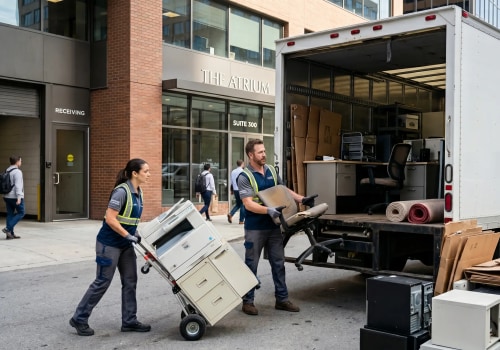
None of this is bad luck. It's a planning gap. Once you see how the 20 yard dumpster size works in real-world home projects, from its driveway-friendly footprint to the access requirements of the truck delivering it and the few municipal rules that govern where you can put it, the entire process gets easier — and your driveway, your project timeline, and your relationship with your neighbors all stay intact.
This is the homeowner checklist we wish more people had before delivery day. It walks through driveway space, surface protection, truck access, permits, and the small-but-critical prep details that separate a clean cleanout from a four-figure repair bill.
TL;DR Quick Answers
20 yard dumpster size
A 20 yard dumpster runs about 22 feet long, 8 feet wide, and 4.5 feet tall. It holds roughly 20 cubic yards of debris, or about six full pickup-truck loads. Weight limits typically cap between two and four tons, varying by hauler.
The detail most homeowners miss: plan for a placement footprint of 24 by 10 feet, with 22 feet of overhead clearance for the delivery truck's lift arms.
Length: ~22 ft
Width: ~8 ft
Height: ~4.5 ft
Capacity: 20 cubic yards (~6 pickup loads)
Weight limit: 2–4 tons, varies by hauler
Footprint to plan: 24 × 10 ft
Overhead clearance: 22 ft+
Top Takeaways
A typical 20 yard dumpster size is about 22' long × 8' wide × 4.5' tall, and it holds roughly six pickup-truck loads of debris.
Plan for a placement footprint of about 24' × 10', with 22'+ of overhead clearance for the delivery truck's lift arms.
Driveway placement on private property usually doesn't need a permit; street placement almost always does.
Plywood under the wheels is the single highest-ROI step in this entire checklist.
Schedule morning deliveries in hot weather to protect asphalt.
Call 811 before delivery if you're unsure what's running underground in the placement zone.
The rear door faces the work site, not the street — walk-in loading saves your back.
What a 20 Yard Dumpster Actually Is
A 20 yard dumpster is a roll-off container that holds roughly 20 cubic yards of debris — about the volume of six full-size pickup-truck loads. Dimensions vary slightly by hauler, but most 20-yarders are around 22 feet long, 8 feet wide, and 4.5 feet tall. That's the sweet-spot 20 yard dumpster size for most medium-scope home projects: a single-story roof tear-off, a finished-basement gut, a full garage clearout, an estate cleanout, or a yard renovation that's heavier on debris than on green waste.
For a complete breakdown of 20 cubic yard dumpster dimensions and what a rental typically costs, this size and pricing guide from Jiffy Junk is a solid reference. The term itself, for the curious, traces back to a brand name that's now generic for any large roll-off container used at residential and commercial worksites.
Why Placement Matters Before the Truck Arrives
A fully loaded 20 yard container weighs between four and eight tons. That much weight, sitting on a few wheel contact points for seven to ten days, will leave a mark on something — the only question is whether you decided what gets marked, or whether the dumpster decided for you.
Then there's the truck. Roll-off delivery vehicles need a clear runway to back in, drop, and lift the container, and planning that access ahead of time can help keep roll-off dumpster rental prices predictable and your delivery running smoothly. Low branches, awnings, narrow streets, and parked cars in the wrong spot turn a 20-minute delivery into a phone call to reschedule. And we haven't started on permits, HOAs, neighbor sightlines, or the buried sprinkler system you forgot was right where you wanted to drop it.
The Homeowner's 20 Yard Dumpster Placement Checklist
Step 1 — Measure your available space
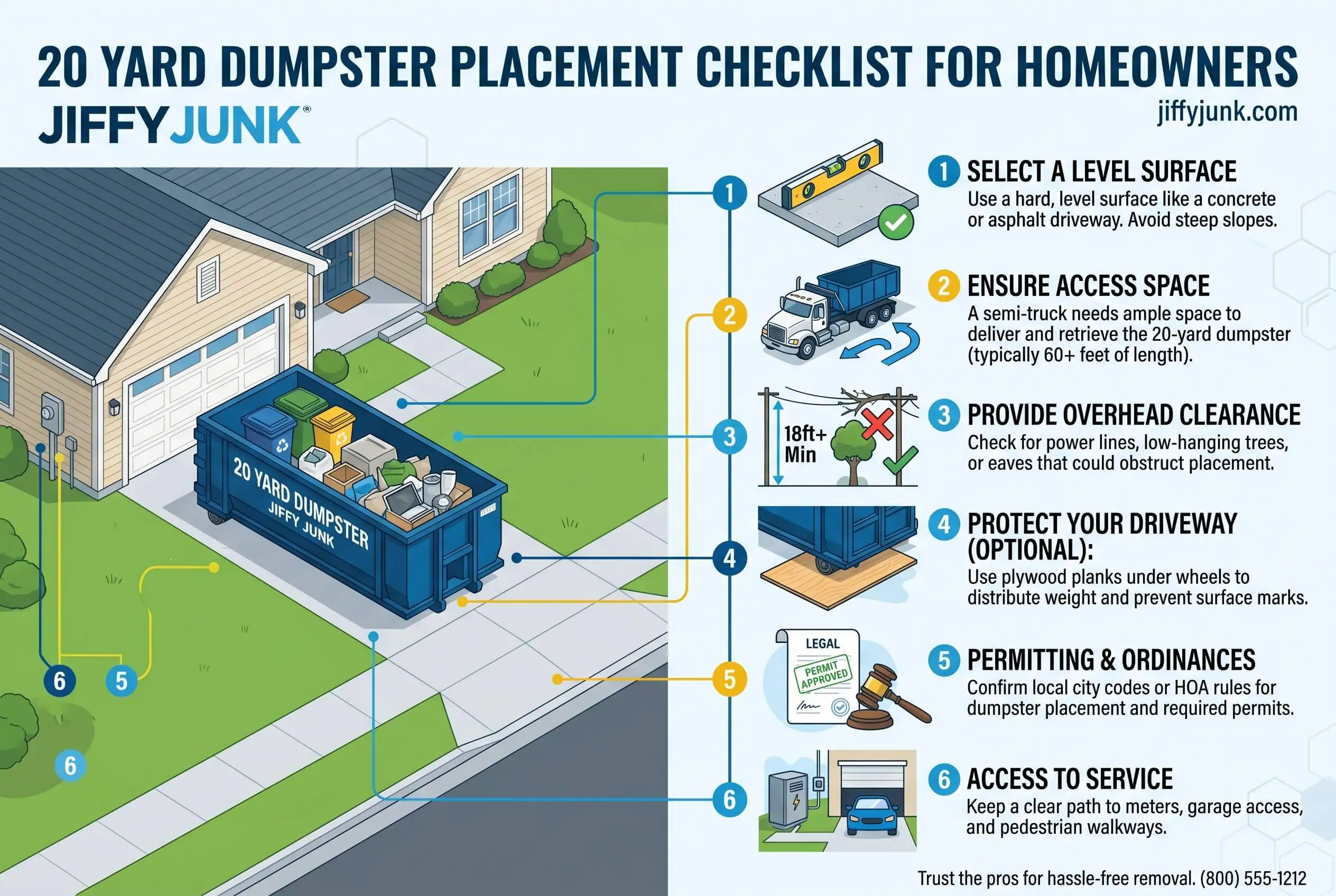
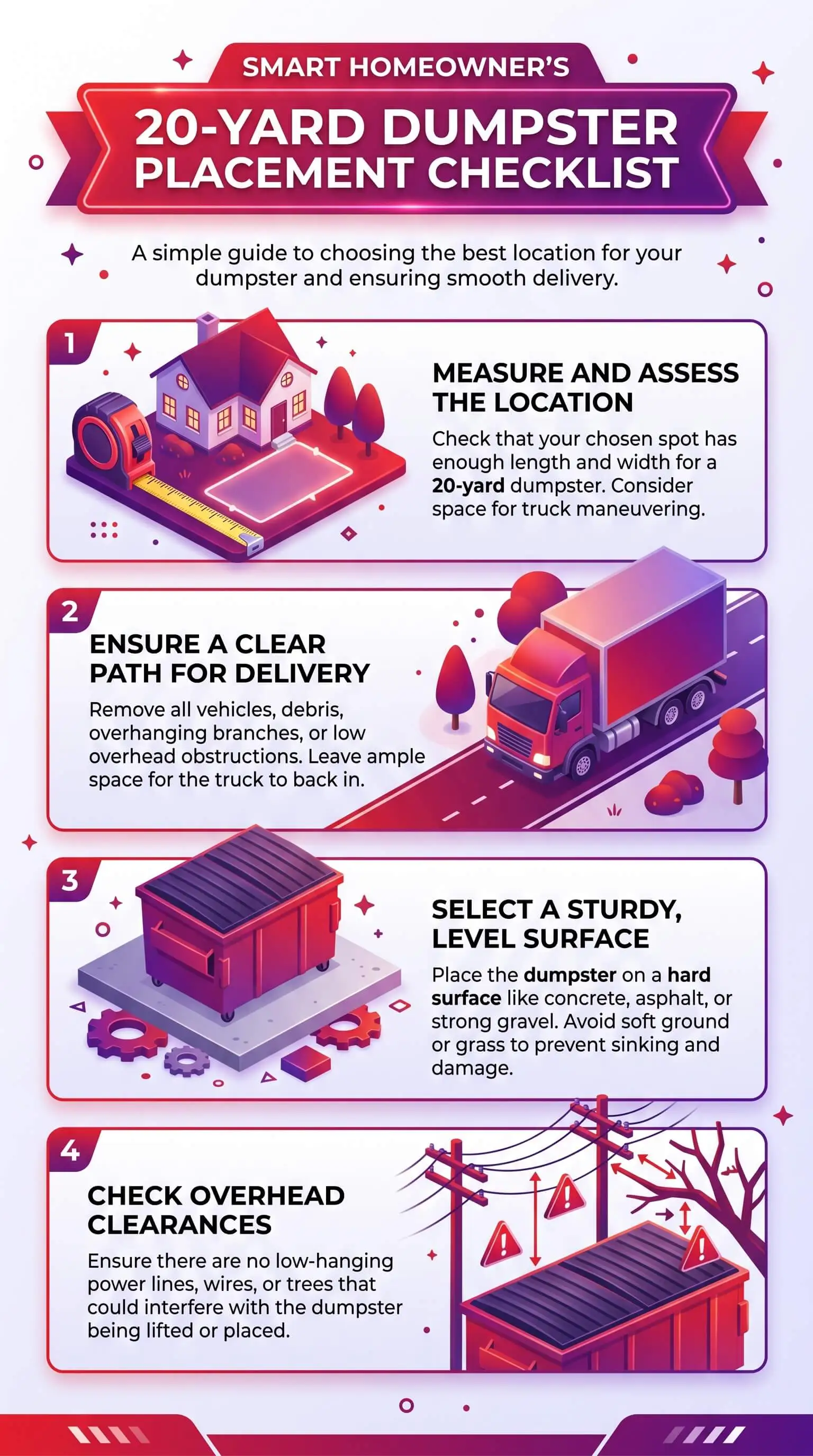
Plan for a footprint of roughly 24 feet long by 10 feet wide — that's the container plus a working perimeter. Vertical clearance matters too: the truck's lift arms need 22 feet or more above the drop zone to set the container down cleanly.
Step 2 — Evaluate driveway surface and slope
Concrete handles weight better than asphalt, but both can be damaged without protection. Asphalt softens above about 85°F — schedule morning deliveries in summer to keep the surface cool. On concrete, avoid placing the wheels directly over slab joints, which crack easily under point load. If the driveway slopes more than about 5%, mention it to the hauler before delivery.
Step 3 — Confirm truck access and overhead clearance
Walk the truck's full path from the street to the drop point. Look up — tree branches, power lines, awnings, and roof overhangs are the most commonly missed obstacles. On a tight street, the hauler may need to back in from a specific direction; flag that in advance instead of on delivery morning.
Step 4 — Check local permits and HOA rules
Driveway placement on private property typically does not require a permit. Street, alley, or right-of-way placement almost always does — and processing time can run several business days, so this isn't a same-day decision. New York City, for example, requires a Department of Transportation permit for any container placed adjacent to a curb. HOAs add their own layer: some cap the days a dumpster can sit on-site, others restrict visibility from the street.
Step 5 — Protect the driveway surface
Lay two sheets of ¾-inch plywood under the wheels and rear contact points. It's the cheapest insurance on this list. Skip placement directly over irrigation lines, septic clean-outs, or buried utilities — call 811 before delivery if you're unsure what's running underneath.
Step 6 — Plan for loading convenience
Position the rear (door-end) of the container facing your work site. Walk-in loading through the rear door is far less back-breaking than chucking debris over a 4.5-foot wall. Keep at least three feet of clearance on the door side for the swing room.
Step 7 — Consider neighbors and visibility
A heads-up to the adjacent neighbors costs nothing and prevents most complaints. Cover the container overnight if you can — illegal dumping by passersby is a real and surprisingly common problem during multi-day residential rentals.
Common Placement Mistakes to Avoid
Placing on freshly sealed asphalt (less than 30 days old).
Blocking the only vehicle exit from the property.
Forgetting to look up before scheduling — branches and lines win arguments with delivery trucks.
Placing on pavers or stamped concrete with no surface protection.
Skipping the permit when any portion of the container will sit in the street.
Underestimating the swing room needed for the rear door.
How to Prep the Day Before Delivery
Move parked vehicles out of the placement zone and the truck's approach path.
Clear the area of toys, planters, hoses, and trash bins.
Lay plywood at the planned drop point.
Mark the placement zone with chalk, painter's tape, or cones.
Confirm the delivery window with the hauler 24 hours out.
Walk the truck path one final time — and look up.
“After you've watched enough roll-offs come and go from residential driveways, you stop blaming bad luck for the cracked corner or the missed delivery window. The pattern is too consistent. Almost every placement problem we see started as a five-minute conversation that didn't happen — between the homeowner and the hauler, or between the homeowner and the property itself.”
7 Essential Resources
These are the references we keep close when the placement question gets complicated:
Plain-language background on roll-off containers, capacity ranges, and the history of the term itself.
2. OSHA 1926.252 — Disposal of Waste Materials
Federal safety standard governing how debris can be moved into containers, including drop-distance and chute requirements.
National Waste & Recycling Association safety hub. NWRA serves as the Secretariat for the ANSI Z245 container-safety standard.
4. NYC DOT — Commercial Refuse Container Permits
A live municipal example of how curb-adjacent dumpster permits work. Most U.S. cities follow a similar structure.
The free national service that flags buried utilities before you (or a heavy container) puts pressure on the wrong spot.
6. EPA — Sustainable Management of Construction & Demolition Materials
Federal guidance on what's actually in your debris, where it ends up, and how to keep more of it out of landfill.
7. Harvard JCHS — Leading Indicator of Remodeling Activity (LIRA)
The benchmark dataset for U.S. residential renovation spending. Useful context for sizing and scheduling decisions.
3 Statistics
A few numbers worth knowing before you book:
600 million tons. Construction and demolition debris generated in the United States in 2018 — more than twice the volume of municipal solid waste in the same year. (U.S. EPA)
$522 billion. Projected annual U.S. homeowner spending on improvements and maintenance, including projects that can improve air quality, by the end of 2026, per the Harvard Joint Center for Housing Studies' Leading Indicator of Remodeling Activity. . (Harvard JCHS, 2026)
~$30 billion. Estimated annual U.S. cost of damages to buried utilities, with failure to contact 811 before digging the leading driver. (811 Before You Dig)
Final Thoughts and Opinion
Most placement problems aren't really placement problems — they're communication problems disguised as logistics. The homeowner doesn't tell the hauler about the low oak branch over the driveway. The hauler doesn't ask about the slope. Nobody checks for the irrigation line. The container shows up, the wheels punch into hot asphalt, and an avoidable repair bill enters the chat.
Our take, after enough deliveries to be confident in the pattern: the 24 hours before delivery are worth more than the seven days of the rental that follow. Walk the truck path. Lay the plywood. Make the three phone calls — to the city, to 811, to the neighbor. The container itself is the easy part. Everything around the container is where homeowners save money or lose it.
A 20 yard dumpster is genuinely the right tool for a remarkable range of residential projects. It's also a piece of heavy equipment that will sit on your property for a week. Treat it that way.
Frequently Asked Questions
Can a 20 yard dumpster fit in a standard residential driveway?
Yes, in most cases. A 20 yard dumpster is typically about 22 feet long and 8 feet wide. Most two-car driveways accommodate it lengthwise with a few feet of clearance, but always confirm by measuring before delivery.
Do I need a permit to place a 20 yard dumpster on my driveway?
Typically no — a permit is not required when the dumpster sits entirely on private property. A permit is almost always required if any portion will sit on the street, sidewalk, or public right-of-way. Check with your local public works or building department before booking.
How much weight can a 20 yard dumpster hold?
Most 20 yard dumpsters have a weight limit between two and four tons (roughly 4,000–8,000 lbs), though limits vary by hauler and project type. Heavier debris like concrete, dirt, or roofing tile may push you toward a smaller-but-stronger container instead.
Will a 20 yard dumpster damage my driveway?
It can, if you skip surface protection. Plywood sheets under the wheels distribute the weight and prevent gouging or cracking. Asphalt in hot weather is the most vulnerable surface — schedule deliveries early in the day during summer.
How long can I keep a 20 yard dumpster?
Standard residential rental periods are seven to ten days, though most haulers offer extensions for a daily fee. Confirm the included rental window when you book to avoid overage charges.
What's the difference between a 20 yard and a 30 yard dumpster?
A 30 yard dumpster holds about 50% more debris and is typically the same length and width as a 20 yard but taller (around 6 feet vs. 4.5). A 20 yard is the more common choice for medium home projects; a 30 yard is sized for whole-home cleanouts and larger renovations.
Next Step
Once placement is locked in, the next decision is whether 20 yards is actually the right size for your project — and what the rental will cost. A clear breakdown of 20 cubic yard dumpster size, dimensions, and rental cost will save you from upsizing or downsizing on delivery day. Tap there to read the full guide before you book.