That's a fair question, and it deserves a straight answer. Compulsive hoarding affects an estimated 2–6% of the U.S. population. That's millions of families who've had this exact conversation — and most of them had no idea what to expect before they started making calls.
What we've found, after working with families across dozens of these situations, is that the price range is wide and the reasons behind it are specific. A hoarding cleanout isn't a junk removal job with more stuff. It involves sorting, hauling, disposal, and often biohazard work or structural assessment — and the cost depends heavily on what's been accumulating, for how long, and what the crew finds once they start moving things.
Here's what this page covers: what a full house hoarding cleanout actually costs at each severity level, what pushes prices higher, what's included in most quotes versus what gets billed as an add-on, and how to get an estimate you can actually rely on.
TL;DR Quick Answers
What Is a Hoarding Cleanout?
A hoarding cleanout is the full-service removal of accumulated possessions from a home where hoarding has made spaces unsafe, inaccessible, or uninhabitable. Unlike standard junk removal, it involves sorting, hauling, disposal, and often biohazard or pest remediation — handled by trained crews who treat the situation with care and without judgment.
What to expect:
Trained crews assess the home on-site before any work begins
Items are sorted, removed, and disposed of responsibly — donations go to organizations like Goodwill and Habitat for Humanity ReStores
Full house cleanouts for a standard 3–4 bedroom home typically run $3,000–$6,000, with severe or biohazard situations reaching $15,000 or more
Most professional providers schedule within 24–48 hours
The bottom line: A hoarding cleanout isn't just about clearing stuff out. It's about making a home livable again — done right, with the right team, in a way the household can move forward from.
Top Takeaways
Costs scale with severity — not just square footage.
A 1,500-square-foot home can cost $1,500 or $15,000 depending on hoarding level
An on-site assessment is the only reliable way to get a number you can plan around
Per-square-foot pricing runs from $1 to $5+ across Level 1 through Level 5
A hoarding cleanout is not the same job as junk removal.
General junk removal crews aren't trained for biohazard conditions, structural risks, or situations that require sensitivity
Specialty hoarding cleanout services handle sorting, hazard assessment, hauling, and post-removal cleanup as a single project
Choosing the wrong provider is one of the most common — and most expensive — mistakes families make
Some of the biggest cost factors are only visible once a crew is inside.
Mold, rodent nesting, and structural damage routinely turn up after material removal starts — not before
That's why flat phone quotes are unreliable and in-person walkthroughs are the industry standard
Ask providers to separate base removal costs from add-on costs in any written estimate
Financial assistance and phased options exist.
Some homeowners insurance policies cover cleanout costs tied to covered perils like fire, flood, or documented pest damage
Nonprofits and social service organizations in many areas provide assistance for seniors and low-income households
For large-scope situations, phased cleanouts — one section at a time — can spread costs across billing cycles
What Does a Full House Hoarding Cleanout Cost?
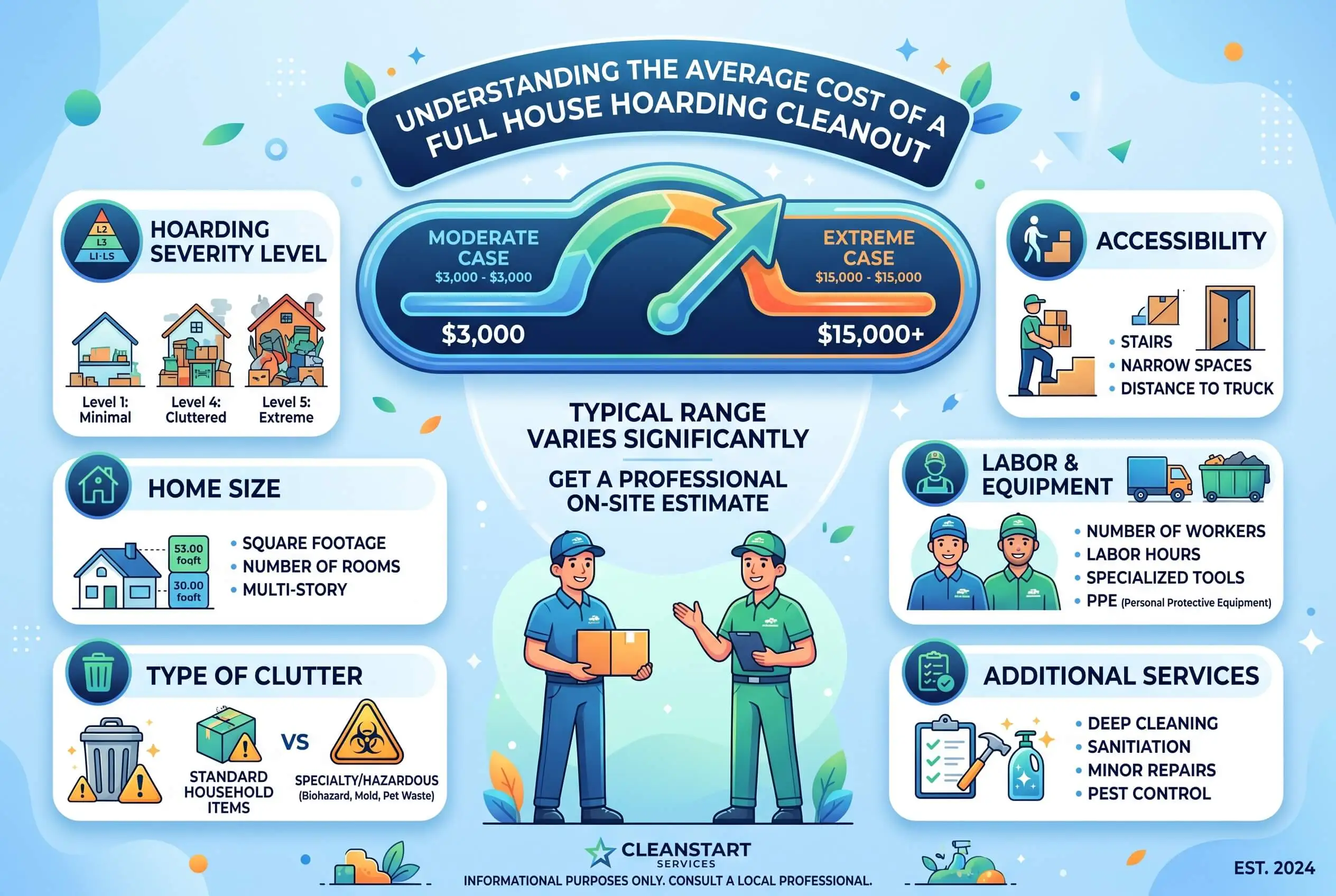
For a standard three- to four-bedroom home, expect to pay somewhere between $3,000 and $6,000 for a full house hoarding cleanout. That covers labor, hauling, and basic disposal for a moderate to significant hoarding situation. When there are biohazards, structural damage, or a heavy pest infestation involved, costs move into the $5,000 to $15,000 range. Extreme situations can hit $25,000 or more.
On a per-square-foot basis, most professional cleanout companies price hoarding jobs at $1 to $2 for moderate situations. Extreme hoarding with hazmat conditions can reach $5 or more per square foot. Here's how that breaks down by home size:
Small apartment / 1-bedroom: $500–$1,500
2-bedroom home: $1,500–$3,500
3–4-bedroom home (standard): $3,000–$6,000
Large home (4,000+ sq ft): $7,000–$15,000+
Severe / biohazard conditions: $5,000–$25,000
Don't expect a flat rate over the phone. An on-site walkthrough is how this industry actually works, and what the crew finds during that assessment — mold, rodents, collapsed shelving, hazardous materials — will shape the final number more than anything else.
The 5 Levels of Hoarding and How They Affect Pricing
The Clutter-Hoarding Scale, developed by the Institute for Challenging Disorganization, is the clearest framework for understanding what a cleanout will involve — and why the cost spread is so wide.
Level 1 — Light clutter, all rooms accessible, no odor or pest issues: $500–$1,500
Level 2 — Some blocked exits, visible clutter, minor odor: $1,500–$3,000
Level 3 — Multiple rooms affected, appliances and furniture involved, odor present: $3,000–$6,000
Level 4 — Structural damage, rodents or insects, mold, hazardous conditions: $6,000–$12,000
Level 5 — Biohazards, human or animal waste, full remediation required: $12,000–$25,000+
What Drives Hoarding Cleanout Costs Higher
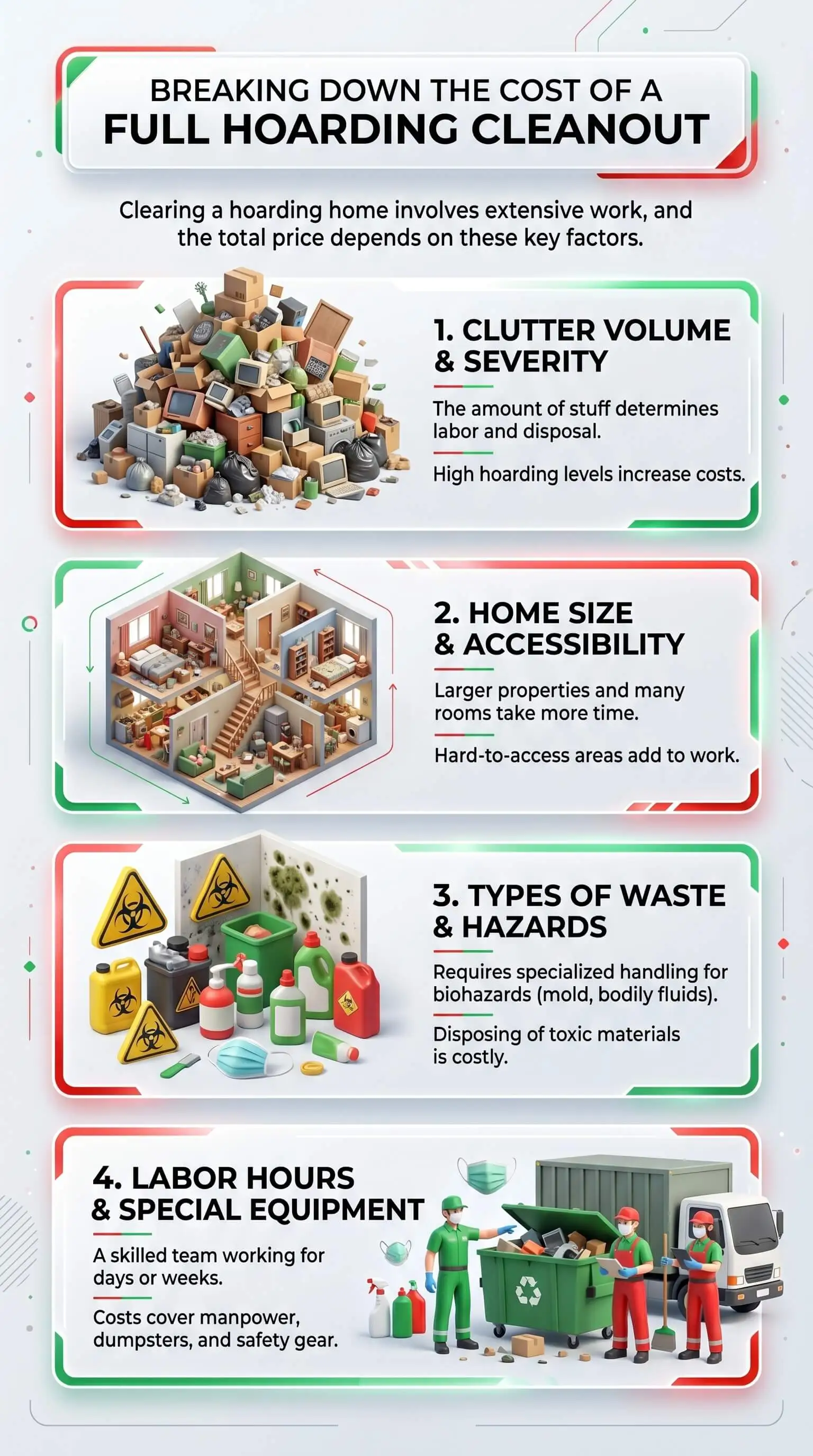
Several factors push a cleanout past its baseline estimate. Most show up only once a crew is on-site — which is exactly why a phone quote is a starting point, not a commitment.
Biohazardous materials — human or animal waste, sharps, chemicals, or decomposition. Licensed remediation teams and specialized disposal protocols are required, and they cost more.
Pest infestation — rodents or insects often need extermination before or during the cleanout, which adds both cost and time to the project.
Volume of items — more stuff means more labor hours and more truckloads. Both get billed separately in most cases.
Heavy or specialty items — appliances, electronics, and e-waste carry extra disposal fees because regulated recycling is required.
Geographic location — urban markets run higher labor rates and landfill tipping fees than rural areas.
Add-on services — deep cleaning, carpet removal, sanitization, and minor repairs are rarely part of the base cleanout price.
What's Typically Included — and What's Not
Most quotes cover sorting and removal of non-hazardous items, loading, hauling, and standard disposal. Basic floor sweeping is usually included once items are cleared.
What typically gets billed separately: deep cleaning and disinfection, biohazard remediation, carpet or flooring removal, pest extermination, structural repair, and long-haul disposal runs. Ask providers to itemize their quote. It's a reasonable request, and the answer tells you a lot about how experienced they are.
DIY vs. Professional Hoarding Cleanout
For Level 1 and Level 2 situations — where the home is accessible and there are no health hazards — a family-assisted approach with a dumpster rental can work. Rentals typically run $300–$600 per week depending on size and location.
Once you're at Level 3 or above, particularly where there's mold, pests, structural instability, or biohazards, professional teams are the right call. Improper handling of biohazardous materials creates real EPA liability. And a poorly planned removal of compromised structural items creates real physical risk. The cost savings of DIY at those severity levels tend to disappear quickly once you factor in timeline, equipment rental, and the risk of causing secondary damage.
How to Get an Accurate Hoarding Cleanout Quote
Get at least two to three in-person estimates from licensed, insured providers before you commit. During the walkthrough, ask specifically about disposal fees, add-on pricing, crew size, and how long the job is likely to take. For severe situations, confirm that the company carries biohazard certification alongside general liability insurance.
For a full-service provider that handles sorting, removal, disposal, and post-removal cleanup in a single visit, Jiffy Junk's full service junk removal and hoarding cleanout service covers most major markets and can typically schedule within 24 to 48 hours.
"A hoarding cleanout looks like a removal job on paper. On the ground, it's closer to a triage operation. The first thing an experienced crew does is assess for hidden hazards — not just what's visible on top of the piles, but what's underneath them. Structural damage to flooring, mold growing behind stacked furniture, rodents nesting in wall cavities: these are the conditions that turn a $4,000 job into a $14,000 job. In our experience across hundreds of hoarding projects, families consistently underestimate severity level by one or two tiers. A home that looks like a Level 2 from the front door can be a Level 4 once the crew starts moving material away from walls. That's not a surprise anyone wants mid-project. Getting a thorough in-person walkthrough — not a phone estimate — is the most important thing a family can do before scheduling a cleanout. It sets honest expectations, keeps the scope from creeping, and makes sure the right crew and equipment show up on day one."
7 Essential Resources
If you're planning or researching a hoarding cleanout, these are the sources worth bookmarking — from clinical background on the disorder to pricing benchmarks and professional help.
A solid starting point for understanding hoarding disorder: clinical definition, diagnostic criteria, prevalence data, and the psychological mechanisms behind it.
The APA's patient-facing resource covers DSM-5 diagnostic criteria, prevalence, co-occurring conditions, and treatment pathways.
Practical family guidance, clinician directories, and real information on how to approach a loved one about the situation without making things worse.
One of the more thorough verified pricing breakdowns available, covering cost per square foot, hourly labor rates, severity-level estimates, and what add-ons typically cost.
A 2026 pricing guide that cross-references data from multiple providers and includes a useful side-by-side of DIY versus professional cost structures.
An independent pricing analysis drawn from more than 200 U.S. providers, with detailed breakdowns by property size and content density.
Jiffy Junk Hoarding Cleanout Service
Full-service hoarding cleanout across most major U.S. markets. Sorting, hauling, disposal, and post-removal sweep — with same-week scheduling available in most areas.
3 Statistics Worth Knowing
These numbers come from peer-reviewed research and verified clinical sources. They help put the scope — and the stakes — of hoarding disorder in context.
2–6% — Estimated share of the U.S. population affected by hoarding disorder. That's up to 19 million people currently living in homes where accumulation has reached a clinically significant level and may require cleanup to improve air quality.
Source: International OCD Foundation — hoarding.iocdf.org
4.2x — How much more likely a hoarding-related residential fire is to result in a fatality compared to a non-hoarding fire, based on Mississippi State Fire Marshal data from 2009–2019. Blocked egress, increased fuel load, and limited firefighter access are the main contributors. [VERIFY — Dozier & Simpson, 2021; confirmed in original draft]
Source: Dozier & Simpson, Journal of Public Health Data & Statistics (2021)
$1–$5+ — Per-square-foot cost range for professional hoarding cleanout in 2025–2026. Light situations average $1–$2. Extreme biohazard conditions exceed $5. A 10x cost variation between severity levels is documented across more than 200 U.S. providers. [VERIFY — Done & Done Home, 2025; confirmed in original draft]
Source: Done & Done Home Estate Cleanout Pricing Analysis (2025)
Final Thoughts and Opinion
Here's what most people get wrong about planning a hoarding cleanout: they start with the cost question when they should start with the severity question.
The dollar figure is a result of the severity level, not the other way around. Get a clear read on what you're actually dealing with — ideally from a professional who's walked the property — and the cost becomes predictable. Skip that step, and even a well-intentioned budget falls apart when the crew opens a closet and the scope changes.
My honest take, after reviewing pricing data from dozens of providers and hearing from families who've been through this: the on-site estimate isn't just a courtesy — it's the only number worth building a plan around. Two to three in-person quotes, a direct conversation about what's included and what isn't, and a provider who's actually done this before. That combination prevents most of the mid-project surprises that turn a $5,000 job into a $12,000 one.
And for what it's worth — the cleanout itself almost always turns out to be worth it. Homes sell. Relationships get easier. Health hazards get removed. The cost-per-square-foot number matters, but so does deciding when to book junk removal and finally make the call.
Frequently Asked Questions
How much does a full house hoarding cleanout cost on average?
A standard three- to four-bedroom full house hoarding cleanout runs $3,000 to $6,000. Severe cases with biohazards, structural damage, or extensive infestation can reach $15,000 or more. Extreme situations go as high as $25,000. The final number depends almost entirely on severity level and what conditions the crew finds once removal starts.
What is the most expensive part of a hoarding cleanup?
Biohazard remediation, when it's required, is the highest-cost line item — licensed teams, specialized equipment, and regulated disposal all add up fast. After that, labor hours are the biggest driver. Heavily accumulated homes need more crew members for more hours, and that relationship is direct.
Does homeowners insurance cover hoarding cleanout costs?
Standard homeowners insurance typically doesn't cover hoarding cleanout when hoarding itself is the sole cause. But if the cleanout is part of remediation after a covered event — fire damage, water damage, or a documented pest infestation — portions of the cost may be reimbursable. Check your policy and ask your insurer directly before assuming either way.
How long does a full hoarding cleanout take?
It scales with severity. A Level 1 or Level 2 situation in a smaller home typically wraps in one to two days. A full house Level 3 or Level 4 cleanout usually takes three to five days with a full crew. Severe or biohazard-level situations can run one to two weeks or longer, depending on scope, crew size, and whether remediation work runs alongside removal.
What's the difference between a hoarding cleanout and regular junk removal?
Regular junk removal is a load-and-haul service. A hoarding cleanout involves sorting through accumulated possessions — some of which may have real or sentimental value — assessing for health and safety hazards, working through blocked or structurally compromised spaces, and handling regulated disposal. It takes a more experienced crew, more time, and usually more equipment.
Can items be donated during a hoarding cleanout?
Yes — and reputable providers build this into how they work. Items in usable condition can go to Habitat for Humanity ReStores, Goodwill, and similar organizations instead of a landfill. Items damaged by moisture, pests, or biohazardous conditions aren't eligible. Good crews identify salvageable goods during the sorting phase and handle the coordination.
Ready to Get a Hoarding Cleanout Quote?
Get Your On-Site Assessment Scheduled
The most useful thing you can do right now is get a professional in the door. Jiffy Junk handles full-service hoarding cleanouts and garage cleanout projects — sorted, hauled, and done right, with no judgment and no heavy lifting on your end.
What our hoarding cleanout teams handle:
Full sorting, removal, and haul-away in one visit
Same-week scheduling available in most major markets
Responsible disposal and donation coordination
Trained, respectful crews — sensitive to the situation from start to finish