On July 16, 2026, smoke from Ontario wildfires settled over Buffalo, and state regulators raised Western New York to a Very Unhealthy air quality advisory. Three months earlier, the American Lung Association had handed the same metro passing grades on all three of its air pollution measures. If you're sizing up air quality in Buffalo, NY, before a move, both facts belong in your notes. The annual grade shows you a typical year. The daily number shows you what you're breathing today.
Don't take the air at a new address for granted. Before signing anything, I'd check three numbers: the annual report-card grades, the live reading near each home on your shortlist, and that home's radon results. Pull up the current air quality in Buffalo NY for every address you're weighing, then read it in context below.
TL;DR Quick Answers
air quality Buffalo NY
Buffalo’s air is good most days. The American Lung Association’s State of the Air 2026 gave the metro a B for ozone and a C for short-term particle pollution, with a passing year-round grade. The risks you can’t see come from Canadian wildfire smoke in summer and radon inside Erie County homes.
2026 report card: B for ozone, C for short-term particles, passing for year-round particles
Main outdoor pollutants: ground-level ozone and fine particles, or PM2.5
Smoke season: usually June through August, peaking at Very Unhealthy on July 16, 2026
Hidden indoor risk: Erie County is a state high-risk radon county, with far higher rates in the Southtowns than in the city
Where to check today: DEC’s Western New York AQI forecast and AirNow’s live map
Top Takeaways
Buffalo passed every State of the Air 2026 measure, yet an annual grade can hide a week of hazardous smoke.
Air near the Peace Bridge plaza and the East Side expressways can differ from what the citywide reading shows.
Wildfire smoke usually arrives between June and August, and it pushed the region to Very Unhealthy in July 2026.
Erie County sits on the state's high-risk radon list, and Southtowns rates run far above the city's.
Your heating system decides whether you can filter smoke for the whole house or one room at a time.
How Does Buffalo's Air Quality Rate on Annual Report Cards?
Buffalo's outdoor air holds up better than most big metros. State of the Air 2026 pulled monitor data from 2022 through 2024 and gave the Buffalo-Cheektowaga-Olean metro these grades:
B for ozone, based on 0.7 unhealthy days a year in Erie and Niagara counties
C for short-term particle pollution, based on about one unhealthy day a year in Erie County
A passing grade for year-round particle pollution, and an improving one
Those grades shift from year to year. The 2025 report ranked this same metro third worst in the Northeast for year-round particle pollution. Coming from downstate? The New York City metro ranked 12th worst in the nation for ozone in 2026.
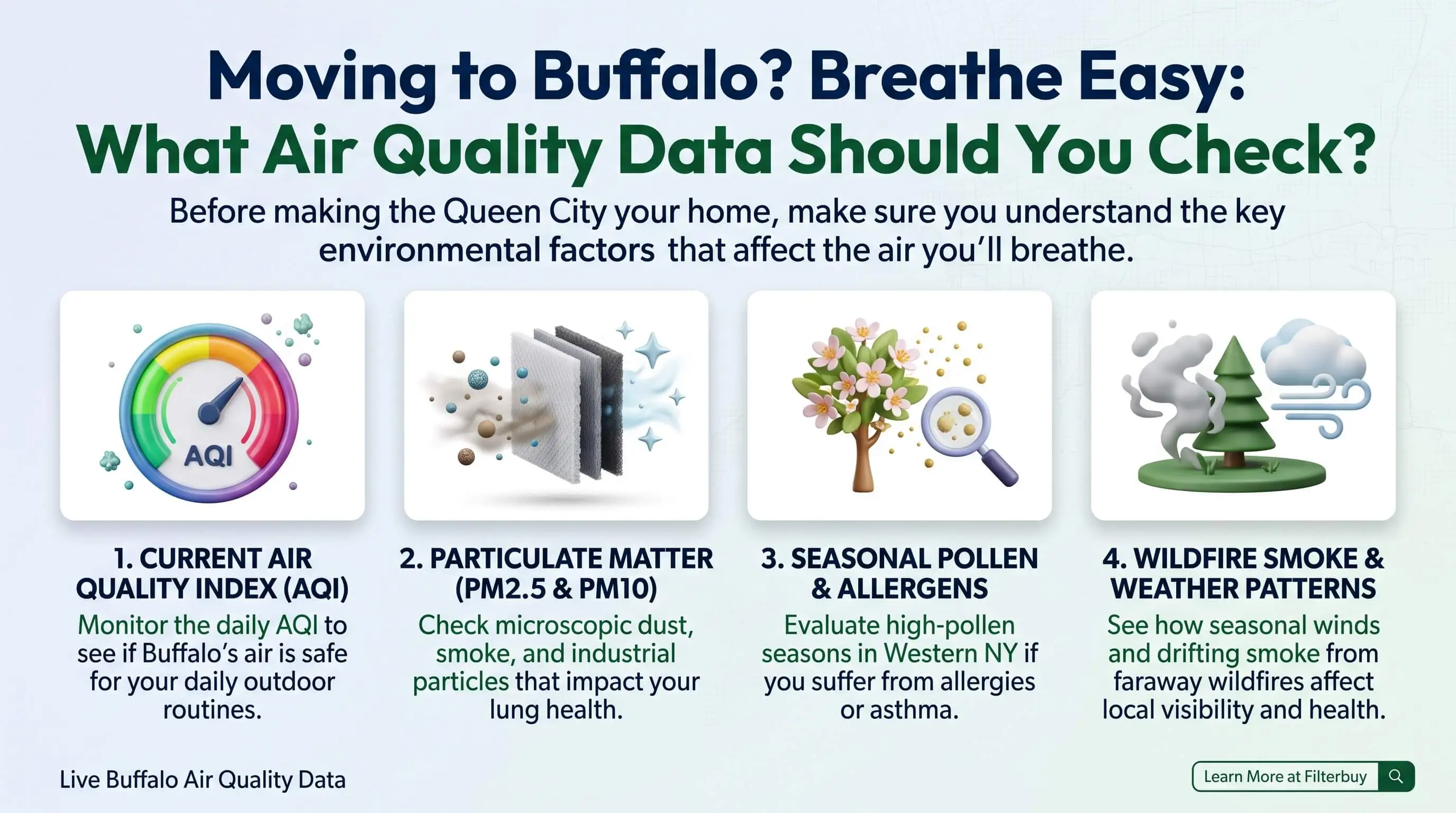
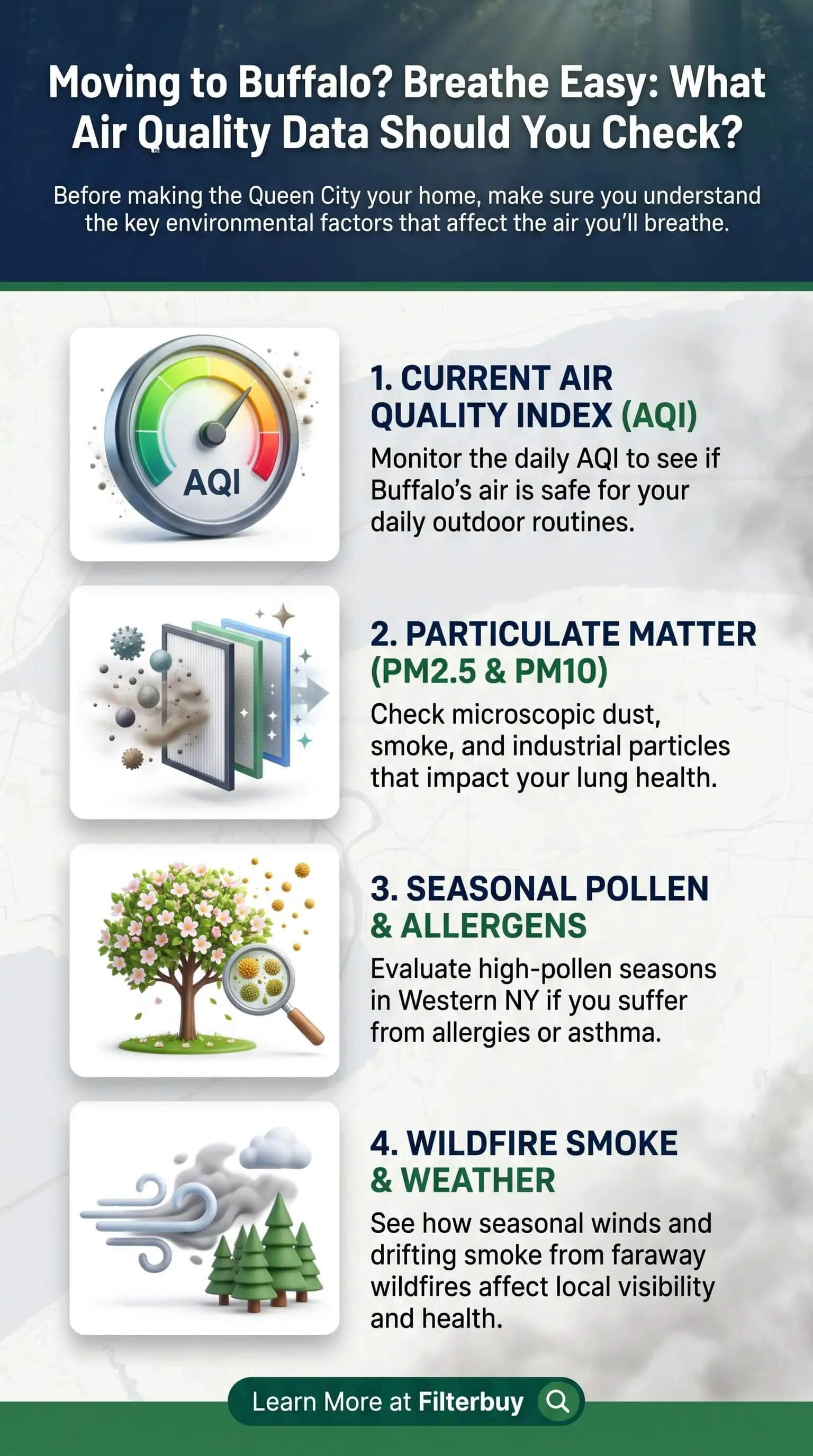
Each grade rests on the Air Quality Index, a 0 to 500 scale that rolls ozone and fine particle readings into one color-coded number. If the scale is new to you, this plain-language guide to what AQI means walks through each color.
Does Air Quality Change Across Buffalo Neighborhoods?
Yes, and traffic explains most of it. For a full year from 2014 to 2015, the state Department of Environmental Conservation monitored the Lower West Side next to the Peace Bridge. Black carbon, the sooty part of fine particle pollution, ran higher at the Busti Avenue monitor than at a nearby background site, climbing and dropping with weekday truck traffic. Fine particles at both sites still stayed under the federal annual standard. So a city can pass its report card while one block's air differs from the next.
DEC went bigger after that. Its Community Air Monitoring Initiative drove sensors down every public road in the Buffalo, Niagara Falls and Tonawanda study area, East Side included, for a year that ended in August 2023, mapping where pollution bunches up. With a shortlist in hand, I'd do two things:
Walk each street on a weekday afternoon, when truck traffic peaks, and note how close it sits to the Peace Bridge plaza, I-190, the Kensington Expressway on Route 33 and the Scajaquada on Route 198.
Compare that address's live reading with the citywide number on a few different days.
When Does Wildfire Smoke Reach Western New York?
Most smoke reaches Buffalo between June and August, drifting south from Canadian fires. Recent seasons follow that pattern:
June 2023: Readings across Western New York climbed into the Unhealthy range of 151 to 200.
August 2025: Smoke pushed Buffalo and its suburbs into the Unhealthy category during a statewide advisory.
July 16, 2026: State regulators raised Erie, Niagara and five neighboring counties to a Very Unhealthy advisory, with fine particle readings above AQI 255.
Smoke is easy to underestimate. The sky can look only a little hazy while the number keeps climbing. DEC and the state Health Department send out an Air Quality Health Advisory any time they forecast ozone or fine particles above AQI 100, and you can get those alerts through DEC Delivers or the toll-free Air Quality Hotline at 1-800-535-1345.
If you're moving in summer, set up indoor filtration before you open a single box. Consider air quality testing to identify potential indoor pollutants and determine your filtration needs. EPA warns that filters and portable air cleaners can be hard to find once smoke rolls in.
Why Radon Data Matters as Much as the AQI in Erie County
Here's the threat an outdoor monitor will never show you. Radon is a colorless, odorless radioactive gas that seeps up from the soil into homes, and the AQI doesn't measure it at all. The New York State Department of Health puts Erie County on its high-risk radon list.
That risk isn't spread evenly. State estimates of homes above 4 pCi/L, the action level where the state recommends fixing a home, split sharply between the city and the Southtowns:
Buffalo city: about 0.5% of living areas and 3% of basements
Cheektowaga: 0.3% of living areas and 3% of basements
Amherst: 1.5% of living areas and 9% of basements
Aurora: 23% of living areas and 51% of basements
Boston: 24% of living areas and 52% of basements
Concord: 33% of living areas and 65% of basements
A low percentage doesn't clear any single house. Ask the seller or landlord for a recent radon test, and if nobody has one, send a test kit to a state-approved lab. The state recommends testing brand-new homes too, even ones built with radon-resistant features.
What Should You Check Inside a Buffalo Home Before Signing?
Plenty of Buffalo homes have decades behind them, and they differ widely in how well they filter air. Run these five checks before you sign a lease or purchase agreement:
Heating system. A forced-air furnace can push the whole house's air through one high-efficiency filter. Boilers and radiators have no ductwork, so you'll be cleaning the air room by room.
Filter slot and rating. MERV is the 1 to 16 scale for how well a filter catches particles. EPA recommends MERV 8 filter or higher during smoke events if your system can handle it, with the thermostat fan switched from Auto to On. This guide to choosing the right MERV rating covers the tradeoffs.
Radon test results or a mitigation fan. Look for a vent pipe running up an outside wall, with a fan in the basement, the attic or outdoors.
Room-level backup. For portable air cleaners, EPA's sizing rule calls for a smoke clean air delivery rate, or CADR, of at least two-thirds of the room's square footage. A 300-square-foot bedroom needs a smoke CADR of about 200.
Window AC settings. Make sure window units can recirculate indoor air rather than pull smoky air in from outside.
“After years of walking Buffalo-area homes before closings, I've learned the filter slot tells me more than any neighborhood ranking. If a one-inch slot can't take a MERV 13 filter, smoke days get handled room by room, and I'd rather a buyer find that out before July than after.”
7 Essential Resources
Check the Western New York AQI Forecast
The NYSDEC Air Quality Index forecast posts a daily ozone and fine particle outlook for the region covering Erie and Niagara counties.
Follow Smoke in Real Time
When smoke readings shift by the hour, AirNow's wildfire guide shows you how to read the Fire and Smoke Map.
Plan Your Home Filtration
The EPA indoor air filtration fact sheet compares MERV 13 HVAC filters, portable air cleaners and do-it-yourself box fan filters.
Test for Radon
Erie shows up on the high-risk list in the New York State radon guide for residents, which also covers testing and mitigation.
See East Side Monitoring Results
New York's East Side environmental update sums up DEC's mobile air monitoring work across Buffalo's East Side.
Review the Peace Bridge Air Study
DEC's Peace Bridge neighborhood study results lay out the black carbon and fine particle findings near the bridge plaza.
Protect Kids on Poor Air Days
The American Academy of Pediatrics outdoor air pollutant guidance explains why kids react more strongly to air pollution than adults do.
3 Statistics
The American Lung Association gave the Buffalo metro a B for ozone and a C for short-term particle pollution in State of the Air 2026.
State health researchers flagged 19 Buffalo ZIP codes as asthma emergency-visit hot spots from 2016 to 2019, more than Rochester's 12 or Syracuse's 11, according to CDC's Preventing Chronic Disease journal.
An estimated 12% of Erie County basements top the 4 pCi/L radon action level, against 3% in Buffalo city, according to the New York State Department of Health's Wadsworth Center.
Buffalo's 2026 air quality grades, 19 asthma-related hot spot ZIP codes, and elevated radon levels in Erie County highlight the importance of monitoring indoor and outdoor pollution and choosing top air filters to help reduce airborne particles at home.
Final Thoughts and Opinion
I think Buffalo's outdoor air deserves more credit than the city's industrial reputation gives it. Most days are fine. The grades have held steady or improved. What newcomers tend to miss are smoke weeks, which can turn a clear-looking July afternoon unhealthy, and radon, which no outdoor monitor will ever pick up.
Get the annual grades, the live number and the radon results for every address on your list. An HVAC air purifier ionizer may also help manage indoor air quality, provided it doesn't produce ozone. You'll pick a home with your eyes open and a plan for protecting the people inside it.
Frequently Asked Questions
Is Buffalo, NY, Air Quality Good?
On most days, yes. The metro earned a B for ozone, a C for short-term particle pollution and a passing year-round grade in State of the Air 2026. Summer smoke is the big exception, and it drove the region to Very Unhealthy levels in July 2026.
Is Buffalo's Air Cleaner Than New York City's?
For ozone, usually. The New York City metro ranked 12th worst in the nation for ozone in 2026, while Buffalo earned a B. Wildfire smoke hits both regions, though, so check the live reading in either city.
Does Buffalo Get Wildfire Smoke?
Yes. Canadian smoke drifts into Western New York most summers, usually between June and August. The worst recent stretch came on July 16, 2026, when the state issued a Very Unhealthy advisory for Erie, Niagara and five neighboring counties.
Should I Test a Buffalo Home for Radon?
Yes. Erie County is on the state's high-risk radon list. Rates in Buffalo city run low, but in Southtowns like Aurora, Boston and Concord, roughly half or more of basements top the action level. A short-term test is cheap and quick.
Where Can I Check Buffalo's Air Quality Today?
Start with DEC's daily AQI forecast for Western New York, then open AirNow for live readings and smoke maps. For alerts, sign up for DEC Delivers or call the Air Quality Hotline at 1-800-535-1345.
Know the Air Before You Choose an Address
Before you sign, pull up the live AQI near every Buffalo address on your list and ask for each home's radon results. Air purifier installation is another step toward improving indoor air quality. Those two numbers will tell you more about the air your family breathes at home than any annual ranking.


