Don’t take your indoor air for granted! Air quality in Columbus Ohio makes the local news every ozone season, yet your family breathes most of its air indoors, where nobody posts a daily reading. Testing makes that invisible air visible. Match the test to the problem you suspect, because the broadest panel is rarely the one you need, and the price follows from that choice.
TL;DR Quick Answers
air quality Columbus Ohio
Air quality in Columbus, Ohio is good most days, but summer ozone and short-term particle spikes push it into unhealthy ranges. Franklin County earned an F for short-term particle pollution in State of the Air 2026. Indoors, some pollutants often run 2 to 5 times higher than outdoors, so check both.
Particle spikes: Franklin County averages 4.8 unhealthy days per year from short-term particle pollution.
Summer ozone: Ozone adds about 1.7 unhealthy days per year, with the county graded C.
Alert threshold: MORPC issues Central Ohio Air Quality Alerts when the forecast AQI reaches 101 or higher.
Indoor air: Americans spend about 90 percent of their time indoors, where the AQI never shows what you’re breathing.
Hidden radon: About half of Ohio homes have elevated radon, and the Ohio Department of Health offers free test kits.
Top Takeaways
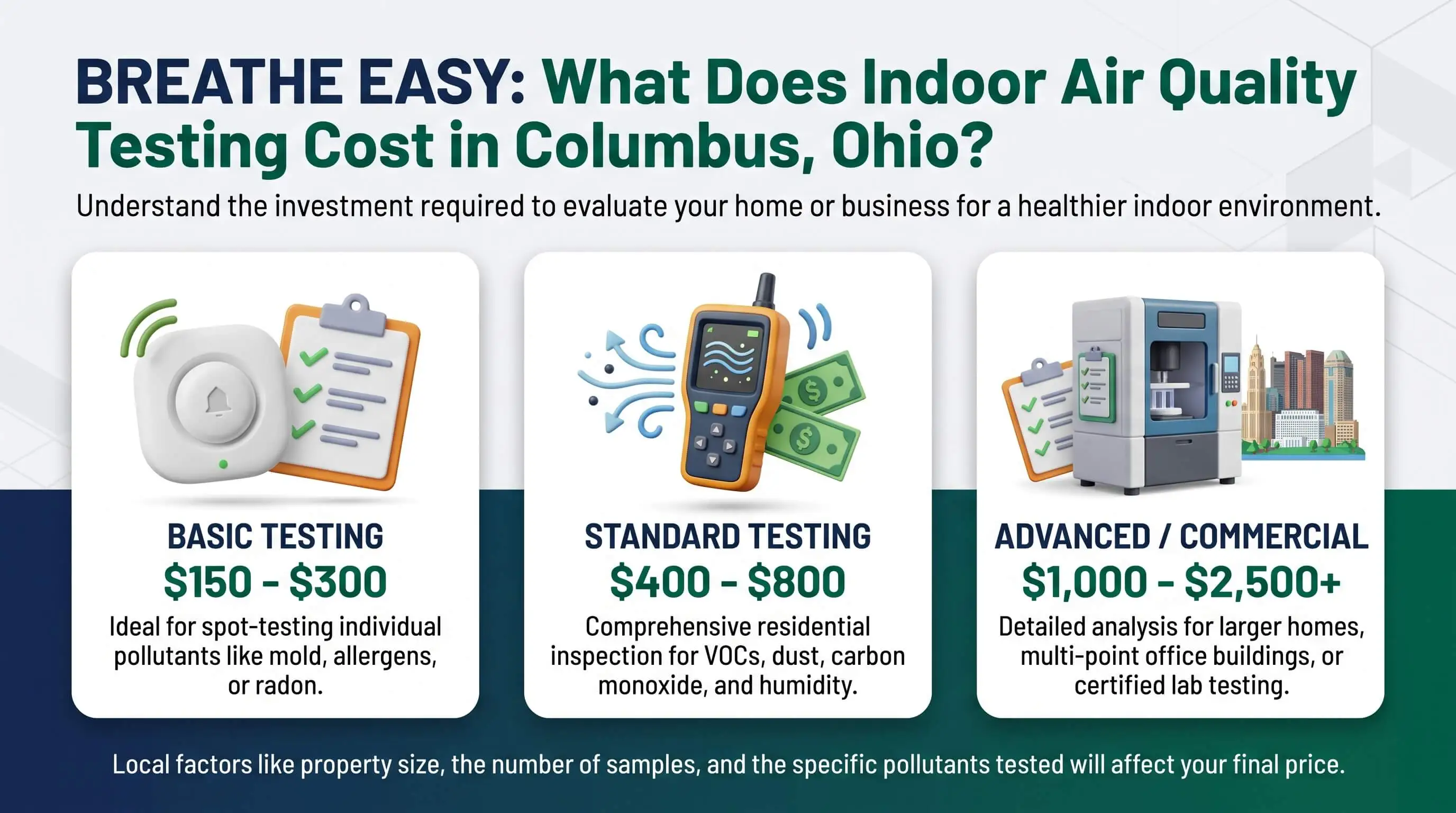
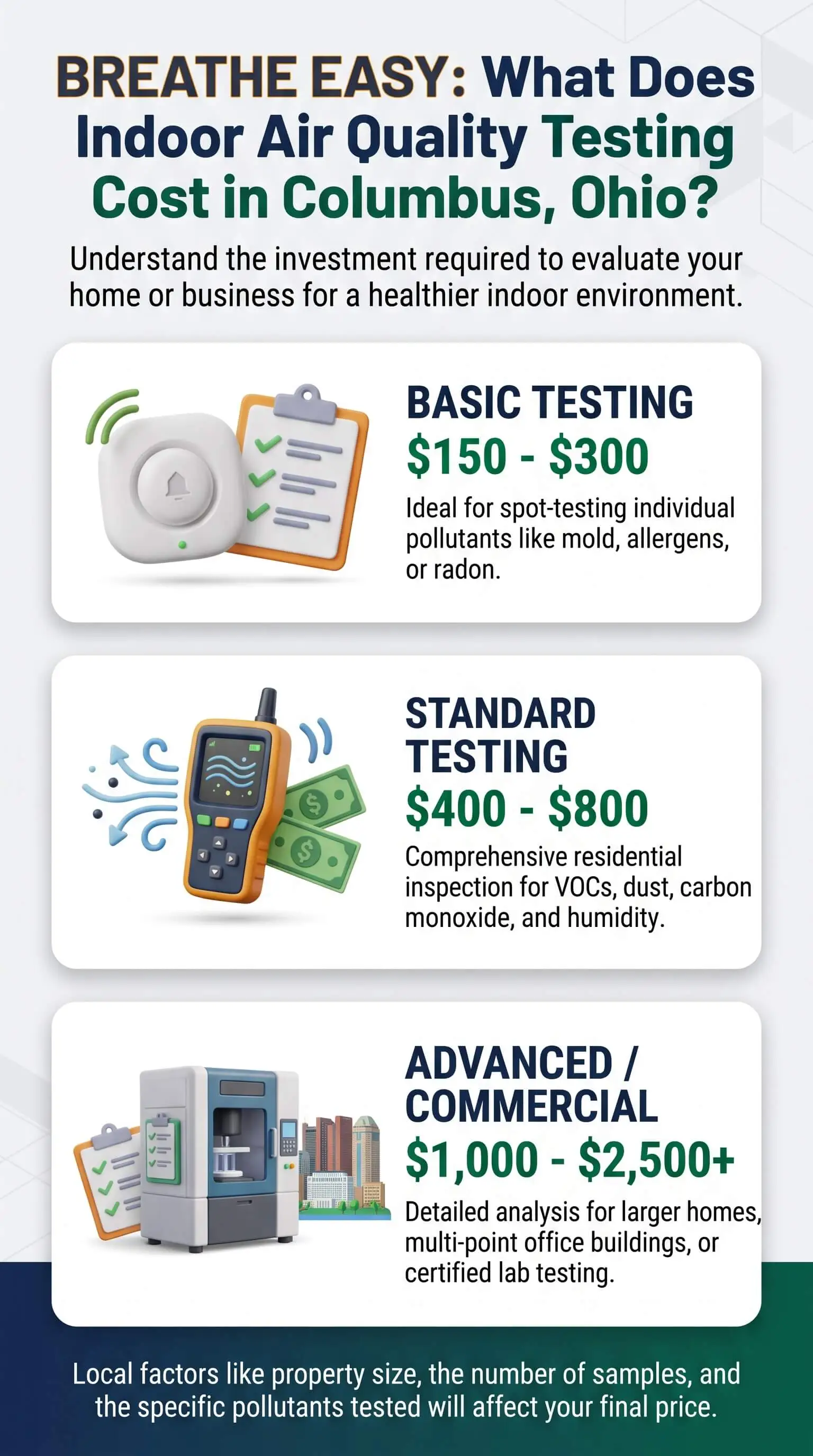
Typical cost: Professional indoor air quality testing in Columbus averages about $385, and most visits fall between $285 and $507.
Radon first: About half of Ohio homes have elevated radon, and free state kits make the first screen easy.
Skip routine mold tests: The CDC recommends fixing visible mold instead of paying to confirm it.
Time particle tests: Check the outdoor AQI and avoid sampling on orange or red days.
Hire licensed pros: Ohio licenses radon testers, so ask for the number before you book.
What Drives Air Quality Testing Prices in Columbus
Your bill comes down to four things.
What you test for: One contaminant costs a fraction of a panel that checks mold, VOCs, and allergens in a single visit.
Home size: Local cost guides price a 1,000 to 2,000 square foot home at about $290 to $480. Go past 2,000 square feet and the range climbs to roughly $480 to $955.
Samples and lab work: Each extra air sample carries its own lab fee, and rush results cost more.
Season: Central Ohio houses stay buttoned up from late fall into spring, and demand for radon testing rises with the cold.
Typical Costs by Test Type in Columbus
These ranges come from current Columbus cost guides.
Radon Testing
A professional radon test in Columbus averages about $392, and most jobs fall between $136 and $829. Doing it yourself costs far less. Short-term kits sell for $10 to $40, long-term kits for $25 to $60, and a reusable digital monitor runs $100 to $240.
Mold Testing
Local mold testing costs $290 to $955, and plenty of homeowners can skip it. The CDC doesn’t recommend routine mold testing. If you can already see or smell mold, your money does more good fixing the moisture and removing the growth. Testing pays off when you suspect mold hiding behind a wall after water damage, or when you need clearance proof once remediation wraps up. While high quality filters help capture airborne mold spores, they don't eliminate existing mold or fix the moisture problem causing it.
VOC and Chemical Screening
A VOC screen runs $195 to $385. Fresh paint, new flooring, and new furniture all give off volatile organic compounds, so I’d save this test for after a renovation or before moving into new construction.
Allergen and Carbon Monoxide Checks
Allergen testing costs about $100 to $290. Expect $100 to $195 for a carbon monoxide check.
Pro Tip: A one-time CO test tells you about one afternoon. Alarms on every level and outside each sleeping area keep watch every night after that.
DIY Kits and Consumer Monitors
Basic single-contaminant kits cost $15 to $50, and pro-grade kits with lab analysis run $100 to $290. Kits are good at screening. They rarely tell you where a problem starts.
Why Radon Testing Comes First in Central Ohio
The Ohio Department of Health estimates that about half of all Ohio homes have elevated radon. You can’t see it or smell it, and two houses on the same street can test far apart. Ohio makes the first answer cheap or free.
Free kits: The Ohio Department of Health radon program offers free test kits to Ohio homeowners.
Licensed testers: Ohio requires anyone who tests radon for hire to hold a state license, so ask for the number before you book.
Seller records: Since 1993, Ohio sellers have had to share earlier radon results with buyers. Ask for them before you pay for a new test.
Library monitors: The Columbus Metropolitan Library started lending continuous radon monitors in late 2025.
How Outdoor Air Affects Your Indoor Test Results
Outdoor air doesn’t stay outdoors. It slips in around window frames, under doors, and through fresh-air intakes. The Air Quality Index scores that air from 0 to 500, and Franklin County earned an F for short-term particle pollution in the latest State of the Air report.
That makes timing part of the job. Sample particles or VOCs on an orange or red day, and your results may describe what blew in instead of what your home produces. Indoor pollutants like pet dander are another factor to consider when testing your home's air. Pull up the live air quality map for Columbus before your tester arrives. When the AQI reads above 100, I’d move particle sampling to a cleaner day. Radon follows different rules, so keep the windows shut for that test whatever the forecast says.
Professional Testing vs. DIY Kits
A DIY kit handles a first-time radon screen, and a basic hygrometer covers humidity. For watching indoor particle trends over a few weeks, a consumer monitor does the job.
Bring in a licensed professional when:
You’re buying a home
A DIY radon result reads at or above the EPA action level of 4 pCi/L
You suspect hidden mold after a leak
Symptoms hang on after you’ve dealt with the obvious sources
It also helps to understand how pros measure indoor air quality before you compare quotes. A useful report names every sampling spot, the lab that ran the analysis, and a reference point such as an outdoor sample or an action level. Ohio also requires a radon tester who later offers mitigation on the same home to disclose that in writing, which keeps the test separate from the sales pitch.
“In my experience, the Columbus homeowners who overspend on testing book a full panel before they know what they’re chasing. A short-term radon kit and a basic hygrometer answer the two most common Central Ohio questions, radon and moisture. Those results point straight to the professional test worth paying for next.”
7 Essential Resources
MORPC Air Quality Program sends Central Ohio Air Quality Alerts when the forecast AQI hits 101 or higher, along with daily ozone and particle forecasts.
CDC: About Mold and Your Health explains why routine mold testing isn’t recommended and what to do instead.
CPSC Carbon Monoxide Information Center covers alarm placement, testing, and the warning signs of CO exposure.
ANSI/AARST MAH-2019 Radon Measurement Protocol sets the method professional testers follow when they measure radon in homes.
AAFA: Indoor Air Quality gives practical advice on indoor allergens, humidity, and asthma triggers.
City of Columbus Healthy Homes Production Grant funds radon, mold, and indoor air repairs for eligible households when applications open.
Franklin County Public Health: Sustainability outlines the county’s air quality monitoring and Healthy Homes inspections.
These seven trusted resources provide Columbus homeowners with guidance on air quality alerts, radon and mold testing, carbon monoxide safety, and available home repair assistance, along with practical steps to improve air quality and reduce indoor health risks.
3 Statistics
About half: Elevated radon is likely present in about half of all Ohio homes, by the state’s own estimate. Source: Ohio Department of Health
2 to 5 times: Americans spend about 90 percent of their time indoors, where some pollutants often reach 2 to 5 times typical outdoor concentrations. Source: U.S. EPA Report on the Environment
F grade: Franklin County drew an F for short-term particle pollution in State of the Air 2026 and averaged 4.8 unhealthy days per year. Source: American Lung Association
Final Thoughts and Opinion
I think the smartest first dollar a Columbus homeowner spends on air quality testing is often no dollar at all. The state’s free radon kit, the seller’s old radon results, and today’s AQI reading cost nothing. Between them, they’ll tell you which paid test deserves your money, if any does. For everyday air maintenance, MERV 8 pleated furnace air filters help capture common airborne particles without adding the expense of unnecessary testing.
I’m also not sold on the “test everything” package. It earns its price when you’re buying a home or cleaning up after water damage. For most other households, a targeted test chosen from what you already see, smell, or measure gets you more answers per dollar.
Frequently Asked Questions
Who Pays for Air Quality Testing When Buying a Home in Columbus?
Buyers usually pay, often as an add-on to the home inspection. Ask the seller for earlier radon results first, since Ohio sellers must disclose them. Recent, low results may mean you only need a follow-up test instead of a full assessment. It's also worth checking the furnace and its filtration system during the home inspection to assess how well the heating system manages indoor air quality.
How Long Do Indoor Air Quality Test Results Take?
A short-term radon test sits in place for 2 to 7 days before the lab gets it. Mold and VOC samples usually come back within a few business days, and faster turnaround costs extra. Long-term radon tests run 90 days or more, which gives you a more reliable yearly average.
Do I Need a Licensed Tester for Radon in Ohio?
Yes, when someone tests your home for hire. Ohio requires radon testers to hold a state license, and the Ohio Department of Health runs the program that issues them. You can still run your own DIY kit without one.
How Often Should I Test My Columbus Home’s Air?
Test for radon at least once, again after a major renovation, and every two years if you have a mitigation system. Test for mold or VOCs when something changes, like a leak, a remodel, or symptoms that ease up when you leave the house.
Does Homeowners Insurance Cover Air Quality Testing?
Usually not. Some policies cover mold testing tied to a covered water loss, such as a burst pipe. Check your policy and talk to your agent before you schedule, since routine testing tends to come out of pocket.
Plan Your Columbus Air Quality Test
You’re already the one in your house who watches over the air your family breathes, and now you know what indoor air quality testing costs in Columbus, Ohio. Start with a free radon kit and a glance at today’s AQI, then pay only for the test your results point to. For everyday air maintenance, a pleated furnace filter helps capture airborne dust and particles circulating through your HVAC system.